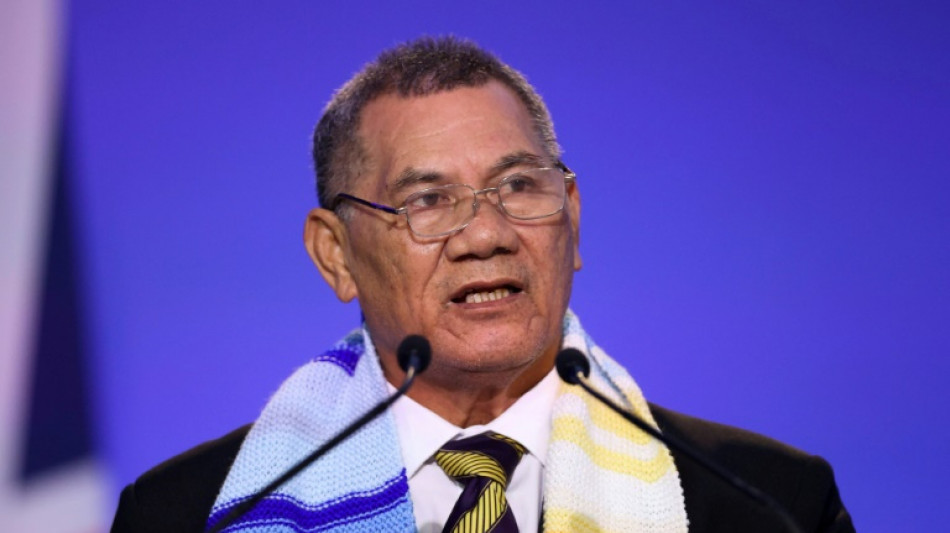
As tiny Tuvalu sinks, PM fights to save the archipelago's identity / Photo: HANNAH MCKAY - POOL/AFP/File

 'Glad it's over': Kim powers to Games gold and military exemption

 After 11 World Cups, football finally comes home for one Indian fan
 Marc Marquez wins sprint at Japan MotoGP, Martin grabs pole

 Alcaraz fends off Arnaldi to reach Japan Open quarters

 Antonelli tops times in final practice at Bahrain GP

 Gauff digs deep to beat Osorio in China Open second round

 Fresh protests to hit Spain after housing measures defeated

 'He's here with me': Japan cycle queen dedicates gold to late brother

 Japan Olympic chief says 'lot more' athletes at Games than expected
 Asian carmakers besting US rivals at home, China poised to strike

 Widgets & Web Offers All-Inclusive Investor Relations Websites for Public Companies, IPOs and SPACs

 Adams named new US captain to 2030 World Cup

 China a better influence in Latin America than US: poll

 Judge pauses construction of border project in Texas national park

 Belgium's De Bruyne fires double to sink Turkey, France held by Italy
 US jobs data boosts stocks as oil prices dip

 US Supreme Court to hear high-stakes climate case
 Trump expected to name intel chief Clayton as AI czar: reports

 Argentina unveils passports-for-investment scheme

 Brazil election debate chaos sparks censorship row
 England's Carse charged by cricket body over nightclub incident

 Amazon vows $1 bn for data center towns, decries 'myths'
 Oil prices drop on G7 fuel release, US jobs data boosts stocks

 G7 agrees deal to ease global energy supply concerns

 Spain's government dealt blow as lawmakers reject housing bills

The flag of Tuvalu contains nine yellow stars -- one for each of the islands that make up the tiny Pacific archipelago, home to some 11,000 people.
Today, however, two of those atolls are on the verge of being swallowed by rising sea levels as a result of the global climate crisis that has already done irreversible harm and will likely leave the nation uninhabitable in the coming decades.
What happens to a country when it disappears beneath the waves, when all its people are forced to leave?
"That is exactly the idea behind the Rising Nations Initiative -- to convince members of the UN to recognize our nation, even if we are submerged underwater, because that is our identity," Prime Minister Kausea Natano told AFP on the margins of the UN General Assembly.
Vague promises and messages of sympathy from the international community have done little for Pacific atoll countries, which began a push Wednesday for a formal legal process to retain their statehood, should the worst come to pass.
The plan aims to reaffirm the international community's commitment to Tuvalu and other island nations' sovereignty.
It would also create a repository for the islands' cultural heritage and designate them as UNESCO World Heritage sites, as well as increase financial support for adaptation measures.
Already, the situation is dire.
As so-called "floating islands" that aren't directly connected to the ground below, atolls sit on top of "lenses" of freshwater, which are increasingly permeated by saltwater as oceans rise.
That has left them dependent on rainwater for drinking and agriculture -- and Tuvalu is now into its sixth month of drought.
"We have to deploy desalination plants, but they are very expensive, they consume very high amounts of electricity," explained Natano.
The archipelago's islands barely break the surface of the ocean, reaching 15 feet at the highest point, but more like four or five feet in other places.
This leaves the islands prone to exceptionally high "King Tides" that wash away root crops, including former island staples taro and cassava, and salt the earth, added Natano.
The circumstances are deeply inequitable: Pacific island nations are among the least responsible for planetary heating, accounting for just 0.03 percent of global emissions.
But even if the world's polluting nations correct course and meet the goal of limiting warming to 1.5C, it could be too late to save the most vulnerable countries like the Marshall Islands and Tuvalu.
- 'We live as a community' -
Natano recalls that more people began leaving -- to New Zealand, Australia and the United States -- after devastating Cyclone Pam struck in 2015, though for now, opportunities for migration remain limited by tough border policies.
"In Tuvalu we live as a community," said Natano, visibly moved. "Even the people who leave don't want to go, they just look at their children and grandchildren and know they have to look for a future for them."
The country has joined calls for so-called "loss and damage" compensation from rich nations based on their historic and ongoing contribution to the climate crisis, but the issue remains contentious.
Natano still hopes, however, to get the assistance his country needs so the people can remain on their land.
There are preliminary discussions on ways to formally apply for a separate identity within other countries, but these are a "last resort," he said.
"When you're in Australia, you will become Australian, same for New Zealand," he added.
"We want to stay in our country, practice our culture and traditions and maintain our legacy."
C.Amaral--PC



