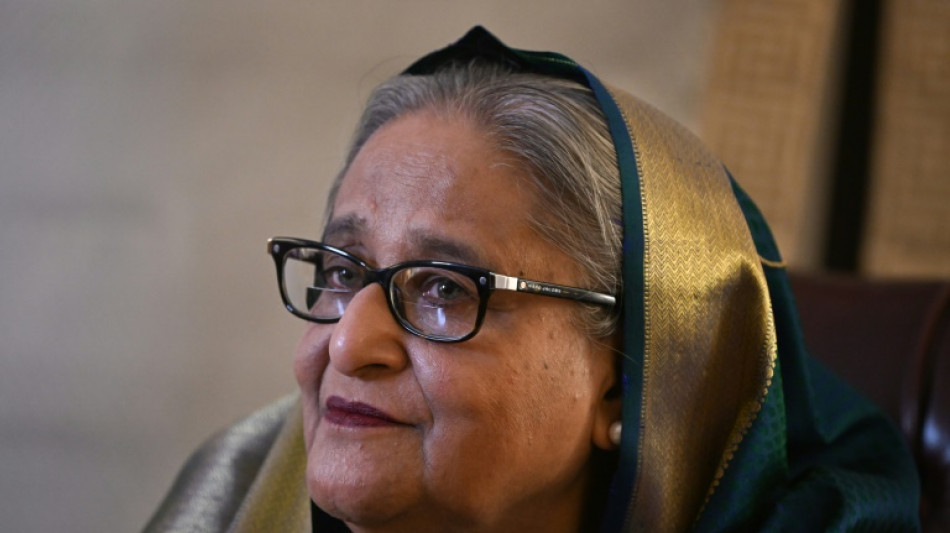
Bangladesh PM denounces 'tragedy' of rich nations on climate / Photo: Ed JONES - AFP

 'Glad it's over': Kim powers to Games gold and military exemption

 After 11 World Cups, football finally comes home for one Indian fan
 Marc Marquez wins sprint at Japan MotoGP, Martin grabs pole

 Alcaraz fends off Arnaldi to reach Japan Open quarters
 Antonelli tops times in final practice at Bahrain GP
 Gauff digs deep to beat Osorio in China Open second round

 Fresh protests to hit Spain after housing measures defeated
 'He's here with me': Japan cycle queen dedicates gold to late brother

 Japan Olympic chief says 'lot more' athletes at Games than expected
 Asian carmakers besting US rivals at home, China poised to strike

 Widgets & Web Offers All-Inclusive Investor Relations Websites for Public Companies, IPOs and SPACs

 Adams named new US captain to 2030 World Cup

 China a better influence in Latin America than US: poll

 Judge pauses construction of border project in Texas national park

 Belgium's De Bruyne fires double to sink Turkey, France held by Italy

 US jobs data boosts stocks as oil prices dip

 US Supreme Court to hear high-stakes climate case

 Trump expected to name intel chief Clayton as AI czar: reports

 Argentina unveils passports-for-investment scheme

 Brazil election debate chaos sparks censorship row

 England's Carse charged by cricket body over nightclub incident

 Amazon vows $1 bn for data center towns, decries 'myths'

 Oil prices drop on G7 fuel release, US jobs data boosts stocks

 G7 agrees deal to ease global energy supply concerns
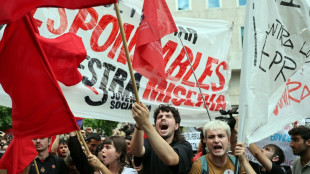 Spain's government dealt blow as lawmakers reject housing bills

A country of fertile, densely populated deltas, low-lying Bangladesh is among the most vulnerable nations in the world to climate change.
But the urgency of the situation is not being matched by actions of countries responsible for emissions, Prime Minister Sheikh Hasina said.
"They don't act. They can talk but they don't act," she told AFP on a visit to New York for the United Nations General Assembly.
"The rich countries, the developed countries, this is their responsibility. They should come forward. But we are not getting that much response from them. That is the tragedy," she said.
"I know the rich countries, they want to become more rich and rich. They don't bother for others."
Bangladesh has produced a miniscule amount of the greenhouse gas emissions that have already contributed to the warming of the planet by an average of nearly 1.2 degrees Celsius above pre-industrial levels.
The Paris accord called for $100 billion a year by 2020 from wealthy nations to help developing nations cope with climate change. That year, $83.3 billion was committed, including through private sources, according to Organization for Economic Co-operation and Development figures.
One key issue facing the next UN climate summit, to take place in Egypt in November, is whether wealthy nations also need to pay for losses and damages from climate change -- not just to pay for adaptation and mitigation.
"We want that fund to be raised. Unfortunately we didn't get a good response from the developed countries," Hasina said.
"Because they are the responsible ones for these damages, they should come forward," the 74-year-old added.
Wealthy nations have agreed only to discuss the loss and damage issue through 2024.
This year's General Assembly featured repeated calls for climate justice. The leader of tiny Vanuatu urged an international treaty against fossil fuels while the prime minister of Pakistan warned that floods that have swamped one-third of his country could happen elsewhere.
- Questions on Rohingya -
Climate is not the only issue on which Bangladesh sees inaction from the West.
Some 750,000 Rohingya fled to Bangladesh in 2017 after a scorched-earth campaign against the minority group by troops in neighboring Myanmar, a campaign that the United States has described as genocide.
While the world has saluted Bangladesh for taking in the refugees -- along with 100,000 who fled earlier violence -- attention has shifted since the Covid-19 pandemic and now Russia's invasion of Ukraine.
"As long as they are in our country, we feel that it is our duty," she said. But for Bangladeshi hosts, patience is running thin, she said.
Michelle Bachelet, then the UN human rights chief, said on a visit in August that there was growing anti-Rohingya sentiment in Bangladesh.
"Local people also suffer a lot," Hasina said. "I can't say that they're angry, but they feel uncomfortable."
"All the burden is coming upon us. This is a problem."
The Rohingya refugees, who are mostly Muslim, live largely in ramshackle camps with tarpaulins, sheet metal and bamboo.
Bachelet on her visit said there was no prospect of sending them back to Buddhist-majority, military-run Myanmar, where the Rohingya are not considered citizens.
But in her interview, Hasina signaled that there were few options other than for the Rohingya to reside in camps.
"It is not possible for us to give them an open space because they have their own country. They want to go back there. So that is the main priority for everybody," Hasina said.
"If anybody wants to take them, they can take them," she added. "Why should I object?"
H.Portela--PC



