Direct impact or nuclear weapons? How to save Earth from an asteroid / Photo: Sophie RAMIS - AFP

 'Glad it's over': Kim powers to Games gold and military exemption

 After 11 World Cups, football finally comes home for one Indian fan

 Marc Marquez wins sprint at Japan MotoGP, Martin grabs pole

 Alcaraz fends off Arnaldi to reach Japan Open quarters

 Antonelli tops times in final practice at Bahrain GP

 Gauff digs deep to beat Osorio in China Open second round

 Fresh protests to hit Spain after housing measures defeated

 'He's here with me': Japan cycle queen dedicates gold to late brother

 Japan Olympic chief says 'lot more' athletes at Games than expected

 Asian carmakers besting US rivals at home, China poised to strike

 Widgets & Web Offers All-Inclusive Investor Relations Websites for Public Companies, IPOs and SPACs

 Adams named new US captain to 2030 World Cup

 China a better influence in Latin America than US: poll

 Judge pauses construction of border project in Texas national park

 Belgium's De Bruyne fires double to sink Turkey, France held by Italy

 US jobs data boosts stocks as oil prices dip

 US Supreme Court to hear high-stakes climate case

 Trump expected to name intel chief Clayton as AI czar: reports

 Argentina unveils passports-for-investment scheme

 Brazil election debate chaos sparks censorship row

 England's Carse charged by cricket body over nightclub incident

 Amazon vows $1 bn for data center towns, decries 'myths'

 Oil prices drop on G7 fuel release, US jobs data boosts stocks

 G7 agrees deal to ease global energy supply concerns

 Spain's government dealt blow as lawmakers reject housing bills
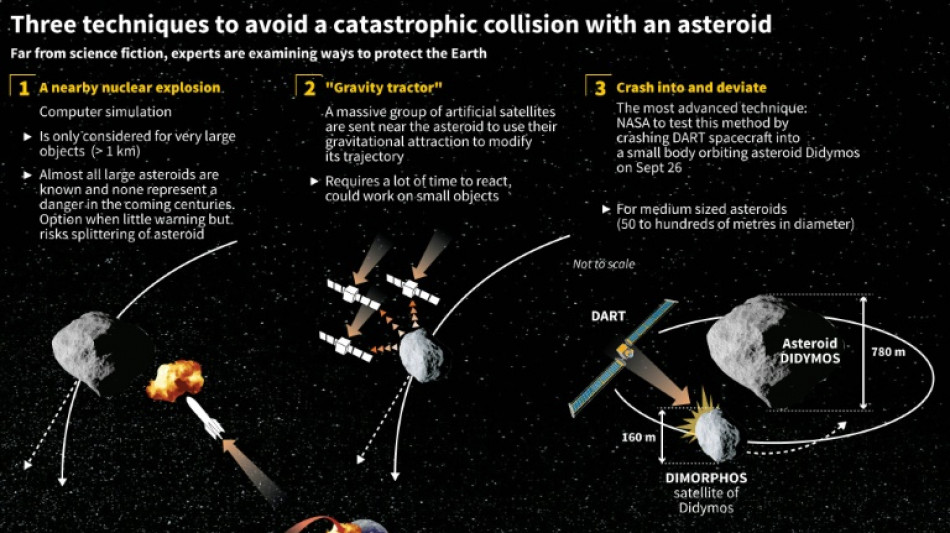
NASA's DART mission to test deflecting an asteroid using "kinetic impact" with a spaceship is just one way to defend planet Earth from an approaching object -- and for now, the only method possible with current technology.
The operation is like playing billiards in space, using Newton's laws of motion to guide us.
If an asteroid threat to Earth were real, a mission might need to be launched a year or two in advance to take on a small asteroid, or decades ahead of projected impact for larger objects hundreds of kilometers in diameter that could prove catastrophic to the planet.
Or, a larger object might require hits with multiple spacecraft.
"This demonstration will start to add tools to our toolbox of methods that could be used in the future," said Lindley Johnson, NASA's planetary defense office, in a recent briefing.
Other proposed ideas have included a futuristic-sounding "gravity tractor," or a mission to blow up the hypothetical object with a nuclear weapon -- the method preferred by Hollywood.
- Gravity tractor -
Should an approaching object be detected early -- years or decades before it would hit Earth -- a spaceship could be sent to fly alongside it for long enough to divert its path via using the ship's gravitational pull, creating a so-called gravity tractor.
This method "has the virtue that the method of moving the asteroid is totally well understood -- it's gravity and we know how gravity works," Tom Statler, a DART program scientist at NASA said at a briefing last November when DART launched.
The mass of the spacecraft however would be a limiting factor -- and gravity tractors would be less effective for asteroids more than 500 meters in diameter, which are the very ones that pose the greatest threat.
In a 2017 paper, NASA engineers proposed a way to overcome this snag: by having the spacecraft scoop material from the asteroid to enhance its own mass, and thus, gravity.
But none of these concepts have been tried, and would need decades to build, launch and test.
- Nuclear detonation -
Another option: launching nuclear explosives to redirect or destroy an asteroid.
"This may be the only strategy that would be effective for the largest and most dangerous 'planet-killer' asteroids (more than one kilometer in diameter)," a NASA article on the subject says, adding such a strike might be useful as a "last resort" in case the other methods fail.
But these weapons are geopolitically controversial and technically banned from use in outer space.
Lori Glaze, NASA's planetary science division director said in a 2021 briefing that the agency believed the best way to deploy the weapons would be at a distance from an asteroid, in order to impart force on the object without blowing it into smaller pieces that could then multiply the threat to Earth.
A 2018 paper published in the "Journal of Experimental and Theoretical Physics" by Russian scientists looked at the direct detonation scenario.
E. Yu. Aristova and colleagues built miniature asteroid models and blasted them with lasers. Their experiments showed that blowing up a 200-meter asteroid would require a bomb 200 times as powerful as the one that exploded over Hiroshima in 1945.
They also said it would be most effective to drill into the asteroid, bury the bomb, then blow it up -- just like in the movie Armageddon.
G.M.Castelo--PC



