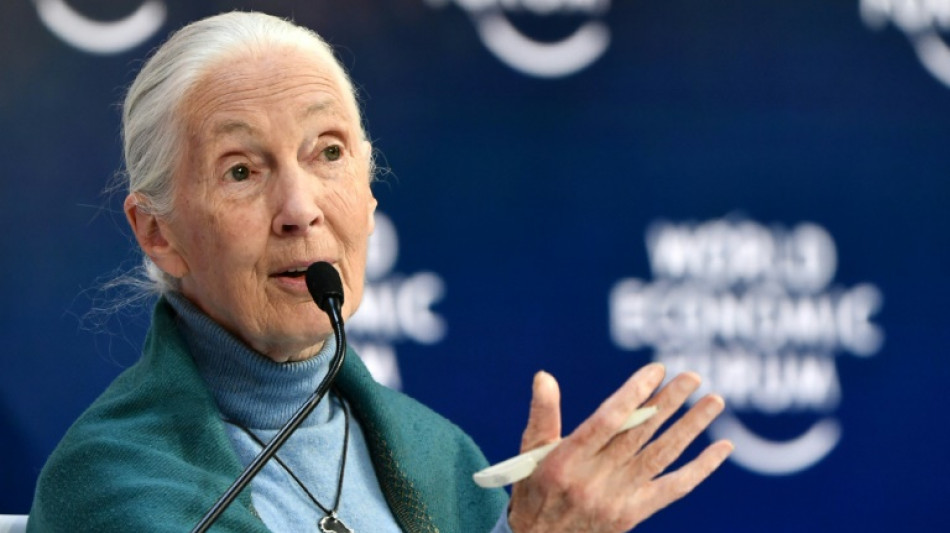
Climate change at 'point of no return': primatologist Goodall
/ Photo: Fabrice COFFRINI - AFP/File

 'Glad it's over': Kim powers to Games gold and military exemption

 After 11 World Cups, football finally comes home for one Indian fan

 Marc Marquez wins sprint at Japan MotoGP, Martin grabs pole

 Alcaraz fends off Arnaldi to reach Japan Open quarters

 Antonelli tops times in final practice at Bahrain GP

 Gauff digs deep to beat Osorio in China Open second round

 Fresh protests to hit Spain after housing measures defeated

 'He's here with me': Japan cycle queen dedicates gold to late brother

 Japan Olympic chief says 'lot more' athletes at Games than expected

 Asian carmakers besting US rivals at home, China poised to strike

 Widgets & Web Offers All-Inclusive Investor Relations Websites for Public Companies, IPOs and SPACs

 Adams named new US captain to 2030 World Cup

 China a better influence in Latin America than US: poll

 Judge pauses construction of border project in Texas national park

 Belgium's De Bruyne fires double to sink Turkey, France held by Italy

 US jobs data boosts stocks as oil prices dip

 US Supreme Court to hear high-stakes climate case

 Trump expected to name intel chief Clayton as AI czar: reports

 Argentina unveils passports-for-investment scheme

 Brazil election debate chaos sparks censorship row

 England's Carse charged by cricket body over nightclub incident

 Amazon vows $1 bn for data center towns, decries 'myths'

 Oil prices drop on G7 fuel release, US jobs data boosts stocks

 G7 agrees deal to ease global energy supply concerns

 Spain's government dealt blow as lawmakers reject housing bills

Earth's climate is changing so quickly that humanity is running out of chances to fix it, primatologist Jane Goodall has warned in an interview.
Goodall, a grandee of environmentalism whose activism has spanned decades, said time was rapidly shortening to halt the worst effects of human-caused global warming.
"We are literally approaching a point of no return," Goodall told AFP in Los Angeles.
"Look around the world at what's happening with climate change. It's terrifying.
"We are part of the natural world and we depend on healthy ecosystems."
Goodall is best known for her pioneering six-decade study of chimpanzees in Tanzania, which found "human-like" behavior among the animals, including a propensity to wage war, as well as an ability to display emotions.
Now 88 years old, the Briton is a prolific writer and the subject of a number of films. She has also been immortalized as both a Lego figure and a Barbie doll.
Goodall said her own environmental awakening came in the 1980s while working in Mongolia, where she realized that hillsides had been denuded of tree cover.
"The reason the people were cutting down the trees was to make more land, to grow food as their families grew, and also to make money from charcoal or timber," she said.
"So if we don't help these people find ways of making a living without destroying their environment, we can't save chimpanzees, forests, or anything else."
Goodall says she has seen some changes for the better over recent decades, but urged quicker action.
"We know what we should be doing. I mean, we have the tools. But we come up against the short-term thinking of economic gain versus long-term protection of the environment for the future," she said.
"I don't pretend to be able to solve the problems that this creates because there are major problems. And yet, if we look at the alternative, which is continuing to destroy the environment, we're doomed."
Goodall was speaking Sunday on the sidelines of a celebration of her $1.3 million Templeton Prize.
The prize is an annual award for an individual whose work harnesses science to explore the questions facing humanity.
The cash went to the Jane Goodall Institute, a global wildlife and environment conservation organization, which runs youth programs in 66 countries.
"The program's main message is that every single one of us makes an impact on the planet every day, and we get to choose what sort of impact we make," Goodall said.
"It’s actually my greatest reason for hope."
O.Gaspar--PC



