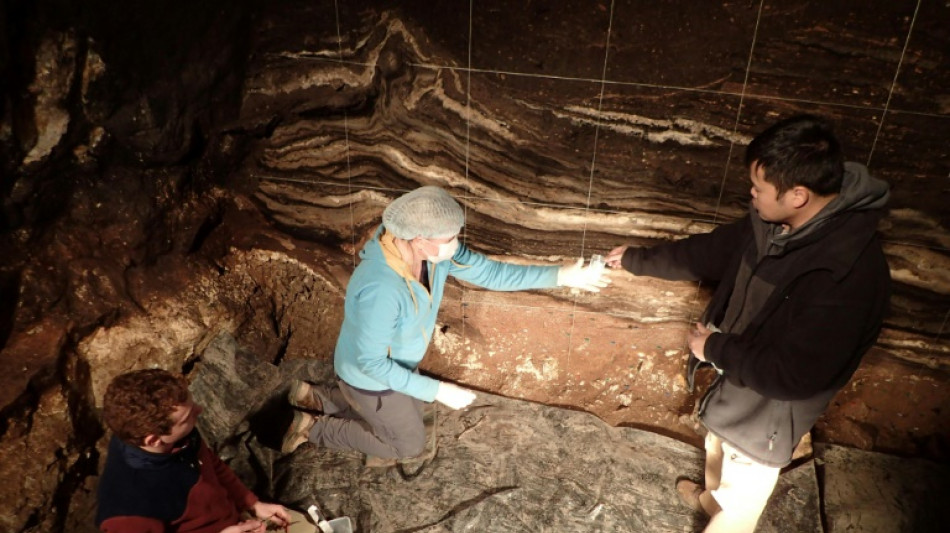
Nobel shines light on paleogenetics, study of ancient DNA / Photo: Handout - Dr. RICHARD G. ROBERTS/AFP/File

 'Glad it's over': Kim powers to Games gold and military exemption

 After 11 World Cups, football finally comes home for one Indian fan

 Marc Marquez wins sprint at Japan MotoGP, Martin grabs pole
 Alcaraz fends off Arnaldi to reach Japan Open quarters

 Antonelli tops times in final practice at Bahrain GP

 Gauff digs deep to beat Osorio in China Open second round

 Fresh protests to hit Spain after housing measures defeated

 'He's here with me': Japan cycle queen dedicates gold to late brother

 Japan Olympic chief says 'lot more' athletes at Games than expected

 Asian carmakers besting US rivals at home, China poised to strike

 Widgets & Web Offers All-Inclusive Investor Relations Websites for Public Companies, IPOs and SPACs

 Adams named new US captain to 2030 World Cup
 China a better influence in Latin America than US: poll

 Judge pauses construction of border project in Texas national park

 Belgium's De Bruyne fires double to sink Turkey, France held by Italy

 US jobs data boosts stocks as oil prices dip

 US Supreme Court to hear high-stakes climate case

 Trump expected to name intel chief Clayton as AI czar: reports

 Argentina unveils passports-for-investment scheme

 Brazil election debate chaos sparks censorship row
 England's Carse charged by cricket body over nightclub incident
 Amazon vows $1 bn for data center towns, decries 'myths'
 Oil prices drop on G7 fuel release, US jobs data boosts stocks

 G7 agrees deal to ease global energy supply concerns

 Spain's government dealt blow as lawmakers reject housing bills

While some may have been surprised that the Nobel Prize in Medicine was awarded to a paleogeneticist Monday, researchers say understanding our distant ancestors helps explain modern human health -- even when it comes to Covid.
New Nobel laureate Svante Paabo is considered the father of both paleogenetics and paleogenomics, which aims to reconstruct the genetic information of long extinct human relatives.
But the prize may have led some to wonder why a pioneer in this field won the Nobel in medicine.
For example, what is the medical benefit of knowing that modern humans have an average of around two percent Neanderthal DNA, one of Paabo's great discoveries?
For the second year running, the scientists behind mRNA vaccines were among the odds-maker's favourites, with millions around the world being aware of the technology after getting it jabbed into their arms.
But the Nobels, which tend to reward research from decades in the past, chose Paabo.
"This revolutionary research in genetics and evolution falls within the range of topics that could and should be recognised by the Physiology or Medicine Nobel Prize," said David Pendlebury, research head at analytics company Clarivate's ISI institute.
"It is, however, not an award for a discovery relevant to clinical medicine, which many anticipated this year after a Nobel Prize focusing on physiology last year," he said in a statement.
- 'Completely justified' -
Paleogeneticist Eva-Maria Geigl of the French research agency CNRS said it was "completely justified" to give Paabo a Nobel Prize in medicine.
"We must not forget that medicine is the exercise of keeping human beings in good health, so we must first understand biology," she told AFP.
Paabo himself provided an example of this in 2020, when he showed that humans with a particular snippet of Neanderthal DNA have a higher risk of getting more serious symptoms from Covid-19.
The research could point towards a potential reason why Covid has often proved deadlier in places like South Asia, where many people have the DNA segment, compared to Africa, where it is far less common.
But the research is unlikely to contribute to new Covid treatment or approach.
And it "is only a small, secondary subject" of Paabo's vast amount of research, Geigl said.
It does however serve as an example of how paleogenetics weaves together the present with the distant past.
"We can understand, for example, what genes have made it possible to adapt in the past, and therefore which are important for our current health," said genetic anthropologist Evelyne Heyer of France's National Museum of Natural History, citing in particular the case of diabetes.
- Crisis in the field -
But, in a way, it was this unique mix of past and present that plunged the field into crisis in the early 2000s, a decade after first coming to prominence.
Numerous paleogenetics papers were discovered to be incorrect, because DNA from modern-day humans had accidentally been mixed in with samples from ancient humans.
It had apparently proved difficult for researchers to avoid contaminating their samples with their own DNA, which was not a problem for paleogeneticists working on animals.
With the discipline brought into question, Paabo and other researchers led to the way to develop more reliable and advanced techniques.
Now, paleogeneticists have created a vast library of knowledge tracing the recent evolution of our species that gives insight not just into medical concerns, but also into social issues such as migration.
"We have thousands of ancient genomes that have been published, not just of Neanderthals but also of more recent humans," Heyer said.
"They let us to show that we all have migrant ancestors, that we are a patchwork tapestry," she added.
"It's fundamental to how our species sees itself."
Paabo said in an interview released by the Nobels on Monday that "it's interesting to think if Neanderthals had survived another 40,000 years, how would that influence us?"
Would there be "racism against Neanderthals, because they were different from us?"
Nogueira--PC



