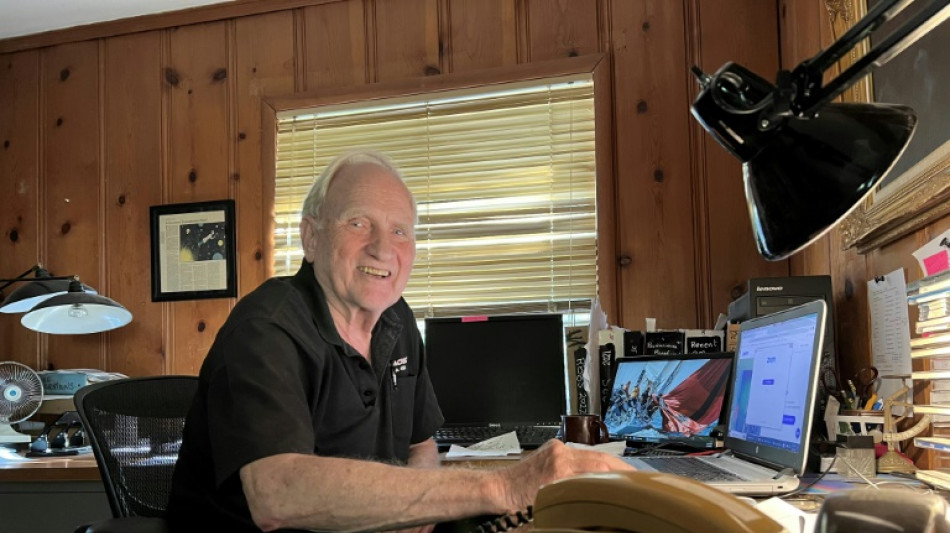
Nobel physics winner wanted to topple quantum theory he vindicated / Photo: Remi Vorano - AFP

 'Glad it's over': Kim powers to Games gold and military exemption

 After 11 World Cups, football finally comes home for one Indian fan

 Marc Marquez wins sprint at Japan MotoGP, Martin grabs pole

 Alcaraz fends off Arnaldi to reach Japan Open quarters

 Antonelli tops times in final practice at Bahrain GP

 Gauff digs deep to beat Osorio in China Open second round

 Fresh protests to hit Spain after housing measures defeated

 'He's here with me': Japan cycle queen dedicates gold to late brother

 Japan Olympic chief says 'lot more' athletes at Games than expected

 Asian carmakers besting US rivals at home, China poised to strike

 Widgets & Web Offers All-Inclusive Investor Relations Websites for Public Companies, IPOs and SPACs

 Adams named new US captain to 2030 World Cup

 China a better influence in Latin America than US: poll

 Judge pauses construction of border project in Texas national park

 Belgium's De Bruyne fires double to sink Turkey, France held by Italy

 US jobs data boosts stocks as oil prices dip

 US Supreme Court to hear high-stakes climate case

 Trump expected to name intel chief Clayton as AI czar: reports

 Argentina unveils passports-for-investment scheme

 Brazil election debate chaos sparks censorship row

 England's Carse charged by cricket body over nightclub incident

 Amazon vows $1 bn for data center towns, decries 'myths'

 Oil prices drop on G7 fuel release, US jobs data boosts stocks

 G7 agrees deal to ease global energy supply concerns

 Spain's government dealt blow as lawmakers reject housing bills

American physicist John Clauser won the 2022 Nobel Prize for a groundbreaking experiment vindicating quantum mechanics -- a fundamental theory governing the subatomic world that is today the foundation for an emerging class of ultra-powerful computers.
But when he carried out his work in the 1970s, Clauser was actually hoping for the opposite result: to upend the field and prove Albert Einstein had been right to dismiss it, he told AFP in an interview.
"The truth is that I strongly hoped that Einstein would win, which would mean that quantum mechanics was giving incorrect predictions," the 79-year-old said, speaking by telephone from his home in Walnut Creek, just outside San Francisco.
Born in Pasadena in 1942, Clauser credits his father, an engineer who designed planes in the war and founded the aeronautics department at Johns Hopkins University in Baltimore, for instilling in him a lifelong love of science.
"I used to wander around his laboratory and say 'Wow, oh boy, when I grow up I want to be a scientist so I can play with these fun toys too.'"
As a graduate student at Columbia in the mid-1960s, he grew interested in quantum physics alongside his thesis work on radio astronomy.
- Quantum entanglement -
According to quantum mechanics, two or more particles can exist in what's called an entangled state -- what happens to one in an entangled pair determines what happens to the other, no matter their distance.
The fact that this occurred instantly contradicted Einstein's theory of relativity which held that nothing -- including information -- can travel faster than the speed of light.
In 1935 he dismissed this element of quantum entanglement -- called nonlocality -- as "spooky action at a distance."
Einstein instead believed that "hidden variables" that instructed the particles what state to take must be at play, placing him at odds with his great friend but intellectual adversary Niels Bohr, a founding father of quantum theory.
In 1964, the Northern Irish physicist John Bell proposed a theoretical way to measure whether there were in fact hidden variables inside quantum particles. Clauser realized he could resolve the long standing Bohr-Einstein debate if he could create the right experiment.
"My thesis advisor thought it was a distraction from my work in astrophysics," he recalled, but undeterred, he wrote to Bell, who encouraged him to take up the idea.
It wasn't until Clauser had completed his doctorate and taken up a job at UC Berkeley that he was actually able to start working on the experiment, along with collaborator Stuart Freedman.
They focused a laser on calcium atoms, making it emit particles of entangled photon pairs that shot off in opposite directions, and used filters set to the side to measure whether they were correlated.
After hundreds of thousands of runs, they found the pairs correlated more than Einstein would have predicted, proving the reality of "spooky action" with hard data.
At the time, leading lights of the field were unimpressed, said Clauser, including the renowned physicist Richard Feynman who told him the work was "totally silly, you're wasting everybody's time and money" and threw him out his office.
Questioning the foundation of quantum mechanics was deemed unnecessary.
- Quantum computing -
That wasn't the view of the Nobel committee, who awarded Clauser, Alain Aspect of France, and Anton Zeilinger of Austria the world's most prestigious science prize for their pioneering work in advancing the field.
"It took a long time for people to realize the importance of the work," chuckled Clauser.
"But I suppose it is a certain vindication, everyone was telling me it was silly."
Einstein's theory had more appeal to Clauser than Bohr's, which he confessed to not fully grasping.
But over time, he came to realize the true value of his and his co-winners' experiments. Demonstrating that a single bit of information can be distributed through space is today at the core of quantum computers.
Clauser pointed to China's quantum-encrypted Micius communications satellite, which relies on entangled photons thousands of kilometers apart.
"We did not prove what quantum mechanics is -- we proved what quantum mechanics isn't," he said, "and knowing what it is not then has practical applications."
P.Mira--PC



