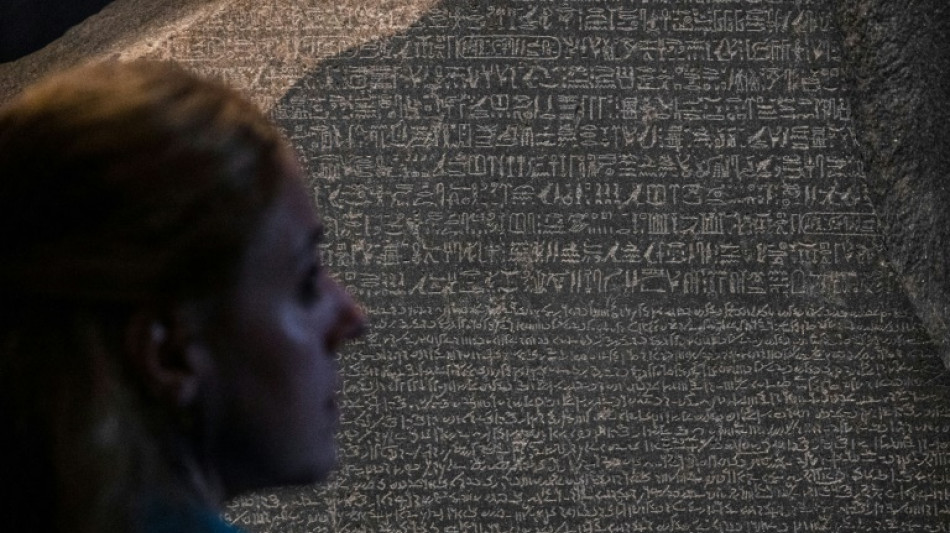
British Museum hails Rosetta Stone's role in cracking hieroglyphs / Photo: CARLOS JASSO - AFP

 'Glad it's over': Kim powers to Games gold and military exemption

 After 11 World Cups, football finally comes home for one Indian fan

 Marc Marquez wins sprint at Japan MotoGP, Martin grabs pole
 Alcaraz fends off Arnaldi to reach Japan Open quarters

 Antonelli tops times in final practice at Bahrain GP

 Gauff digs deep to beat Osorio in China Open second round

 Fresh protests to hit Spain after housing measures defeated

 'He's here with me': Japan cycle queen dedicates gold to late brother

 Japan Olympic chief says 'lot more' athletes at Games than expected

 Asian carmakers besting US rivals at home, China poised to strike
 Widgets & Web Offers All-Inclusive Investor Relations Websites for Public Companies, IPOs and SPACs

 Adams named new US captain to 2030 World Cup

 China a better influence in Latin America than US: poll
 Judge pauses construction of border project in Texas national park

 Belgium's De Bruyne fires double to sink Turkey, France held by Italy

 US jobs data boosts stocks as oil prices dip

 US Supreme Court to hear high-stakes climate case
 Trump expected to name intel chief Clayton as AI czar: reports
 Argentina unveils passports-for-investment scheme

 Brazil election debate chaos sparks censorship row
 England's Carse charged by cricket body over nightclub incident

 Amazon vows $1 bn for data center towns, decries 'myths'
 Oil prices drop on G7 fuel release, US jobs data boosts stocks

 G7 agrees deal to ease global energy supply concerns

 Spain's government dealt blow as lawmakers reject housing bills
The Rosetta Stone stars in a new exhibition opening Thursday at the British Museum marking one of the most significant dates in Egyptology -- 200 years after a French scholar finally cracked its code and deciphered hieroglyphs.
The exhibition comes with the British Museum under pressure from some Egyptologists to hand the Rosetta Stone back to Cairo at a time when UK institutions are beginning to return to other countries artefacts looted during the colonial era.
Once seen as magical symbols unrelated to spoken language, Egyptian hieroglyphs were swathed in mystery for centuries until philologist Jean-Francois Champollion cracked their meaning in 1822.
French troops had discovered the stone in the walls of an Egyptian fort in 1799 and gave it to British forces as part of a surrender agreement. The British Museum has displayed it since 1802.
The basalt slab dating from 196 BC was so crucial because it has inscriptions of identical meaning in three languages: hieroglyphs, an ancient Egyptian vernacular script called Demotic and Ancient Greek, which provided the translation key.
"We decided because the Rosetta Stone was such an important key to that decipherment that we will do this properly: with an exhibition that also features our star objects," said Ilona Regulski, curator of Egyptian written culture at the museum.
"It's a wonderful moment to celebrate."
Yet the anniversary exhibition is controversial to some.
Egyptian archaeologist and former antiquities minister Zahi Hawass recently released a petition for the return of the stone and other foreign-held treasures he considers "stolen".
The British Museum told AFP that Egypt has never made a formal request for the Rosetta Stone's return.
- 'Muddied legacy' -
Regulski added that it was a "universal object" and "it doesn't really matter where it is, as long as it's available to people".
Activists from a group called Culture Unstained protested in the museum on Tuesday calling for Cairo to release political prisoners including British activist Alaa Abdel Fattah, and criticising sponsorship by BP oil giant.
The exhibition, "Hieroglyphs: unlocking ancient Egypt" tracks hieroglyphs' fall into obscurity after Egyptians switched to other forms of script.
It explores the rich discoveries about life in ancient Egypt that came from unlocking the symbols.
"For the first time in 3,000 years, Ancient Egyptians spoke directly to us," the museum's director Hartwig Fischer said.
The exhibition does acknowledge attempts by non-Europeans to grasp the symbols but focuses on the race between Western scholars to crack the code.
"Our travellers... went to Egypt and were amazed by all these intriguing picture-like signs on the temple walls," said Regulski.
This led to their "interpretation as magical signs, as secret knowledge, the idea that if you would be able to decipher hieroglyphs, you will understand the meaning of everything."
Champollion was the first to fully grasp the logic of hieroglyphs, outdoing an English rival, Thomas Young, who was in correspondence with him.
The exhibition suggests the French scholar has a "muddied legacy", however, and "often relied on the work of others", including Young.
It also depicts the more bizarre side of Egyptology including special events where enthusiasts unwrapped a mummified body and took lengths of bandages home as souvenirs.
A.P.Maia--PC



