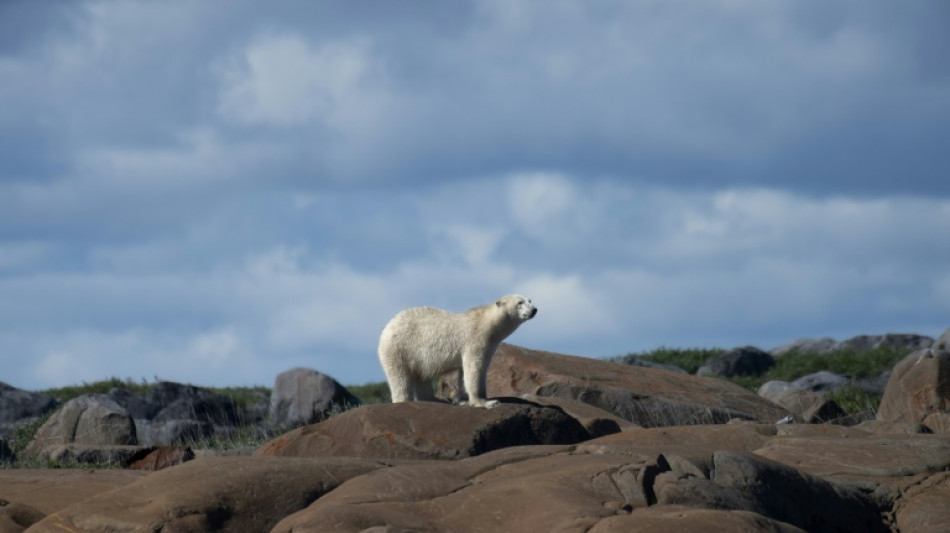
Polar bear hell: An ice pack that keeps receding / Photo: Olivier MORIN - AFP

 'Glad it's over': Kim powers to Games gold and military exemption

 After 11 World Cups, football finally comes home for one Indian fan
 Marc Marquez wins sprint at Japan MotoGP, Martin grabs pole

 Alcaraz fends off Arnaldi to reach Japan Open quarters

 Antonelli tops times in final practice at Bahrain GP

 Gauff digs deep to beat Osorio in China Open second round

 Fresh protests to hit Spain after housing measures defeated

 'He's here with me': Japan cycle queen dedicates gold to late brother

 Japan Olympic chief says 'lot more' athletes at Games than expected

 Asian carmakers besting US rivals at home, China poised to strike

 Widgets & Web Offers All-Inclusive Investor Relations Websites for Public Companies, IPOs and SPACs

 Adams named new US captain to 2030 World Cup

 China a better influence in Latin America than US: poll

 Judge pauses construction of border project in Texas national park

 Belgium's De Bruyne fires double to sink Turkey, France held by Italy
 US jobs data boosts stocks as oil prices dip

 US Supreme Court to hear high-stakes climate case
 Trump expected to name intel chief Clayton as AI czar: reports

 Argentina unveils passports-for-investment scheme

 Brazil election debate chaos sparks censorship row
 England's Carse charged by cricket body over nightclub incident

 Amazon vows $1 bn for data center towns, decries 'myths'

 Oil prices drop on G7 fuel release, US jobs data boosts stocks

 G7 agrees deal to ease global energy supply concerns

 Spain's government dealt blow as lawmakers reject housing bills

Sprawled on rocky ground far from sea ice, a lone Canadian polar bear sits under a dazzling sun, his white fur useless as camouflage.
It's midsummer on the shores of the Hudson Bay and life for the enormous male has been moving in slow motion, far from the prey that keeps him alive: seals.
Every year from late June, when the bay ice disappears -- shrinking until it dots the blue vastness like scattered confetti -- the bears must move onto shore to begin a period of forced fasting.
But that period is lasting longer and longer as temperatures rise.
The whole annual rhythm of the polar bear is in peril, and birth rates are dropping as they scavenge for food.
"There could be a beluga whale carcass they might be able to find, (or a) naive seal near shore, but generally they're just fasting. They lose nearly a kilogram of body weight every day that they're on land," said Geoff York, a biologist for Polar Bears International (PBI). An AFP team joined him on an expedition.
In the Arctic, global warming is occurring three or four times faster than elsewhere in the world, recent studies indicate.
According to a 2020 report published in the journal Nature Climate Change, this means the near-extinction of this iconic animal is approaching: From 1,200 individuals in the 1980s, the polar bear population in western Hudson Bay has dropped to about 800 today.
These days, this super predator of the Arctic sometimes has to feed on seaweed, as a mother and her cub were seen doing not far from the port of Churchill, the Manitoba town and self-declared "polar bear capital."
They are also moving closer to the cities. In Churchill, the bears a few years ago began frequenting the waste disposal site, a source of easy - but harmful - food for them.
Since then, the town has taken precautions. The dump is now guarded by cameras, fences and patrols. Across Churchill, people leave cars and houses unlocked in case someone needs to take refuge quickly after a bad encounter with this large carnivore.
The emergency number for the wildlife protection unit is posted on many walls.
Some areas, like schoolgrounds, are more closely monitored.
When they get an urgent call, Ian Van Nest, the provincial officer of the unit, and his colleagues jump into their pickup truck armed with a rifle and a spray can of repellent, wearing protective vests.
Sometimes the bears can be scared off with just "the horn on your vehicle," Van Neste said. Other times the animals need to be sedated, then kept in cages until winter rolls around and they are freed.
The fate of the polar bear should alarm everyone, said Flavio Lehner, a climate scientist at Cornell University, who notes that the Arctic is a good barometer of planetary health.
And since the 1980s, data show, the bay's summer ice pack has decreased by nearly half.
B.Godinho--PC



