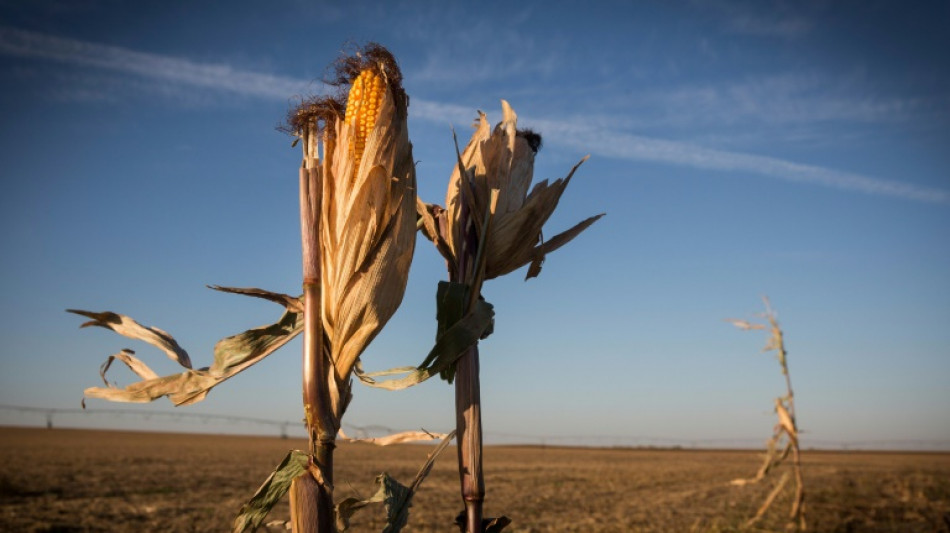
Farmers in US Midwest struggle amid prolonged drought / Photo: Andrew Burton - GETTY IMAGES NORTH AMERICA/AFP/File

 'Glad it's over': Kim powers to Games gold and military exemption

 After 11 World Cups, football finally comes home for one Indian fan
 Marc Marquez wins sprint at Japan MotoGP, Martin grabs pole

 Alcaraz fends off Arnaldi to reach Japan Open quarters

 Antonelli tops times in final practice at Bahrain GP
 Gauff digs deep to beat Osorio in China Open second round

 Fresh protests to hit Spain after housing measures defeated

 'He's here with me': Japan cycle queen dedicates gold to late brother
 Japan Olympic chief says 'lot more' athletes at Games than expected
 Asian carmakers besting US rivals at home, China poised to strike

 Widgets & Web Offers All-Inclusive Investor Relations Websites for Public Companies, IPOs and SPACs

 Adams named new US captain to 2030 World Cup

 China a better influence in Latin America than US: poll

 Judge pauses construction of border project in Texas national park

 Belgium's De Bruyne fires double to sink Turkey, France held by Italy

 US jobs data boosts stocks as oil prices dip

 US Supreme Court to hear high-stakes climate case
 Trump expected to name intel chief Clayton as AI czar: reports
 Argentina unveils passports-for-investment scheme

 Brazil election debate chaos sparks censorship row

 England's Carse charged by cricket body over nightclub incident

 Amazon vows $1 bn for data center towns, decries 'myths'

 Oil prices drop on G7 fuel release, US jobs data boosts stocks

 G7 agrees deal to ease global energy supply concerns

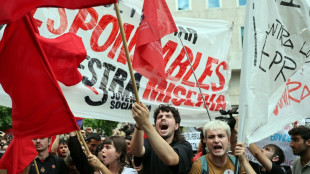 Spain's government dealt blow as lawmakers reject housing bills
Months without rain have left farmers across the vast US Midwest, part of the country's essential "breadbasket," seeing crop yields in freefall, with some fields too damaged to harvest.
At the 4,000-acre (1,600-hectare) Tucker Farms in Venango, Nebraska, "we were only able to harvest... around 500" acres, most of it wheat, said Rachel Tucker.
Much of the rest had shriveled up under a relentlessly hot sun.
The drought has attracted grasshoppers, which threatened the flowers the Tuckers also grow -- until they brought in praying mantises to control the winged pests.
If the American West has been suffering through water shortages for years, the Midwest has not seen conditions this bad since 2012.
"It's even worse than 2012," said Tucker. "Much worse."
Her husband, whose grandfather farmed these same fields, says things have not been this bad since the so-called Dust Bowl days of the 1930s.
The story is just as grim to the south, in western Kansas.
"I was catching up with some older farmers this morning," said Marc Ramsey, whose family has farmed near the small town of Scott City for nearly a century.
"Guys that are in their 70s and 80s are saying, you know, they haven't even experienced anything like this in their lifetime. So it's pretty bad."
Rainfall has been almost nonexistent since late July, he said. Two inches "was all we've had, basically all year."
Rex Buchanan, director emeritus of the Kansas Geological Survey, said one thing seems different from the dry years of 2010-2012: "It seems like when the rain shut off, it just completely shut off."
- Dwindling groundwater -
Drought has hit the three major US crops: wheat, corn and soybeans, and the US Department of Agriculture recently had to lower its nationwide yield predictions.
Along With Kansas and Nebraska, the Midwestern state of South Dakota has also been hard-hit.
In normal times, these three states provide one-third of US winter wheat production, and one-fourth of the corn output.
Approximately 30 percent of Marc Ramsey's land is irrigated and, meaning that portion is doing better than his other fields. Tucker Farms' single irrigated field also fares better than the others.
But even some of Ramsey's irrigated fields are producing only 80 bushels of corn per acre, less than half the usual rate.
High levels of water usage have led to "pretty dramatic declines" in aquifers across western Kansas, Buchanan said, adding that farmers in some areas "have really struggled."
"They’ve seen some wells go dry. They’ve had to return to dryland farming," meaning without irrigation.
- 'You just worry' -
With water rights strictly limited, Buchanan said some farmers have banded together in agreements on more cautious use of subterranean water, drawing as much as 20 percent less than permitted.
Ramsey, like the Tuckers, carries crop insurance covering exceptional losses.
But a year like 2022 can push up premiums, which were already rising due to increased commodity costs.
Insurance "covers your cost of productivity, for the most part," Ramsey said. "And so we'll be here next year and try it again."
But insurance doesn't refill dwindling aquifers -- something that autumn rains usually take care of.
The lack of soil moisture "will be a concern going forward into winter and next spring without a change in what we are currently seeing," said Brian Fuchs, a climatologist with the National Drought Mitigation Center at the University of Nebraska-Lincoln.
Though Buchanan says that "there’s certainly an awareness (among farmers) about climate change," despite the political sensitivity of the subject in the United States.
Farming is always difficult and unpredictable work -- and in years like this, said farmer Rachel Tucker, "you just worry about the suicide rate."
"So I'm hoping that everybody can stay in high spirits, and hope for the best next year."
T.Batista--PC



