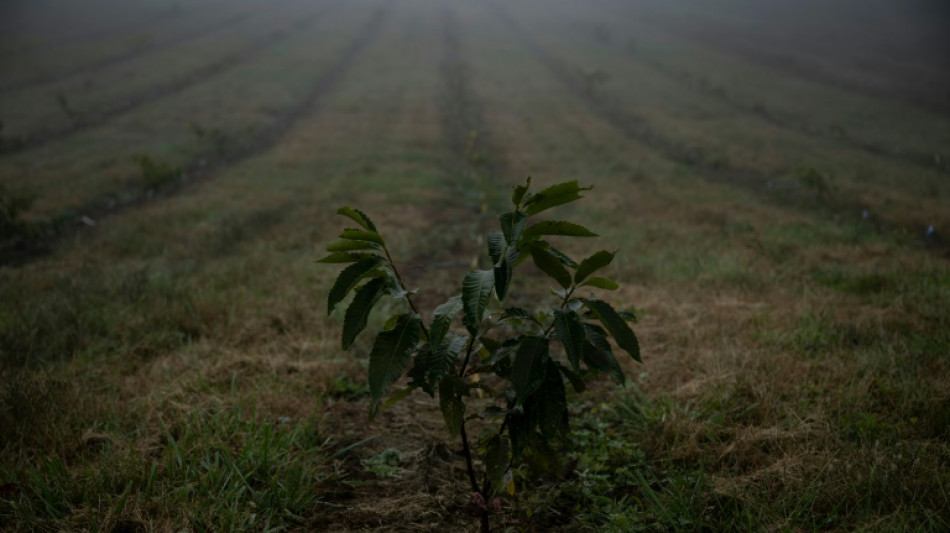
For blight-ridden American chestnut tree, rebirth may be in offing / Photo: Brendan Smialowski - AFP

 'Glad it's over': Kim powers to Games gold and military exemption

 After 11 World Cups, football finally comes home for one Indian fan

 Marc Marquez wins sprint at Japan MotoGP, Martin grabs pole

 Alcaraz fends off Arnaldi to reach Japan Open quarters

 Antonelli tops times in final practice at Bahrain GP

 Gauff digs deep to beat Osorio in China Open second round

 Fresh protests to hit Spain after housing measures defeated

 'He's here with me': Japan cycle queen dedicates gold to late brother

 Japan Olympic chief says 'lot more' athletes at Games than expected

 Asian carmakers besting US rivals at home, China poised to strike

 Widgets & Web Offers All-Inclusive Investor Relations Websites for Public Companies, IPOs and SPACs

 Adams named new US captain to 2030 World Cup

 China a better influence in Latin America than US: poll

 Judge pauses construction of border project in Texas national park

 Belgium's De Bruyne fires double to sink Turkey, France held by Italy

 US jobs data boosts stocks as oil prices dip

 US Supreme Court to hear high-stakes climate case

 Trump expected to name intel chief Clayton as AI czar: reports

 Argentina unveils passports-for-investment scheme

 Brazil election debate chaos sparks censorship row

 England's Carse charged by cricket body over nightclub incident

 Amazon vows $1 bn for data center towns, decries 'myths'

 Oil prices drop on G7 fuel release, US jobs data boosts stocks

 G7 agrees deal to ease global energy supply concerns

 Spain's government dealt blow as lawmakers reject housing bills

The American chestnut tree, once a regal pillar of forests across the eastern United States, is on life support, struggling to survive.
"These look like death," said Vasiliy Lakoba, research director for the American Chestnut Foundation (ACF), which has been working since the 1980s to resurrect the species.
He pointed to a patch of stunted shrubs, chestnut trees that were a far cry from the noble, erect chestnut trees of yesteryear.
Settlers along the US eastern seaboard relied on abundant chestnut trees to feed their hogs, their children and themselves. Chestnuts made up about 50 percent of hardwood forests in much of the eastern seaboard, and the wood was ideal for building.
But then came a terrible fungus, identified in 1904 at the Bronx Zoo on a tree from Japan. In less than three decades, millions of American chestnut trees had perished. It has been considered the greatest tragedy in the history of American forestry.
"The devastation was so fast," said Lakoba, referring to "ghost forests."
Today, only a few rare specimens still survive to adulthood in the wild.
- 'Tall and straight' -
Nestled in the Appalachian Mountains, the foundation's main laboratory farm spans 36 hectares (almost 90 acres) in Virginia and includes tens of thousands of trees.
Workers use a crane to harvest the burrs, or spiny prickly shells that cover the nuts, then take them to a shed to be studied and used for future planting.
"It's like picking apples, but with pricks," laughed Jim Tolton, a technician on the farm, during a chestnut harvest day in early October.
Before the disease, the American chestnut tree "grew tall and straight through the forest, fighting for light," Lakoba said.
But the blight causes cankers to appear on the branches and stems of the American chestnut tree.
Blighted trees grow other branches here and there, giving them a bushy appearance, instead of maintaining a tall, straight shape.
No cure has yet been found to stop the spread.
- Hybrids and GMOs -
Finding a way to fight the blight is precisely the mission of ACF.
To do this, two main research avenues are under investigation: The first, which has been in place for years, consists of crossing an American chestnut tree with other species that already show some resistance to the fungus, such as the Chinese chestnut tree.
A first specimen is produced from this hybridization, before it is crossbred again with an American chestnut tree, then once again -- all in order to preserve as much of the original genetic characteristics as possible. The current hybrid has 15/16ths of the genetic makeup of an American chestnut tree -- while ideally acquiring the resistance of the Chinese chestnut tree.
One of the main drawbacks with these hybrids, explained Lakoba, "is that blight resistance and susceptibility have turned out to be a genetically much more complex phenomenon than previously thought."
ACF researchers have not abandoned their crossbreeding efforts. But a second avenue of research has opened up: genetic modification.
Working on a transgenic version of the American chestnut tree, researchers at the State University of New York at Syracuse have developed a specimen that shows very promising early results of disease resistance, according to Lakoba, who is collaborating with the researchers.
Combining crossbreeding with genetic modification might yield better results, he said.
- 'Keep chipping away' -
Once a resistant specimen has been developed, the time will come for the Herculean task of reintroducing the tree to an American landscape deeply altered by more than a century of development.
"So much has changed in terms of climate, in terms of invasive species, in terms of pollution, habitat change, land use, change, soil loss and erosion, that it really isn't the same world from 100 years ago," Lakoba said.
Not only has the landscape been altered, Lakoba said, climate change adds another wildcard to whether the American chestnut can ever prosper again.
"Overall, there will be more pests, there will be more diseases," he said.
Any revival of the American chestnut may be decades -- or centuries -- away.
"This is definitely at least a couple centuries of a mission going forward. And from there, I think we just keep chipping away at it," Lakoba said.
But he is hopeful that scientific advances are on the side of the American chestnut.
"We see it really as a matter of time."
G.Teles--PC



