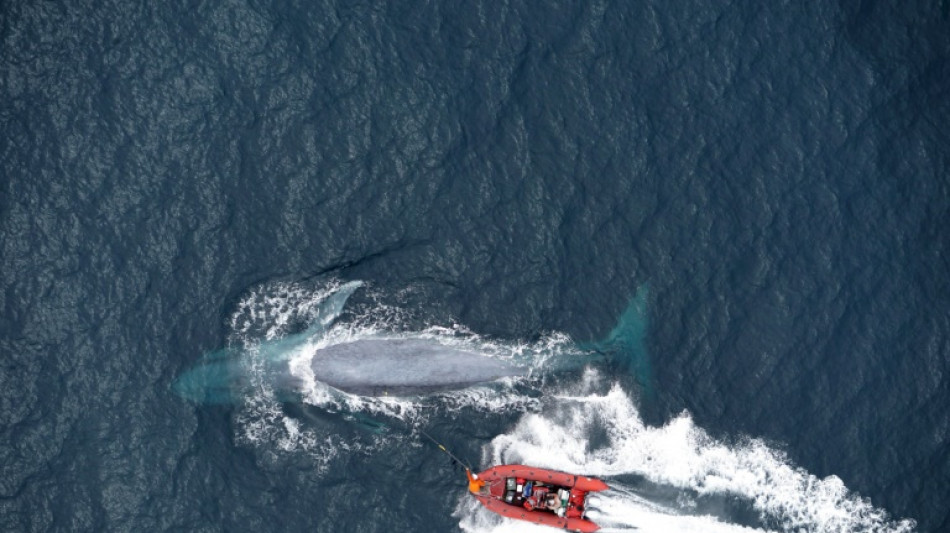
Blue whales eat 10 million pieces of microplastic a day: study / Photo: - - Goldbogen Laboratory/AFP/File

 World No.1 Sinner pulls out of Shanghai Masters to delay return

 Red Bull's Verstappen grabs pole position for Bahrain GP

 India beat Pakistan in blockbuster as golfer Kim wins 'crazy' gold

 India beat arch-rivals Pakistan to win Asian Games cricket gold

 Ethiopia's Tigray rebels abandon regional capital as govt advances: journalist

 Tom Kim powers to Games gold and exemption from military service

 Split loyalties for Indian football fans at Brazil friendly

 India-Pakistan blockbuster brings cricket fever to Japan baseball field

 Wong waiting on Rafa after winning Asian Games tennis gold

 With Russia next door and rising costs, Latvia goes to the polls

 Penalty hero rues empty seats as Games hosts Japan win football gold

 North Korea fires ballistic missile after Seoul's apology demand

 US regulator finds Boeing 737 MAX software bug 'not a safety concern'

 Ohtani 'managing' injuries as Dodgers launch MLB post-season

 Botched US execution leaves murderer unconscious on ventilator: lawyers

 Cornell rape case exposes sexual violence at US colleges

 France held by Italy in Zidane's homecoming after Olise stunner

 Ethiopian pro-government militia claims Tigray airport as regional tensions spike

 Ohtani shaking off injuries as Dodgers launch MLB post-season

 Sea levels to rise in California as coastal wave surges up west coast

 New rallies urged in France as protests disrupt over 730 schools

 Djokovic survives China Open scare, Sabalenka starts strong

 King Charles to evoke colonial 'darkest days' on Caribbean tour

 Tesla shares jump after global car sales top estimates

 DR Congo Ebola outbreak killed more than 4,000: official figures

Blue whales consume up to 10 million pieces of microplastic every day, research estimated Tuesday, suggesting that the omnipresent pollution poses a bigger danger to the world's largest animal than previously thought.
The tiny fragments of plastic have been found everywhere from the deepest oceans to the highest mountains, and even inside human organs and blood.
Now a modelling study published in the journal Nature Communications has estimated how much is being ingested by whales.
A US-led research team put tags on 191 blue, fin and humpback whales that live off the coast of California to observe their movements.
"It's basically like an Apple Watch, just on the back of a whale," said Shirel Kahane-Rapport, a researcher at California State University, Fullerton and the study's first author.
The whales mostly fed at depths of between 50 to 250 metres (165-820 feet), which is home to the "greatest concentration of microplastics in the water column," Kahane-Rapport told AFP.
The researchers then estimated the size and number of mouthfuls the whales had daily and what was filtered out, modelling three different scenarios.
Under the most likely scenario, the blue whales ate up to 10 million microplastic pieces a day.
Over the 90-120 day annual feeding season, that represents more than a billion pieces a year.
The largest animal ever to live on Earth is also likely the biggest microplastic consumer, eating up to 43.6 kilogrammes a day, the study said.
"Imagine carrying around an extra 45 kilogrammes -- yes, you're a very big whale, but that will take up space," Kahane-Rapport said.
Humpback whales were estimated to eat around four million pieces a day.
While it is easy to imagine whales sucking in vast amounts of microplastics as they gulp their way through the ocean, the researchers found that was not the case.
Instead, 99 percent of the microplastics entered the whales because they were already inside their prey.
"That's concerning for us," Kahane-Rapport said, because humans eat that prey.
"We also eat anchovies and sardines," she said, adding that "krill is the basis of the food web".
Previous research has shown that if krill are in a tank with microplastic, "they will eat it," Kahane-Rapport said.
Now that the researchers know how much microplastic is being consumed by whales, next they aim to determine how much harm it could be doing.
"The dose defines the poison," Kahane-Rapport said.
Ferreira--PC



