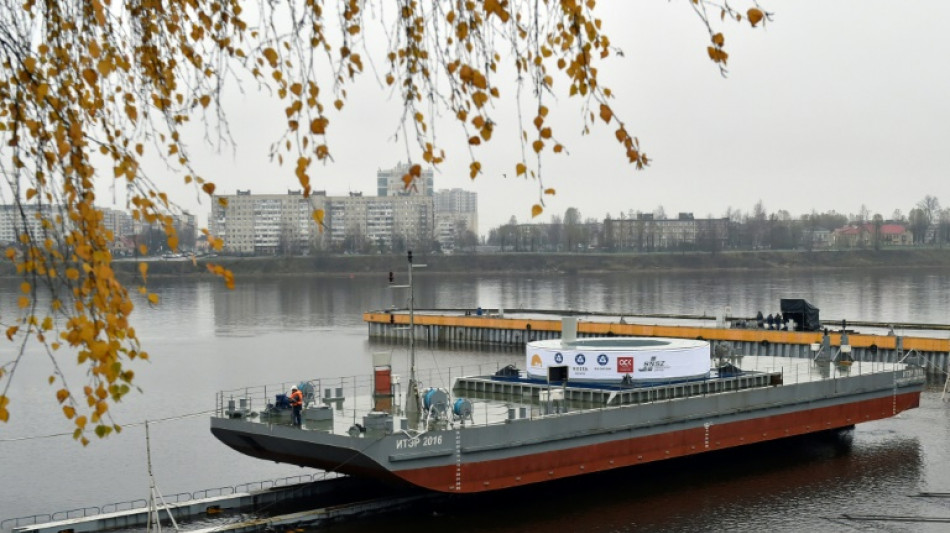
Despite conflict Russia sends France giant magnet for nuclear fusion project / Photo: Olga MALTSEVA - AFP

 DiDi Advances Robotaxi Operations in China with New R2 Vehicle and Expanded Safety Infrastructure

 Freezz Italia Awarded ESA Contract for IRIS(2) Low-LEO Pre-Operational and De-Risk Activities
 French Economy Shrinks 0.1% as Consumer Confidence Slumps

 Wall Street Ends Turbulent Week Higher Despite Inflation and AI Jitters

 Kansas City Fed Chief Says Inflation Is Still Running Too Hot
 Oil Heads for Second Weekly Loss as Supply Surplus Emerges

 Middletown High School Football Team Ends Legal Battle After Playoff Forfeit
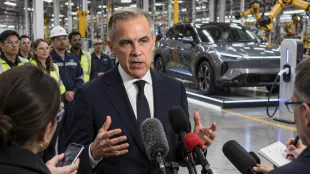 Canada Signals Openness to Chinese Automakers if US Trade Talks Fail
Russia on Tuesday dispatched one of six giant magnets needed for the ITER nuclear fusion programme in France, one of the last international scientific projects Moscow participates in despite the Ukraine conflict.
The ship carrying the Russian-made magnet -- or "poloidal field coil" -- departed Saint Petersburg on Tuesday under grey skies.
On board, the massive nine-metre-wide coil, which weighs 200 tonnes had been tightly wrapped to withstand a two-week trip to Marseille, southern France.
The ring-shaped magnet built under Russian atomic agency Rosatom's supervision will make up the top part of the world's largest "tokamak".
The tokamak is a magnetic fusion device built in France following the same principle that powers our sun and stars.
The Russian piece was meant to leave in May but sanctions forbidding Russian ships docking in Europe delayed the departure.
Still, the "current situation did not change the fact that we will fullfil our obligations", Rosatom representative for international projects Viacheslav Perchukov said.
Geopolitical tensions "practically did not affect the realisation of this project", Perchukov said.
"Without (the Russian coil), the tokamak will not work," senior ITER centre scientist Leonid Khimchenko told AFP.
He hailed a "unique" achievement, over eight years in the making.
In southern France, 35 nations are collaborating to build the largest nuclear fusion device in the world.
"This is such an interesting project that in fact we are all one family... there is no competition between us, nothing," Khimchenko said.
The project was set in motion after a 1985 summit between US President Ronald Reagan and Russian leader Mikhail Gorbachev.
Andrey Mednikov, a scientist in charge of the production of the poloidal field coil, praised the continuing international cooperation.
"If this cooperation was brought to a halt," Mednikov said, "everyone would lose: both Russia and the international community."
A.Motta--PC