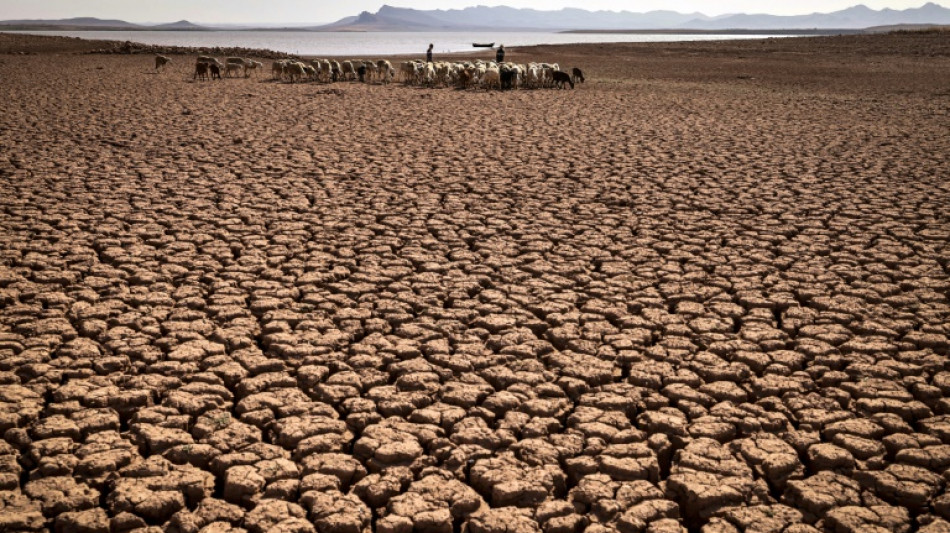
Rich nation 'gestures' on climate damage only a start: observers / Photo: FADEL SENNA - AFP/File

 World No.1 Sinner pulls out of Shanghai Masters to delay return
 Red Bull's Verstappen grabs pole position for Bahrain GP

 India beat Pakistan in blockbuster as golfer Kim wins 'crazy' gold

 India beat arch-rivals Pakistan to win Asian Games cricket gold

 Ethiopia's Tigray rebels abandon regional capital as govt advances: journalist

 Tom Kim powers to Games gold and exemption from military service

 Split loyalties for Indian football fans at Brazil friendly

 India-Pakistan blockbuster brings cricket fever to Japan baseball field

 Wong waiting on Rafa after winning Asian Games tennis gold
 With Russia next door and rising costs, Latvia goes to the polls

 Penalty hero rues empty seats as Games hosts Japan win football gold

 North Korea fires ballistic missile after Seoul's apology demand

 US regulator finds Boeing 737 MAX software bug 'not a safety concern'

 Ohtani 'managing' injuries as Dodgers launch MLB post-season

 Botched US execution leaves murderer unconscious on ventilator: lawyers
 Cornell rape case exposes sexual violence at US colleges
 France held by Italy in Zidane's homecoming after Olise stunner

 Ethiopian pro-government militia claims Tigray airport as regional tensions spike
 Ohtani shaking off injuries as Dodgers launch MLB post-season
 Sea levels to rise in California as coastal wave surges up west coast
 New rallies urged in France as protests disrupt over 730 schools

 Djokovic survives China Open scare, Sabalenka starts strong
 King Charles to evoke colonial 'darkest days' on Caribbean tour

 Tesla shares jump after global car sales top estimates
 DR Congo Ebola outbreak killed more than 4,000: official figures
A trickle of climate "loss and damage" funding pledges from rich countries at the COP27 summit in Egypt have been welcomed by observers and developing nations, who say they must pave the way for a broad global financing deal.
The controversial issue is a key focus of the UN meeting, as a relentless surge of impacts wreak death, destruction and mounting economic losses on developing nations least responsible for planet-heating emissions.
A handful of European nations and regions have announced small funding pledges during the Sharm el-Sheikh talks, with Germany, Austria, Ireland and Belgium saying they would make contributions.
"These are good gestures. It shows that the issue has been acknowledged after years of advocacy," said Harjeet Singh, head of global political strategy at the Climate Action Network.
But he said that this should not distract from calls by developing nations for a robust framework that can pay out when countries are hit by increasingly ferocious floods, heatwaves and droughts, along with slow-onset impacts such as sea level rise.
Pledges so far are miniscule in comparison to the damages already incurred.
Austria has offered $50 million and Belgium says it will give $2.5 million to Mozambique, adding to $13 million that Denmark has earmarked for loss and damage in North Africa and the Sahel.
Scotland, which kicked off the loss and damage pledges last year when Britain hosted the COP26 summit, has also upped its contribution to $8 million.
Meanwhile, Germany is touting its "global shield" project, due to be officially launched in Egypt next week, as a way to provide climate risk insurance and prevention to vulnerable countries.
It announced $170 million for the project this week, while Ireland said it would contribute $10 million for 2023.
- Heatwaves, droughts, floods -
These countries "have begun to show the way" by recognising the need to provide funds to countries already being slammed by the impacts of climate change," Gaston Browne, the Prime Minister of Antigua and Barbuda, told delegates on Tuesday.
"It would be right for the major polluters -- particularly those that have been involved in the historical use of fossil fuel energies -- to follow this example."
The summit is taking place at as a devastating drought is threatening millions with starvation in the Horn of Africa.
Heatwaves and droughts have caused crops to wither on four continents, while Pakistan is still reeling from catastrophic flooding that destroyed homes, roads and bridges and swallowed vast areas of farmland.
The World Bank has estimated the Pakistan floods alone caused $30 billion in damages and economic loss. Millions of people were displaced and two million homes destroyed.
Rachel Cleetus, policy director and lead economist for the Climate and Energy Program, Union of Concerned Scientists, said climate disasters and rocketing fossil fuel prices were hurting countries already burdened with "crushing debt".
She said that while measures like Germany's insurance programme are important additions to loss and damage, they would be "inadequate" to deal with loss and damage more broadly.
"We're talking about losing land to sea level rise and desertification. Insurance can help you up to a point but climate change is now creating conditions in many parts of the world that are beyond the bounds of what's insurable," she said.
"In a year like this, on this climate vulnerable continent of Africa, it would just be unconscionable to come away without an agreement on a loss and damage facility."
A.S.Diogo--PC



