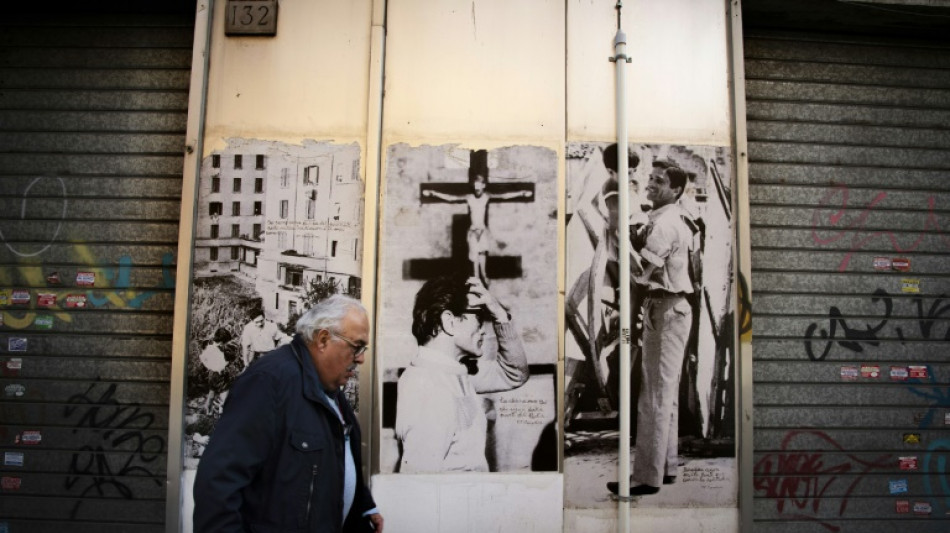
Who killed Pasolini? Italy still questions century after birth

 Germans vote in elections threatening fresh blow to Merz

 US fears rapid escalation in Mideast after Houthis attack Riyadh

 Japan triathlete Hojo wins first gold of Asian Games

 IOC president impressed by 'beautiful' Asian Games wooden huts

 First Asian Games gold goes to Japan as China's 13-year-old Yu lights up pool

 Data centre command hub keeps AI up and running

 Pope Leo in France: the issues on the table

 Packing for a pope: behind the scenes on foreign trips

 Republicans find transgender issues a powerful political weapon in midterm campaigning

 German state elections threaten new shock waves for Merz

 Chile's Bachelet quits race to be next UN chief

 Raphinha treble fires perfect Barca to win at Sevilla

 Thiam makes winning heptathlon return at Decastar meet

 Czechs beat USA to qualify for Davis Cup finals

 Dortmund sink Stuttgart to climb to Bundesliga summit

 Trump says will not tolerate attempts to slow AI growth

 'It has to stop': runners protest women's murders in S.Africa district

 Fire erupts near Riyadh airport as Houthis claim strikes

 Cuba works to restore power after another blackout

 England thrash Sri Lanka again to return to top of T20 rankings

 Arsenal thrashed by Brighton, sorry Spurs lose again
 South Korea, Austria qualify for Davis Cup finals
 Seare shocks Ingebrigtsen to win world 5km gold
 Brigitte Bardot widower slams sale of star's belongings

 Aston Villa compound Tottenham's misery despite late rally

Provocative Italian filmmaker and poet Pier Paolo Pasolini had no shortage of enemies, but half a century after his brutal murder on a beach, his death remains a mystery.
Italy marks the 100th anniversary on March 5 of the birth of one of its leading left-wing intellectuals, while a retrospective of his estimated two dozen movies is planned in Los Angeles.
But the most crucial questions that have gripped Italy since his mangled body was found on a beach of Ostia outside Rome on November 2, 1975 -- who ordered his killing and why -- remain unanswered.
Pasolini was only 53 when he died, beaten with fists and sticks, then run over by an Alfa Romeo GT, either his own or someone else's.
A 17-year-old male prostitute, Giuseppe "Pino" Pelosi, was stopped while running away from the filmmaker's car and admitted killing him, saying Pasolini tried to rape him.
Pelosi was jailed for nearly 10 years, but in 2005 he recanted on his confession, instead blaming three unnamed men with Sicilian accents.
The investigation was reopened in 2010, based on DNA found on Pasolini's clothes, but only one sample could be identified -- Pelosi's.
In the years since Pasolini died, theories have swirled about why the artist was killed, ranging from blackmail to a hit by the far-right or mafia.
Pasolini lived his life unafraid of controversy as he took aim at bourgeois values, Catholic censorship and the threat of neo-fascism, while exposing the hardships of life through an often unbearably grim lens.
He was "an uncomfortable person for those in power", his childhood friend, Silvio Parello, told AFP at his Rome workshop that has become a shrine to the filmmaker.
- Right to scandalise -
Through his essays, poems, plays and films, Pasolini highlighted the downsides of Italy's post-war "economic miracle", which brought modernity but also shanty towns and growing regional inequality.
"All his life he sought out an archaic, pre-industrial, pre-globalised peasant world, which he saw as innocent," another friend, Italian writer Dacia Maraini, told AFP.
Pasolini was already known in Italy for his poetry when he began in film. His last movie, "Salo or the 120 Days of Sodom", was released after his death.
The films range from gritty realism to loose adaptations full of symbolism -- "Salo" was based on the work by the Marquis de Sade -- while his novels reveal a fascination with small-time hooligans from the Rome suburbs.
"To scandalise is a right. To be scandalised is a pleasure," he said in his last television interview, in Paris, on October 31, 1975.
But not everybody appreciated what he was trying to do.
Shortly before his death, the filmmaker received threats over "Salo", a critique of Fascist Italy that caused outrage because of its graphic depiction of violence and sexual abuse.
Some believe Pasolini's murder was linked to his investigations into the suspicious death of Enrico Mattei, the boss of energy giant Eni, in a 1962 plane crash likely caused by a bomb.
- Political crime -
For criminologist Simona Zecchi, author of two books on Pasolini, the writer was killed for his journalism at a time when Italy was in the throes of violence between far-left and far-right groups, known as the "Years of Lead".
In 1974, Pasolini -- who was close to Italy's Communist party -- published an inflammatory article about the December 1969 Piazza Fontana attack in Milan, which left 17 people dead and more than 80 injured.
It was first blamed on anarchists, then members of a neo-fascist group. Pasolini claimed he knew who was responsible, but said he had no proof. No one was ever convicted.
There is also speculation blackmail played a role in his death, as weeks before, reels of "Salo" had been stolen in Rome. But investigators later ruled out the theory.
Zecchi believes there was never any will to find out what really happened.
"Italy has a problem with the truth, because this truth has often passed through the dark side of our institutions," she said.
Pasolini's French biographer, Rene de Ceccatty, said solving the murder is complicated by the "several layers" of individual actors likely involved.
"From the moment you accept it was a political crime, it's not surprising that there is so much fog around it."
P.Sousa--PC