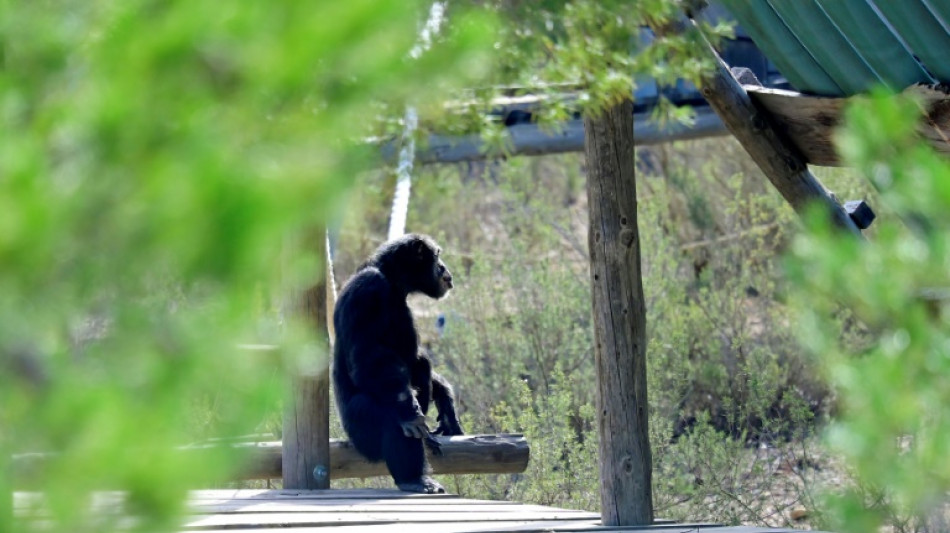
Spain seeks ground-breaking law for great apes / Photo: Jose Jordan - AFP

 Stocks diverge with earnings, tech in focus

 England recall batsman Lawrence for Pakistan series
 Siemens shares plunge on disappointing guidance raise

 New Australia coach Kiss gives Japan starts to Ross, Amatosero

 'Stretch our money': Romanians face highest EU inflation

 Iran says close to Hormuz plan with Oman, but reopening depends on US

 Messi scores twice to set Leagues Cup record in Miami victory

 Asian stocks mostly down with tech firms back under pressure
 Back to the future as world champion Springboks host All Blacks

 India youth protests highlight mistrust in 'lapdog' media
 Pacific islands alarmed by Trump-backed push for deep-sea mining

 Erratic rains dictate menu at three-star Michelin restaurant in Brazil

 Zverev, Auger-Aliassime and Medvedev exit Montreal Masters

 Google-parent Alphabet shakes up AI division

 FIFA back Infantino, apologise for World Cup privatisation plan

 Auger-Aliassime out of Montreal ATP event with injury

 Colombian baby hippo of Escobar stock dies after rescue

 Preakness shifts 2027 dates to entice more Derby horses

 Guatemalan volcano eruption ends, locals return home

 WHO chief urges stronger Ebola response in DR Congo visit

 Newcastle appoint Jaissle as new head coach after Howe exit

 Swiss ski star Lara Gut-Behrami calls time on 18-year career

 US indicts leaders of Mexico's CJNG cartel, ups reward money

 Noosha Aubel: Klarar hon av Potsdams problem?

 Noosha Aubel: Zvládne problémy Postupimi?

For decades Achille, 50, eked out a miserable existence living alone in wretched conditions in a cramped circus cage.
But better days could lie ahead for the chimpanzee and almost 150 great apes in Spain who stand to benefit from a pioneering bill that would strengthen laws safeguarding their well-being.
Animal rights activists hope the draft legislation will drive the debate on apes' legal status -- in Spain and beyond.
"Apes are like us, they are sociable animals," said Olga Bellon, a primate expert at the Primadomus foundation that took in Achille.
Putting them through the treatment Achille suffered "is inhumane", she told AFP.
The initiative could "change our perception" of the mammals, who are genetically very close to humans, and better appreciate their needs, added Bellon.
Spain's left-wing government took a first step towards legislating on animal welfare last year with a law that increased prison sentences for mistreatment.
Now it is going further, with the pioneering draft law launched in July aiming to eradicate practices harming "the life, physical integrity, dignity and survival of great apes".
Almost 150 primates including gorillas, orangutans and chimpanzees could benefit from the draft law, according to associations.
- 'Non-human people' -
The Primadomus shelter, located near the Mediterranean city of Alicante in eastern Spain and founded in 2009 by Dutch association Animal Advocacy and Protection (AAP), hosts around 60 primates.
Like Achille, they are taken from individuals or circuses and sometimes arrive traumatised or with behavioural disorders.
Great apes suffer stress and depression and can self-harm as humans do, explained Bellon. "Here, we want them to recover and feel well."
Behind her, four chimpanzees frolicked in the trees and bushes, hunting for chickpeas lying scattered on the ground.
Lots of patience -- sometimes years -- is necessary before they recover their instincts, said Bellon.
Science shows that the animals are closer to humans than was thought and that justifies "a specific treatment", said Jose Ramon Becerra, a senior civil servant coordinating the new initiative.
The bill could shift the terms of the debate on their legal status, "even beyond Spain", Becerra told AFP.
Some schemes have been launched in recent years. In Argentina, a female orangutan and a chimpanzee were recognised as "non-human people" and authorities demanded their removal from cramped enclosures.
However, no country has granted this status to all great apes, said Pedro Pozas, executive director in Spain of the "Great Apes Project", an international movement campaigning for the species' basic rights.
- Debate 'moving forward' -
In 2008, the Spanish parliament voted a resolution calling for the matter to be studied.
But with the country in the throes of a painful financial crisis, MPs never followed it up, and some were revolted at the idea of elevating primates to the same level as humans.
Becerra is convinced this time will be different because society is "more mature" and social sensibilities have changed.
In a sign of the great expectations, the social rights ministry Becerra belongs to has collected more than 300 contributions after consultations with experts and associations, a first step in the legislative process.
Among them are proposals to guarantee better living conditions in enclosures, banning the use of primates in films and shows or banning the separation of mothers from their children.
Others like the Jane Goodall Institute and the Great Apes Project want to go further by outlawing their reproduction in captivity, with a long-term objective of removing all great primates from zoos, said Rozas.
For Marta Merchan, public policy lead at AAP in Spain, great apes must live in their natural habitat with their species.
Although the goal of taking them out of zoos is a long way off, "what matters is that the debate moves forward," she said.
The new bill is a "first step" that will "help raise awareness", benefiting great apes and potentially all animals, Merchan added.
E.Ramalho--PC