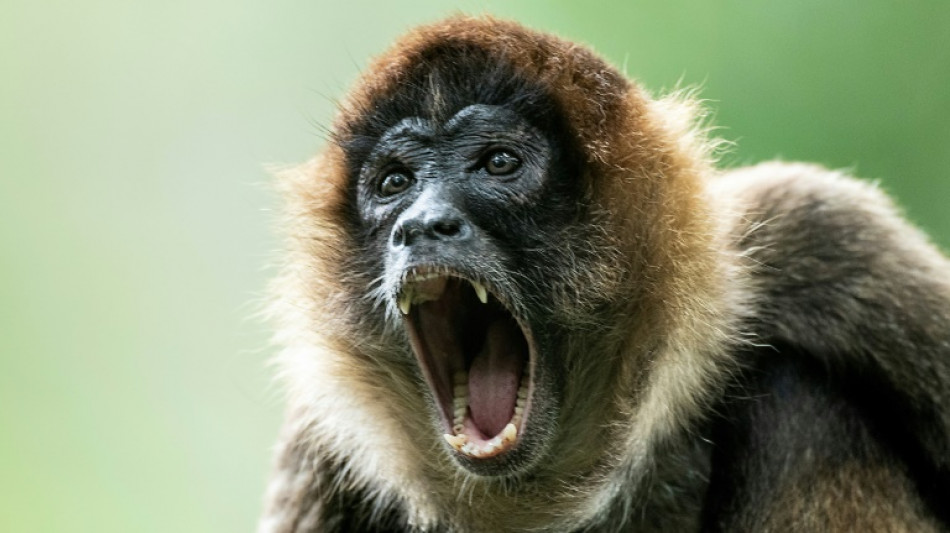
Revealed: Why monkeys are better at yodelling than humans / Photo: Ezequiel BECERRA - AFP/File

 Multi-Asset Trading Venue Monochrome Exchange Announces IEO of Its Native Token, $MCR

 South Korea break Japan hearts to win Asian Games basketball gold

 Acosta takes first victory at Austrian MotoGP

 PSG president Nasser al-Khelaifi under investigation in France for conflict of interest

 China swim sensation, 13, sets Games record after Japan win early

 Drones hit Moscow as Russians go to the polls

 New England boss Fleming says 'wrong' to ask Stokes to end retirement

 Germans vote in elections threatening fresh blow to Merz

 US fears rapid escalation in Mideast after Houthis attack Riyadh

 Japan triathlete Hojo wins first gold of Asian Games

 IOC president impressed by 'beautiful' Asian Games wooden huts

 First Asian Games gold goes to Japan as China's 13-year-old Yu lights up pool

 Data centre command hub keeps AI up and running

 Pope Leo in France: the issues on the table

 Packing for a pope: behind the scenes on foreign trips

 Republicans find transgender issues a powerful political weapon in midterm campaigning

 German state elections threaten new shock waves for Merz

 Chile's Bachelet quits race to be next UN chief

 Raphinha treble fires perfect Barca to win at Sevilla

 Thiam makes winning heptathlon return at Decastar meet

 Czechs beat USA to qualify for Davis Cup finals

 Dortmund sink Stuttgart to climb to Bundesliga summit

 Trump says will not tolerate attempts to slow AI growth

 'It has to stop': runners protest women's murders in S.Africa district

 Fire erupts near Riyadh airport as Houthis claim strikes

Yodellers of the world, you never stood a chance: Monkeys will always be better at yodelling than humans because they have a "cheap trick" hidden in their voice box, scientists revealed Thursday.
When monkeys howl -- or yodellers yodel -- they rapidly switch back and forth between low and high frequency sounds.
This is in contrast to opera singers, who are trained to precisely control how they gradually move from note to note, in a way that is pleasing to listen to.
Yodellers and monkeys, however, make bigger jumps far more abruptly, creating vocal breaks that sound like Tarzan's yell.
When yodelling, a human might be able to jump an octave, which doubles the frequency.
Monkeys can manage three and half octaves, according to a new study.
A "cheap trick" in their larynx means these monkeys will always beat humans, senior study author Jacob Dunn of the UK's Anglia Ruskin University told AFP.
Both humans and monkeys have a pair of vocal folds in their larynx which vibrate to create sound.
But monkeys have an additional pair of membranes that gives them a far wider pitch range, the international team of researchers discovered.
This is thought to give monkeys, which are social creatures, a more complex way of communicating with each other.
All other primates, and even ancient human ancestors, appear to have this special tissue, Dunn said.
At some during our evolution, humans seem to have lost these membranes, he added.
But the shame of being inferior yodellers may have been worth the trade-off.
To be able to speak clearly, humans needed a "streamlined" larynx -- and these membranes would have gotten in the way, Dunn explained.
"If you put a human brain on the primate larynx" it would struggle to speak intelligibly because of the membranes and other things like air sacs, he said.
For the study, the researchers put sensors on the necks of some monkeys at Bolivia's La Senda Verde Wildlife Sanctuary.
This allowed them to see what was going on in the larynx of black and gold howler monkeys, tufted capuchins, black-capped squirrel monkeys and Peruvian spider monkeys.
The spider monkey was the best yodeller, managing around four octaves, Dunn said.
The researchers also studied the larynges of dead monkeys and used computer modelling to analyse the frequencies.
The study was published in the journal Philosophical Transactions of the Royal Society B.
E.Raimundo--PC