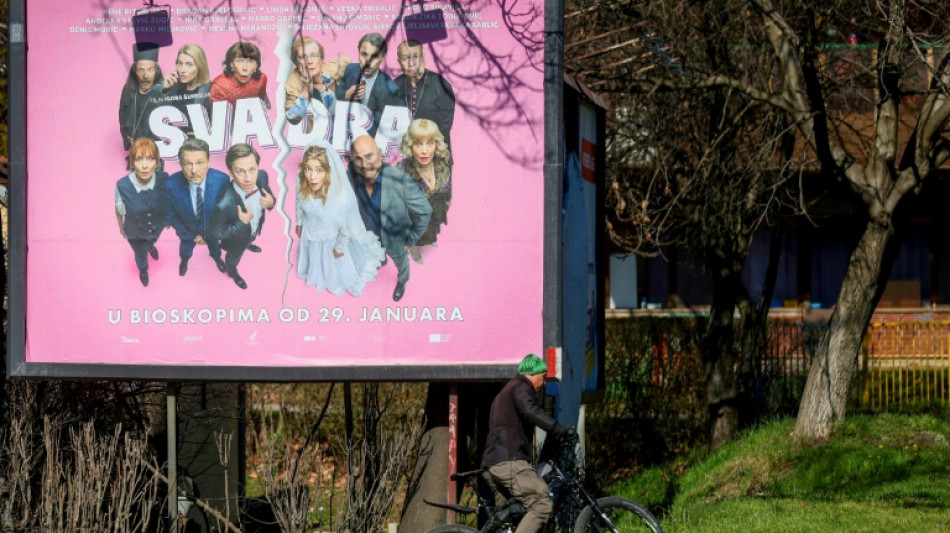
Balkan 'forbidden' love comedy smashes stereotypes and records / Photo: Oliver Bunic - AFP

 Drones hit Moscow as Russians go to the polls

 New England boss Fleming says 'wrong' to ask Stokes to end retirement
 Germans vote in elections threatening fresh blow to Merz
 US fears rapid escalation in Mideast after Houthis attack Riyadh

 Japan triathlete Hojo wins first gold of Asian Games
 IOC president impressed by 'beautiful' Asian Games wooden huts
 First Asian Games gold goes to Japan as China's 13-year-old Yu lights up pool
 Data centre command hub keeps AI up and running

 Pope Leo in France: the issues on the table
 Packing for a pope: behind the scenes on foreign trips

 Republicans find transgender issues a powerful political weapon in midterm campaigning

 German state elections threaten new shock waves for Merz

 Chile's Bachelet quits race to be next UN chief

 Raphinha treble fires perfect Barca to win at Sevilla

 Thiam makes winning heptathlon return at Decastar meet

 Czechs beat USA to qualify for Davis Cup finals
 Dortmund sink Stuttgart to climb to Bundesliga summit

 Trump says will not tolerate attempts to slow AI growth

 'It has to stop': runners protest women's murders in S.Africa district

 Fire erupts near Riyadh airport as Houthis claim strikes

 Cuba works to restore power after another blackout

 England thrash Sri Lanka again to return to top of T20 rankings

 Arsenal thrashed by Brighton, sorry Spurs lose again

 South Korea, Austria qualify for Davis Cup finals

 Seare shocks Ingebrigtsen to win world 5km gold

When two students in London tell their families they are going to get married, it should be one of the happiest moments of their lives.
But there's a catch -- she is Croatian and he is Serbian.
The rivalry between the two Balkan neighbours becomes comedy gold in the smash hit film "Wedding", which has audiences in both countries laughing at themselves.
The Croatian-Serbian co-production mocks stereotypes of the two peoples who share a very similar language but who ended up fighting in a bloody war in the 1990s when Yugoslavia, the country they shared for generations, collapsed.
The young couple's families are horrified by the looming "mixed marriage".
The Croat Catholic father senses something is amiss from his daughter's voice when she calls to share the news that a baby is on the way -- only to learn the "shocking truth" that the father and future son-in-law is a Serb.
There's a similar reception on the Serbian side, where the grandmother calls her future in-laws "Ustashas", a slur alluding to Croatia's World War II pro-Nazi regime.
- Most watched film ever -
The movie, called "Svadba" in Croatian, has become a box office phenomenon at a time when relations between Zagreb and Belgrade are among their lowest since the war.
In Croatia it has become the most-watched film ever, with nearly 700,000 people seeing it in just over a month -- one in five of the population -- sinking the three-decade-old record held by "Titanic" by around 200,000 tickets.
So far it has been seen by some two million people across the Balkans and in Austria, Switzerland and Germany, which have large diaspora populations.
Director Igor Seregi said its success showed people were missing the same thing: "Laughter -- to laugh at each other but also at ourselves.
"I think everyone recognised someone from their own family or wider circle and that resonated," Seregi told AFP.
He cast renowned actors from both nations in his "Romeo and Juliet" tale where the two fathers particularly struck a chord.
The politically-connected Croatian tycoon needs to expand into Serbia to avoid bankruptcy, while the father of the groom is a Serbian minister looking for funds from the European Union, of which Croatia is a member.
Marko Jovanovic, an administrator from Belgrade, told AFP that the comedy was a spot-on portrayal of the two countries' elites.
"A shady businessman with a gold chain and a politically connected schemer whose children study in London, felt almost like a documentary," he said.
- 'Strips prejudices bare' -
Ivana, a Serbian woman who married in Zagreb 20 years ago, loved it for stripping prejudices bare.
"The time has come for such a human story that reveals the reality beyond the politics," she said.
The movie gently mocks absurd traditions, the clergy and generational divides.
Lorna, a psychology student from Zagreb, liked it for "poking fun equally at Serbian and Croatian society and their absurdities".
Zagreb-born Seregi believes viewers outside the Balkans also relate to the movie as it is about division, whether between rich and poor, urban and rural, or along racial lines.
"Real life hasn't always been as smooth or romantic as depicted in the movie, but in the end, love always wins," the 42-year-old said.
Psychologist Petar Kraljevic echoed many viewers in praising the film's feelgood vibe.
"The baby's birth unites the families for good, letting optimism and hope for a better future prevail," he said.
P.Mira--PC