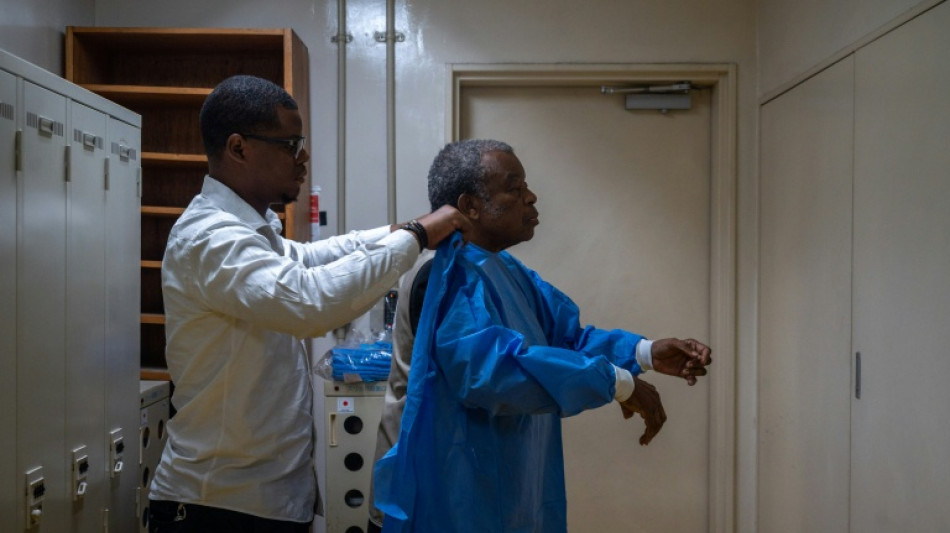
'We have always won': Ebola pioneer still on front line at 84 / Photo: Hardy BOPE - AFP

 Germans vote in elections threatening fresh blow to Merz

 US fears rapid escalation in Mideast after Houthis attack Riyadh

 Japan triathlete Hojo wins first gold of Asian Games

 IOC president impressed by 'beautiful' Asian Games wooden huts

 First Asian Games gold goes to Japan as China's 13-year-old Yu lights up pool

 Data centre command hub keeps AI up and running

 Pope Leo in France: the issues on the table

 Packing for a pope: behind the scenes on foreign trips

 Republicans find transgender issues a powerful political weapon in midterm campaigning

 German state elections threaten new shock waves for Merz

 Chile's Bachelet quits race to be next UN chief

 Raphinha treble fires perfect Barca to win at Sevilla

 Thiam makes winning heptathlon return at Decastar meet

 Czechs beat USA to qualify for Davis Cup finals

 Dortmund sink Stuttgart to climb to Bundesliga summit

 Trump says will not tolerate attempts to slow AI growth

 'It has to stop': runners protest women's murders in S.Africa district

 Fire erupts near Riyadh airport as Houthis claim strikes

 Cuba works to restore power after another blackout

 England thrash Sri Lanka again to return to top of T20 rankings

 Arsenal thrashed by Brighton, sorry Spurs lose again
 South Korea, Austria qualify for Davis Cup finals

 Seare shocks Ingebrigtsen to win world 5km gold

 Brigitte Bardot widower slams sale of star's belongings

 Aston Villa compound Tottenham's misery despite late rally

In 1976, young Congolese doctor Jean-Jacques Muyembe was sent to a remote village to look into a mysterious illness and found himself confronting Ebola, a deadly virus the world did not yet know.
Just back in the Democratic Republic of Congo after studying in Belgium, he had been called to Yambuku where doctors initially thought they were dealing with typhoid or yellow fever.
He drew blood from a sick nun and sent the sample to Belgium where microbiologist Peter Piot would soon isolate the new virus, later named Ebola after a nearby river.
At the time, Muyembe had little sense of the danger he had exposed himself to.
"When I removed the needle, the blood kept flowing and my fingers were covered in it," he told AFP in Kinshasa.
"We had no gloves, no gowns, no masks as we do today."
Fifty years later, and now aged 84, Muyembe is still on the front line against a virus he helped uncover as the DRC battles its 17th deadly outbreak.
Despite the scale of the crisis, with 808 people infected and 192 killed in the country, according to the World Health Organization, he stressed: "We have always won the battle against Ebola."
- Animals to humans -
The latest outbreak, declared on May 15, has mainly hit the remote, conflict-weary northeastern Ituri province.
Causing it is the Bundibugyo strain, for which there is currently no vaccine or treatment, unlike the more common Zaire strain, against which vaccines were developed in 2018 and 2019.
But "the lack of a vaccine does not mean the battle is lost," said Muyembe, who heads the state-run National Institute of Biomedical Research (INRB).
On his desk is a medal and photographs of him with dignitaries, as well as piles of letters from international partners and donors.
He pointed out that the DRC had overcome 15 Ebola outbreaks in the past using public health measures alone, long before vaccines and modern treatments were available.
Muyembe also said he was pleased to see African scientists, once reliant on foreign labs, play a key role in responding to outbreaks on the continent.
Still, health authorities in the DRC have faced criticism this time for delays in detecting the outbreak and in supporting overstretched frontline workers.
In recent weeks, fearing border closures, the government has insisted that the situation is under control.
Also lying on Muyembe's desk is an open file on mpox -- a reminder that Ebola is only one of several threats facing the DRC.
Muyembe believes the crises are linked. The country's exceptional biodiversity, combined with deforestation and climate change, has pushed communities deeper into the forests, and into closer contact with wildlife.
It makes the DRC "particularly vulnerable to epidemics of zoonotic diseases" that pass from animals to humans, like Ebola and mpox, he said.
- 'Greatest risk' -
After the initial 1976 outbreak, Ebola disappeared for nearly two decades, returning in 1995 in the western city of Kikwit, where it appeared as an outbreak of "red diarrhoea".
Drawing on his experience, Muyembe experimented by treating eight patients with blood transfusions from survivors.
Seven of them lived. The sample was small, but the concept laid the groundwork for a line of research that would eventually lead to the development of Ebanga, the first approved Ebola treatment, licensed in 2020.
Now a father of nine and grandfather to many, Muyembe reflected on that first mission as a young graduate freshly returned to the DRC.
Looking back, the virologist said he took "the greatest risk of my life" that day.
"I took part in identifying the virus and in treating the disease," the virologist said. "What more can one do in a lifetime?"
P.Cavaco--PC