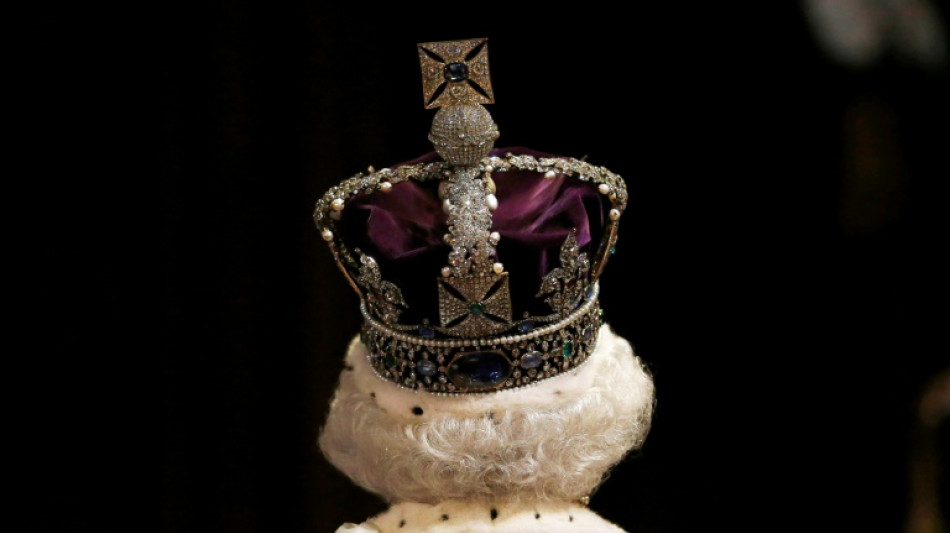
All the queen's kingdoms: where did Elizabeth II reign? / Photo: Suzanne PLUNKETT - POOL/AFP/File

 Drones hit Moscow as Russians go to the polls

 New England boss Fleming says 'wrong' to ask Stokes to end retirement
 Germans vote in elections threatening fresh blow to Merz

 US fears rapid escalation in Mideast after Houthis attack Riyadh

 Japan triathlete Hojo wins first gold of Asian Games

 IOC president impressed by 'beautiful' Asian Games wooden huts

 First Asian Games gold goes to Japan as China's 13-year-old Yu lights up pool

 Data centre command hub keeps AI up and running

 Pope Leo in France: the issues on the table

 Packing for a pope: behind the scenes on foreign trips

 Republicans find transgender issues a powerful political weapon in midterm campaigning

 German state elections threaten new shock waves for Merz

 Chile's Bachelet quits race to be next UN chief

 Raphinha treble fires perfect Barca to win at Sevilla

 Thiam makes winning heptathlon return at Decastar meet

 Czechs beat USA to qualify for Davis Cup finals

 Dortmund sink Stuttgart to climb to Bundesliga summit

 Trump says will not tolerate attempts to slow AI growth

 'It has to stop': runners protest women's murders in S.Africa district

 Fire erupts near Riyadh airport as Houthis claim strikes

 Cuba works to restore power after another blackout

 England thrash Sri Lanka again to return to top of T20 rankings

 Arsenal thrashed by Brighton, sorry Spurs lose again

 South Korea, Austria qualify for Davis Cup finals

 Seare shocks Ingebrigtsen to win world 5km gold
Queen Elizabeth II's reign encompassed to a large degree Britain's declining global influence, from an empire that once bestrode the world to a middle-ranking economy.
During her time as queen, the footprint of her monarchy shrank dramatically, but at her death she was still head of state of the United Kingdom and 14 Commonwealth countries or realms, from Canada and Jamaica to Australia and New Zealand.
- Ceremonial -
At her coronation in 1953, Elizabeth II was crowned queen of seven independent countries: the United Kingdom, Canada, Australia, New Zealand, South Africa, Pakistan and Ceylon, which later changed its name to Sri Lanka.
The numbers grew as decolonisation accelerated and British colonies and dependencies became new Commonwealth realms.
Some decided to keep her as head of state, others did not.
Where she remained queen, the role was largely ceremonial, and her duties were carried out by one of her governor generals -- a viceroy who effectively acts as head of state.
She was the queen of each newly independent country in its own right, not merely because she was the British monarch previously.
At her death, she was head of state of: Antigua and Barbuda, Australia, The Bahamas, Belize, Canada, Grenada, Jamaica, New Zealand, Papua New Guinea, Saint Kitts and Nevis, Saint Lucia, Saint Vincent and the Grenadines, Solomon Islands, Tuvalu and the UK.
These countries are distinct from the broader 54-state Commonwealth of nations that have historical ties to the United Kingdom, but did not necessarily choose to have the queen as head of state.
Over her entire reign, she was head of state of 32 countries in total.
Seventeen of those decided to cut ties at some point after becoming independent. They were:
Barbados 1966-2021
Ceylon (Sri Lanka) 1952-1972
Fiji 1970-1987
The Gambia 1965-1970
Ghana 1957-1960
Guyana 1966-1970
Kenya 1963-1964
Malawi 1964-1966
Malta 1964-1974
Mauritius 1968-1992
Nigeria 1960-1963
Pakistan 1952-1956
Sierra Leone 1961-1971
South Africa 1952-1961
Tanganyika 1961-1962
Trinidad and Tobago 1962-1976
Uganda 1962-1963
At the peak, she was queen of 18 countries at the same time, between 1983 and 1987. Since then, Fiji (1987), Mauritius (1992) and Barbados (2021) have become republics.
When Rhodesia -- Zimbabwe today -- unilaterally declared its independence from Britain in 1965, it proclaimed its allegiance to the queen before declaring itself a republic with a president in 1970, although its status was never recognised internationally.
Being queen of New Zealand also meant she was the head of state of the Cook Islands and Niue, which are associated states that form part of the wider realm of New Zealand.
Britain has 14 overseas territories, including Bermuda, the Falkland Islands, Gibraltar and British Antarctic Territory, over which she also ruled.
Her shortest reigns were in Kenya, Tanganyika -- now the major part of Tanzania -- and Uganda, which each lasted exactly a year between independence from Britain and becoming a republic.
During her time on the throne, eight referendums were held on becoming a republic, three of which passed: Ghana (1960), South Africa (1960) and The Gambia (1970).
Barbados declared itself a republic without holding a referendum.
Those that did not pass were a first referendum in The Gambia (1965), two in Tuvalu (1986 and 2008), Australia (1999) and Saint Vincent and the Grenadines (2009).
J.Oliveira--PC