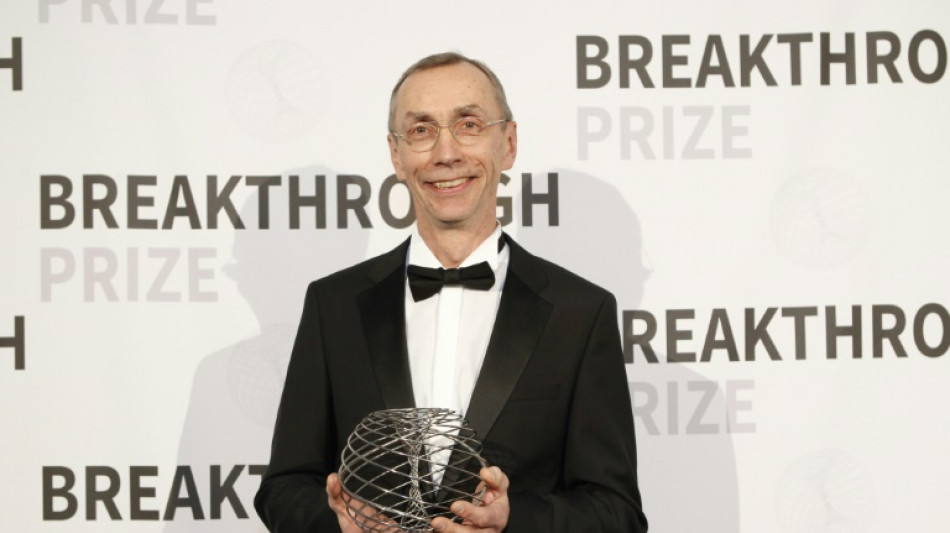
Svante Paabo, Swedish medicine Nobel-winner follows in father's footsteps / Photo: Kimberly White - GETTY IMAGES NORTH AMERICA/AFP/File

 US warns of rapid escalation in Mideast war
 Iran 'put hearts on the court' to win Asian Games basketball bronze
 School girl Yu helps China dominate in Asian Games swimming openers

 Myanmar win first Asian Games teqball gold as Spain great Puyol watches

 China's 13-year-old Yu scorches to first major gold at Asian Games

 Russians vote on last day of parliamentary elections

 Hong Kong pays final respects to former city leader Tung

 Typhoon put people off Asian Games opening ceremony, official says

 China's 13-year-old Yu cruises as Asian Games swimming begins

 AI 'warning shots' focus Beijing on national security risks

 Philippine tribe in limbo over US-led tech hub

 Leo XIV, first US pope transcends his restrained style

 Singer Ed Sheeran says Gaza situation 'unjustifiable' following controversy

 In 'Tenzing', a Sherpa mountaineer gets his due

 Ed Sheeran set to return to stage after Palestinian controversy

 Toulouse edge Vannes, Lyon beat Pau to take Top 14 summit

 Germans arrested for Louvre stunt in Mona Lisa hall

 Saudi-led coalition says Houthis fired ballistic missile at Riyadh

 France's debt climbs to highest since 1978: ministry

 McIlroy two shots off the lead at Wentworth after eagle on 18

 Martinez brace saves Inter in Serie A top-two clash with Roma

 Rosenior abused but guides Paris FC past old club Strasbourg

 Seven-try Lyon beat Pau, climb to Top 14 summit

 Brighton defeat a 'big lesson' against complacency for Arsenal, says Arteta

 Thousands protest inaction over climate crisis in Switzerland

Swedish paleogeneticist Svante Paabo, who won the Nobel Medicine Prize on Monday for using DNA to reveal the link between humans and Neanderthals, drew early inspiration from his Nobel laureate father.
However Paabo later learned that his father had been living a "double life", and his existence had been kept a secret from his father's other family.
Paabo, 67, was awarded the medicine Nobel for a long list of achievements including sequencing the Neanderthal genome for the first time and discovering the existence of a distant human relative called the Denisovans.
He was born in Stockholm in 1955 to Estonian chemist Karin Paabo and Sune Bergstrom, a biochemist who won the Nobel Medicine Prize in 1982. His father died in 2004.
In his 2014 memoir "Neanderthal Man: In Search of Lost Genomes", Paabo wrote that he gained inspiration to study medicine at Sweden's Uppsala University from his father, who had previously been a medical doctor.
Later he learned that his father "had two families, one of which did not know about the other," he wrote.
"I had grown up as the secret extra-marital son of Sune Bergstrom," Paabo wrote, adding that he had "only occasionally" seen his father as an adult.
Paabo also followed in his father's footsteps by studying biochemistry, earning a PhD at Uppsala University for using DNA research to study a protein of adenovirus, common viruses which cause cold-like symptoms.
But Paabo had long been fascinated with mummies and "could not quite shake off my romantic fascination with ancient Egypt," he wrote in his memoir.
- An impossible task -
The crossover of his medical research using DNA and preoccupation with mummies put him on the path that would become his life's work.
"Could it be possible to study ancient DNA sequences and thereby clarify how ancient Egyptians were related to one another and to people today?" he asked in his book.
"Such questions were breathtaking. Surely they must have already occurred to someone else."
Finding that they had not, Paabo sought his own answers.
It proved a difficult task, because there are only trace amounts of DNA left in ancients remains.
He first made international news in 1985, when he published research that found a DNA fragment in the mummy of a 2,400-year-old child.
Paabo then turned his focus toward Neanderthals when he was recruited by Germany's Munich University in 1995.
A year later, he managed to sequence some mitochondrial DNA from a 40,000-year-old piece of Neanderthal bone.
He then became the head of the genetics department at the Max Planck Institute for Evolutionary Anthropology in Leipzig, Germany.
He accomplished the "seemingly impossible task" of publishing the first Neanderthal genome sequence in 2010, according to a statement from the Nobel Assembly.
The research surprised by the scientific world by showing that Neanderthal genomes are still present in one to four percent of humans from European or Asian descent.
"We find traces of their DNA everywhere," Paabo told AFP in 2018.
- 'Normal human beings' -
Also in 2010, Paabo and his team revealed the existence of Denisovans, an extinct human relative, just by sequencing the DNA from a 40,000-year-old finger bone.
Only a year before these breakthroughs were published, Paabo developed potentially life-threatening blood clots in his lungs.
While researching his illness, "to my amazement I stumbled upon references to my father's work in 1943", Paabo wrote in his memoir.
His father had "elucidated the chemical structure of herapain," the drug "which had perhaps saved my life," he wrote.
In an interview published by the Nobels on Monday, he said that having a Nobel-winning parent may have also given him confidence by showing that "such people are normal human beings and it's not such an amazing thing".
"You don't put your parents on a pedestal," he added.
He now identifies as bisexual and has two children with primatologist Linda Vigilant, who also works at the Max Planck Institute.
L.Torres--PC