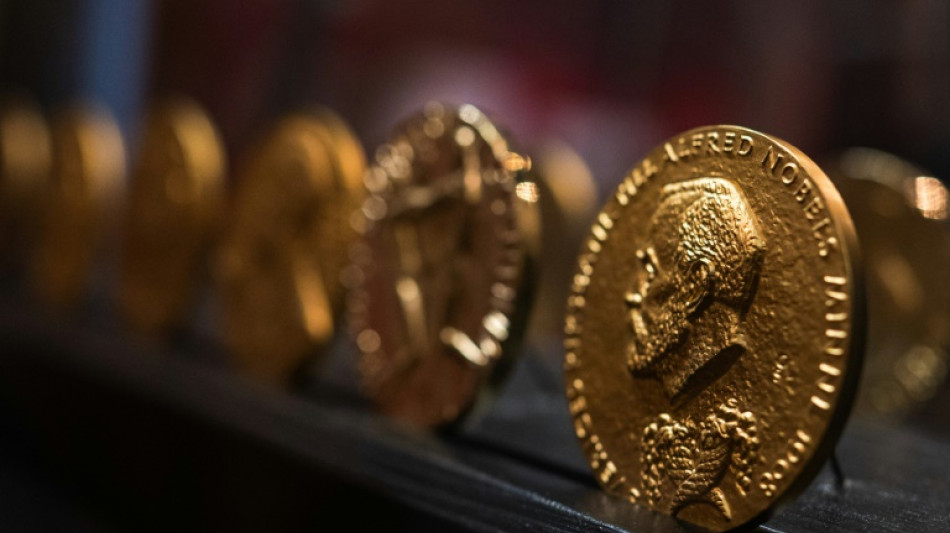
Bestseller or dark horse for 2022 Nobel Literature Prize? / Photo: Jonathan NACKSTRAND - AFP/File

 US warns of rapid escalation in Mideast war
 Iran 'put hearts on the court' to win Asian Games basketball bronze
 School girl Yu helps China dominate in Asian Games swimming openers

 Myanmar win first Asian Games teqball gold as Spain great Puyol watches

 China's 13-year-old Yu scorches to first major gold at Asian Games

 Russians vote on last day of parliamentary elections

 Hong Kong pays final respects to former city leader Tung

 Typhoon put people off Asian Games opening ceremony, official says

 China's 13-year-old Yu cruises as Asian Games swimming begins

 AI 'warning shots' focus Beijing on national security risks

 Philippine tribe in limbo over US-led tech hub

 Leo XIV, first US pope transcends his restrained style

 Singer Ed Sheeran says Gaza situation 'unjustifiable' following controversy

 In 'Tenzing', a Sherpa mountaineer gets his due

 Ed Sheeran set to return to stage after Palestinian controversy

 Toulouse edge Vannes, Lyon beat Pau to take Top 14 summit

 Germans arrested for Louvre stunt in Mona Lisa hall

 Saudi-led coalition says Houthis fired ballistic missile at Riyadh

 France's debt climbs to highest since 1978: ministry

 McIlroy two shots off the lead at Wentworth after eagle on 18

 Martinez brace saves Inter in Serie A top-two clash with Roma

 Rosenior abused but guides Paris FC past old club Strasbourg

 Seven-try Lyon beat Pau, climb to Top 14 summit

 Brighton defeat a 'big lesson' against complacency for Arsenal, says Arteta

 Thousands protest inaction over climate crisis in Switzerland

The Swedish Academy will on Thursday announce the 2022 winner of the often-criticised Nobel Literature Prize, with the award committee known for its penchant for spotlighting lesser-known writers over bestselling authors.
In the past two years, the 18-member Academy has bestowed the prestigious prize on US poet Louise Gluck and Tanzanian author Abdulrazak Gurnah, two writers whose work had not been widely translated and was not known to the broad public -- or even some publishers.
"After last year, I think it's maybe even a bit harder to guess" who could win this year, admitted Lina Kalmteg, literary critic for public broadcaster Swedish Radio, recalling the "total surprise" in the studio when Gurnah's name was read out last year.
"I think we can expect a more well-known name this year, after last year's surprise", said Bjorn Wiman, culture editor at Sweden's newspaper of reference Dagens Nyheter.
The Academy is slowly recovering from a devastating #MeToo scandal that led to the postponement of the 2018 prize, and its controversial decision a year later to honour Austrian author Peter Handke.
His pro-Serbian positions extended to backing Serbia's former president Slobodan Milosevic, who was on trial for genocide when he died in 2006.
Three years ago, the body promised new criteria would lead to a more global and gender-equal literature prize.
"The Academy is now very conscious of its reputation when it comes to diversity and gender representation, in a totally different way than they were before the 2017-2018 scandal", Wiman told AFP.
"A lot of new people have joined the Academy with new perspectives and other references", he said, noting that it was no longer just made up of "older white men".
Since the #MeToo scandal, the Academy has awarded the Nobel to two women -- Louise Gluck and Olga Tokarczuk of Poland -- and one man.
Does that bode well for another woman this year?
If so, Joyce Carol Oates of the United States, Annie Ernaux and Maryse Conde of France and Canada's Margaret Atwood could get the nod this year.
A prize to Russian author and outspoken Kremlin critic Lyudmila Ulitskaya, often cited as a potential candidate, would also send a strong message after Moscow's invasion of Ukraine.
- Bets are on Houellebecq -
A prize to Ulitskaya "would spark reactions", Wiman said, noting it would highlight her opposition to the Kremlin but also be considered controversial for promoting Russian culture at a time when Moscow is being lambasted for its war in Ukraine.
"This is the kind of complex intellectual debate you really want to see around the Nobel", Wiman said.
Unlike many other literary awards, there is no shortlist for the Nobel, and the nominations to the Academy and its deliberations are kept secret for 50 years.
Left to mere speculation, betting sites list the favourite as France's Michel Houellebecq, whose name has made the rounds in Nobel circles for many years.
In second spot is British author Salman Rushdie, who was the victim of an attempted murder attack in August.
It took the Academy 27 years to finally denounce, in 2016, the Iranian fatwa on "The Satanic Verses" author, a highly controversial silence it attributed to its neutrality and independence.
Other names often cited as possible winners are Kenya's Ngugi wa Thiong'o, Hungary's Laszlo Krasznahorkai and US authors Thomas Pynchon and Don DeLillo.
"The great American postmodern novels haven't been honoured yet," Jonas Thente, literary critic at Dagens Nyheter, noted.
Yet other favourites include Jon Fosse and Karl Ove Knausgaard of Norway, who could bring the prize back to Scandinavia more than a decade after it went to Swedish poet Tomas Transtromer.
Maria Hymna Ramnehill, critic at regional daily Goteborgs-Posten, meanwhile said she was hoping the prize would go to French-Moroccan writer Tahar Ben Jelloun or Croatia's Dubravka Ugresic.
"In different ways, both have a body of work that explores identity in relation to nationalism and to gender," she said.
"They talk about their identity in a complex manner that highlights the complicated and hard-to-grasp reality we live in and which can't be explained with simple solutions".
R.J.Fidalgo--PC