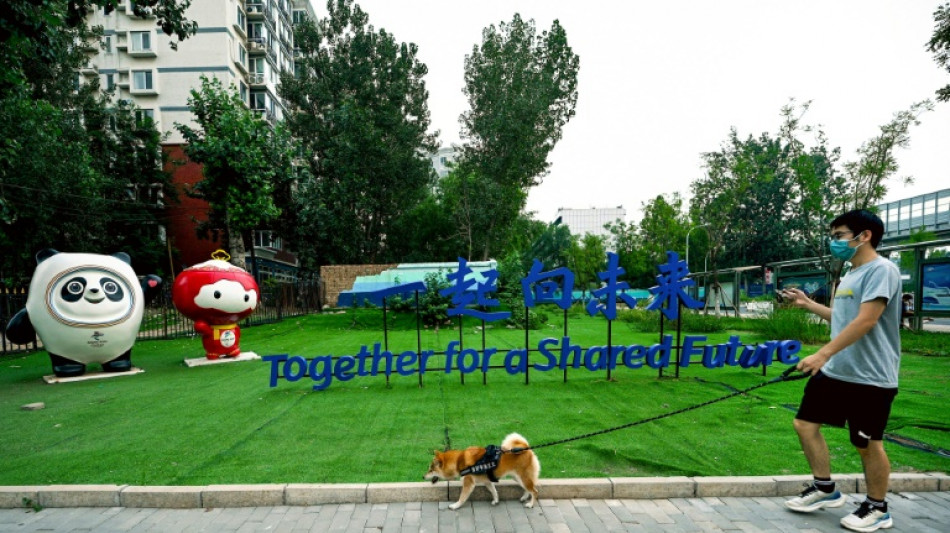
Xi's 'Chinese Dream' flickers in one Beijing neighbourhood / Photo: Noel CELIS - AFP/File

 US warns of rapid escalation in Mideast war

 Iran 'put hearts on the court' to win Asian Games basketball bronze
 School girl Yu helps China dominate in Asian Games swimming openers

 Myanmar win first Asian Games teqball gold as Spain great Puyol watches

 China's 13-year-old Yu scorches to first major gold at Asian Games

 Russians vote on last day of parliamentary elections

 Hong Kong pays final respects to former city leader Tung

 Typhoon put people off Asian Games opening ceremony, official says

 China's 13-year-old Yu cruises as Asian Games swimming begins

 AI 'warning shots' focus Beijing on national security risks

 Philippine tribe in limbo over US-led tech hub

 Leo XIV, first US pope transcends his restrained style

 Singer Ed Sheeran says Gaza situation 'unjustifiable' following controversy

 In 'Tenzing', a Sherpa mountaineer gets his due

 Ed Sheeran set to return to stage after Palestinian controversy

 Toulouse edge Vannes, Lyon beat Pau to take Top 14 summit

 Germans arrested for Louvre stunt in Mona Lisa hall

 Saudi-led coalition says Houthis fired ballistic missile at Riyadh

 France's debt climbs to highest since 1978: ministry

 McIlroy two shots off the lead at Wentworth after eagle on 18

 Martinez brace saves Inter in Serie A top-two clash with Roma

 Rosenior abused but guides Paris FC past old club Strasbourg

 Seven-try Lyon beat Pau, climb to Top 14 summit

 Brighton defeat a 'big lesson' against complacency for Arsenal, says Arteta

 Thousands protest inaction over climate crisis in Switzerland

Wu has staked out his patch of the Chinese Dream. Married with a second child on the way, he has a Beijing apartment and a car paid for by a tech job with a comfortable salary.
He has even jumped the fence of China's restrictive residency rules to move from eastern Shandong province to the capital, near the middle-class neighbourhood of Shangdi.
"Things are going pretty well," the fresh-faced thirty-something says with a smile.
His ascent through the hurly-burly of China's competitive capital has broadly tracked the leadership of President Xi Jinping.
It is 10 years since Xi unveiled the "Chinese Dream", a grand vision to restore the country's global influence through a collective struggle for prosperity, power and glory -- steered by the Communist Party.
Its achievements include pulling tens of millions from poverty into an economy fizzing on tech, manufacturing supply chains and the breathless energy of 1.4 billion people.
That has brought new freedoms and opportunities, alongside unexpected challenges for a party primed for control and self-preservation.
"Everyone has their own ideals, aspirations and dreams," Xi said in a speech on November 29, 2012 shortly after he was made party general secretary.
"In my opinion, realising the great rejuvenation of the Chinese nation is the greatest Chinese Dream."
But as Xi prepares for the party to anoint him for an unprecedented third term in office, some say that dream is losing definition.
Even in Shangdi, anxiety lurks behind the baubles of affluence.
Workers struggle with burnout and the soaring costs of housing and childcare, as well as the social pressures of marriage -- all in an economy weighed down by the Covid-19 pandemic.
Expectations for the future are changing, with potentially profound implications for China's direction.
"People are chasing different things from what they used to," says 29-year-old Anna Chen, who works for another tech firm in Shangdi.
- Tech tales -
Over the last decade, hulking office blocks have transformed Shangdi from an unremarkable suburb to a landmark on China's tech map.
The area is near the ruins of the Old Summer Palace -- destroyed by British soldiers in 1860 -- a reminder of China's "century of humiliation" at the hands of Western nations that still rankles in Beijing.
Many of Shangdi's new residents work for tech giants such as Baidu, Kuaishou and Didi Chuxing -- companies that dominate daily life in the world's most populous nation and now outsize many of their Western rivals.
With his wire-framed glasses, dark T-shirt and sweatpants, 31-year-old Sheldon Zhang wears the uniform of a generation of young tech professionals who have emerged as some of the best-educated and most cosmopolitan in China's history.
A fast-talking college dropout who co-founded a startup in his early 20s, Zhang is now a user experience architect at a major firm, tinkering with robotics and artificial intelligence in a mission he says is for the "future benefit of humanity".
Hubs such as Shangdi are drivers of AI, quantum computing, sensors and chips earmarked in the party's last five-year plan as essential for the next phase of China's development.
But industry insiders warn a "winter" has settled across the tech sector.
In a widespread crackdown, Beijing has been bringing to heel major firms over fears they have too great a hold over Chinese consumers.
Revenue growth is in decline at big-hitters such as Alibaba and Tencent, and job layoffs in the sector are rising.
China's economy grew just 0.4 percent in the second quarter of this year -- its worst performance since the start of the pandemic.
"Without an explosion of new technologies, we may start to slow down or regress," Zhang says.
- Reality bites -
Others are already feeling the squeeze.
Li Mengzhen, a 27-year-old strategy specialist at a short-video platform, says the tech scene's rank and file now self-effacingly label themselves "digital blue-collars".
"Our situation is quite similar to migrant workers in the 1990s," she says.
She has a decent salary but fears property ownership in Shangdi, where apartments easily sell for 100,000 yuan ($13,900) per square metre, will forever be beyond her.
"We left our hometowns to work in Beijing... but can't say that we're Beijingers," says Li.
"Our coders are like the people who worked on sewing machines or putting in screws... their jobs are easily replaceable."
It is an ennui spreading across much of her generation, with many seeking shared solace in a counterculture of "lying flat" -- abandoning the endless work cycle to meet the impossible goals of urban living.
China's zero-Covid strategy has chopped back at growth, making it even harder to get a job and then keep it.
Youth unemployment in urban areas has repeatedly hit record highs this year, peaking in July when nearly 20 percent of people aged 16-24 were jobless, according to the National Bureau of Statistics.
But new city cultures also provide ladders out.
At a cafe in southern Shangdi, a beaming Feng Jing says she has just quit her job at a video platform to become a yoga teacher.
"I'm someone who chases freedom," the 29-year-old says.
"I don't feel tied down by money or other preconceived ideas."
- Family values -
At the district's Love Park, giggling children chase each other while being watched over by stone statues inscribed with Communist shibboleths of China's past.
"Stabilise low birth levels, raise the quality of the newborn population," reads one monument to a family planning policy imposed in the late 1970s to slow population growth, which restricted many families to having one child.
The government is now encouraging couples to have up to three children to head off a demographic crisis poised to burden a declining, weary young workforce with the costs of paying for hundreds of millions of retirees.
It is perhaps the biggest challenge of all to the Chinese Dream, threatening to warp state spending to provide healthcare and pensions for about 400 million people over 60 years old by 2040.
If current trends continue, the population will likely peak by the end of the decade before entering a "sustained" decline, according to the state-linked Chinese Academy of Social Sciences.
Such a decline would inflict "extremely unfavourable social and economic consequences" on the country, the academy adds.
Moves to stir a baby boom, with tax breaks and childcare rebates, have so far fallen flat.
"One kid is expensive enough," said one father, declining to be identified.
Others question the need to marry or have children at all -- a radical position in a patriarchal society where the pressure to start a family is high.
Tech worker Anna Chen said she aims to earn just enough to travel the world and support her parents through their dotage.
"There are quite enough people in the world already," she told AFP, using a pseudonym to avoid blowback from her employer.
"And the way society is developing, you can live well without marriage or kids."
- Rejuvenated nation? -
In the shadow of a block of luxury apartments in Beijing, 70-year-old Wang Yufu dozes through the midday heat.
Wang moved to the city from eastern Jiangsu province around the same time Xi unfurled his Chinese Dream.
Spry and unassuming, he leads a team of migrant workers beautifying Shangdi's green spaces, earning around 6,500 yuan ($917) per month -- several times his wages when he first arrived.
China's rapid urbanisation in the last four decades has depended on migrant labour.
According to official data, there are currently 290 million people from the countryside working in urban areas, many staffing low-paid jobs.
But strict residency requirements and ballooning living costs prevent most from settling in the cities they have helped to construct.
The lunch break over, Wang cajoled his team back to work in a nearby park.
Things are better than they were a decade ago, he said, but big dreams are still for other people.
"People like us could never afford houses here."
G.Machado--PC