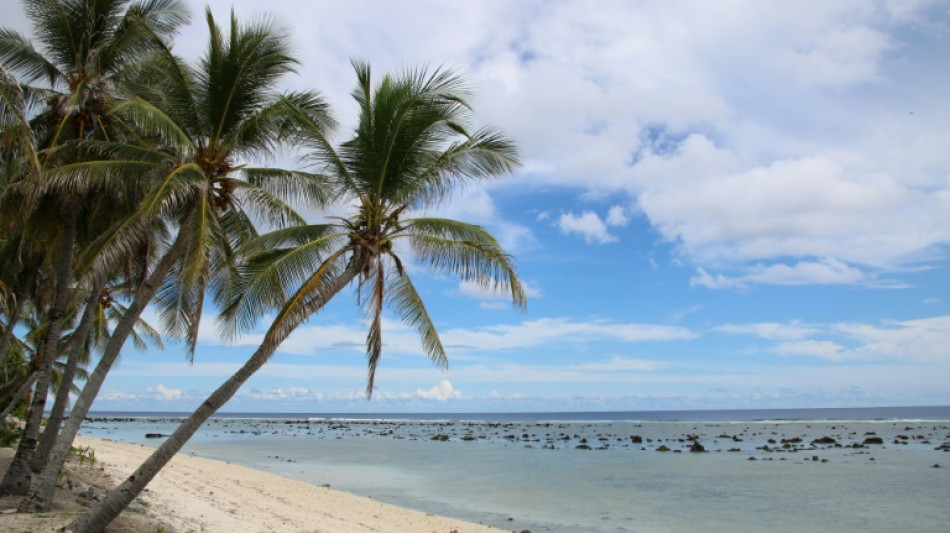
Concerns and impatience over mining the world's seabeds / Photo: Mike LEYRAL - AFP

 Trump's beef policies irk Texas ranchers, testing their loyalty

 Nvidia, OpenAI CEOs to attend Xi dinner at White House

 Anthropic picks Accenture for in-house AI safety evaluation

 Balogun returns as Monaco beat Lens to continue strong Ligue 1 start

 'Pause' on overt repression in Venezuela, but reforms still needed: HRW

 Global stocks mixed as yen falls despite Bank of Japan rate hike

 Cuba hit with seventh major blackout of the year

 Murray out with concussion so Wentz will start for Vikings

 UN chief 'deeply regrets' US visa refusal to Abbas for annual meeting

 England quick Carse to face no charges over alleged nightclub assault

 Mancini brings nine newcomers into the first squad of his Italy comeback

 Czechs level Davis Cup tie against USA as South Korea eye Finals

 New France boss Zidane confirms Mbappe as captain after naming first squad

 California governor signs order to explore AI 'kill switch'

 Head leads run spree as Australia win Zimbabwe ODI series

 In-form Raphinha wants to finish career at Barcelona

 Warren Buffett steps down as Berkshire Hathaway chairman

 Carrick confident Man Utd can 'work through' tough time

 Mbappe ends Nike partnership to join Swiss brand On

 Liverpool boss Iraola puts Bournemouth love affair on hold

 'A disaster' if Man City do not win says Maresca after flawless start

 Kerry James Marshall: American 'blackness' painter celebrated in Europe

 Spain coach De la Fuente offers 'full support' to people of Ceuta

 Russia seizes assets of Nestle, French firms over West's Ukraine support

 England can build on World Cup 'spirit', says Tuchel

The prospect of large-scale mining to extract valuable minerals from the depths of the Pacific Ocean, once a distant vision, has grown more real, raising alarms among the oceans' most fervent defenders.
"I think this is a real and imminent risk," Emma Wilson of the Deep Sea Conservation Coalition, an umbrella organization of environmental groups and scientific bodies, told AFP.
"There are plenty of stakeholders that are flagging the significant environmental risks."
And the long-awaited treaty to protect the high seas, even if it is adopted in negotiations resuming on Monday, is unlikely to alleviate risks anytime soon: it will not take effect immediately and will have to come to terms with the International Seabed Authority (ISA).
That agency, established under the UN Convention on the Law of the Sea, has 167 member states.
It has authority over the ocean floors outside of member states' Exclusive Economic Zones (which extend up to 200 nautical miles, or 370 kilometers, from coastlines).
But conservation groups say the ISA has two glaringly contradictory missions: protecting the sea floors under the high seas while organizing the activities of industries eager to mine untapped resources on the ocean floor.
For now, some 30 research centers and enterprises have been approved to explore -- but not exploit -- limited areas.
Mining activities are not supposed to begin before negotiators adopt a mining code, already under discussion for nearly a decade.
- Making waves -
But the small Pacific island nation of Nauru, impatient with the plodding pace of progress, made waves in June 2021 by invoking a clause allowing it to demand relevant rules be adopted within two years.
Once that deadline is reached, the government could request a mining contract for Nori (Nauru Ocean Resources), a subsidiary of Canada's The Metals Company.
Nauru has offered what it called a "good faith" promise to hold off until after an ISA assembly in July, in hopes it will adopt a mining code.
"The only thing we need is rules and regulations in place so that people are all responsible actors," Nauru's ambassador to the ISA Margo Deiye told AFP.
But it is "very unlikely" that a code will be agreed by July, said Pradeep Singh, a sea law expert at the Research Institute for Sustainability, in Potsdam, Germany.
"There's just too many items on the list that still need to be resolved," he told AFP. Those items, he said, include the highly contentious issue of how profits from undersea mining would be shared, and how environmental impacts should be measured.
NGOs thus fear that Nori could obtain a mining contract without the protections provided by a mining code.
Conservation groups complain that ISA procedures are "obscure" and its leadership is "pro-extraction."
The agency's secretary-general, Michael Lodge, insists that those accusations have "absolutely no substance whatsoever."
He noted that contracts are awarded by the ISA's Council, not its secretariat.
"This is the only industry...that has been fully regulated before it starts," he said, adding that the reason there is no undersea mining "anywhere in the world right now is because of the existence of the ISA."
- Target: 2024 -
Regardless, The Metals Company is making preparations.
"We'll be ready, and aim to be in production by the end of 2024," chief executive Gerard Barron told AFP.
He said the company plans to collect 1.3 million tons of material in its first year and up to 12 million tons by 2028, all "with the lightest set of impacts."
Barron said tons of polymetallic nodules (rich in minerals such as manganese, nickel, cobalt, copper and rare earths), which had settled to the ocean floor over the centuries, could easily be scraped up.
This would occur in the so-called Clipperton Fracture Zone, where Nori in late 2022 conducted "historic" tests at a depth of four kilometers (2.4 miles).
But Jessica Battle of the WWF conservation group said it is not that simple. Companies might, for example, suck up matter several yards (meters) down, not just from the seabed surface.
"It's a real problem to open up a new extractive frontier in a place where you know so little, with no regulations," she told AFP. "It will be a disaster."
Scientists and advocacy groups say mining could destroy habitats and species, some of them still unknown but possibly crucial to food chains; could disturb the ocean's capacity to absorb human-emitted carbon dioxide; and could generate noises that might disrupt whales' ability to communicate.
- Moratorium calls -
"The deep ocean is the least known part of the ocean," said deep-sea biologist Lisa Levin of the Scripps Institution of Oceanography. "So change might take place without anybody ever seeing it."
She has signed a petition calling for a moratorium on mining. Some companies and about a dozen countries support such a call, including France and Chile.
With its slogan, "A battery in a rock," The Metals Company emphasizes the world's need for metals used in electric-vehicle batteries; Nauru makes the same case.
But while island nations are among the first to feel the impact of global warming, Nauru says it can't wait forever for the funds rich countries have promised to help it adapt to those impacts.
"We're tired of waiting," said Deiye, the Nauru ambassador.
And Lodge says people should keep the anti-extraction arguments in perspective.
Of the 54 percent of seabeds under ISA jurisdiction, he said, "less than half a percent is under exploration... and of that half a percent, less than one percent is likely ever to be exploited."
V.Fontes--PC