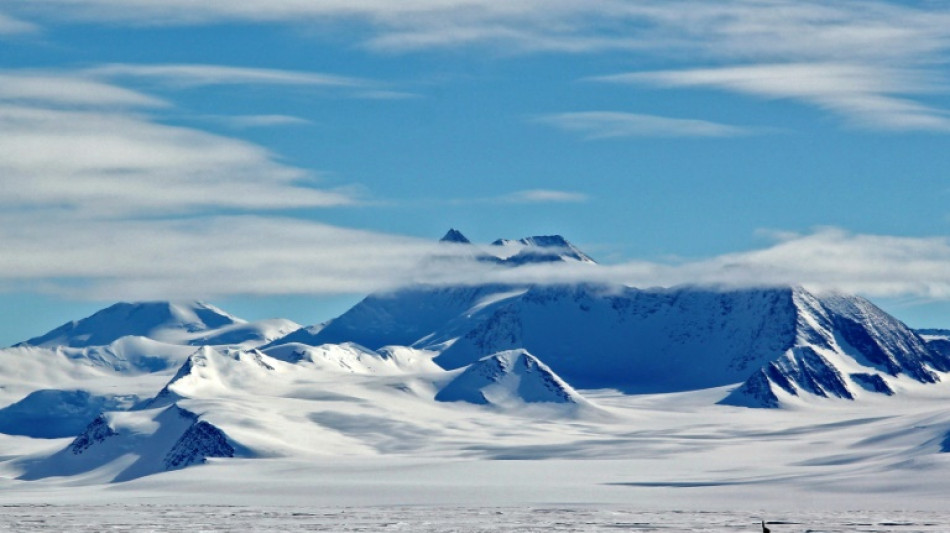
Sea ice in Antarctic at record low: US data center / Photo: Felipe TRUEBA - INACH/AFP

 Trump's beef policies irk Texas ranchers, testing their loyalty

 Nvidia, OpenAI CEOs to attend Xi dinner at White House

 Anthropic picks Accenture for in-house AI safety evaluation

 Balogun returns as Monaco beat Lens to continue strong Ligue 1 start

 'Pause' on overt repression in Venezuela, but reforms still needed: HRW

 Global stocks mixed as yen falls despite Bank of Japan rate hike

 Cuba hit with seventh major blackout of the year

 Murray out with concussion so Wentz will start for Vikings

 UN chief 'deeply regrets' US visa refusal to Abbas for annual meeting

 England quick Carse to face no charges over alleged nightclub assault

 Mancini brings nine newcomers into the first squad of his Italy comeback

 Czechs level Davis Cup tie against USA as South Korea eye Finals

 New France boss Zidane confirms Mbappe as captain after naming first squad

 California governor signs order to explore AI 'kill switch'

 Head leads run spree as Australia win Zimbabwe ODI series

 In-form Raphinha wants to finish career at Barcelona

 Warren Buffett steps down as Berkshire Hathaway chairman

 Carrick confident Man Utd can 'work through' tough time

 Mbappe ends Nike partnership to join Swiss brand On

 Liverpool boss Iraola puts Bournemouth love affair on hold

 'A disaster' if Man City do not win says Maresca after flawless start

 Kerry James Marshall: American 'blackness' painter celebrated in Europe

 Spain coach De la Fuente offers 'full support' to people of Ceuta

 Russia seizes assets of Nestle, French firms over West's Ukraine support

 England can build on World Cup 'spirit', says Tuchel

Antarctic sea ice likely shrunk to a record low last week, US researchers said Monday, its lowest extent in the 45 years of satellite record-keeping.
The National Snow and Ice Data Center (NSIDC) at the University of Colorado Boulder said that Antarctica's sea ice fell to 1.79 million square kilometers (691,000 million square miles) on February 21.
That exceeded the previous record low set in 2022 by 136,000 square kilometers (52,500 square miles).
NSIDC scientists stressed that the latest figure was preliminary since further late-season melt was still possible. They said they would issue a final number on the extent of ice in early March.
Melting sea ice exposes the thicker ice shelves buttressing Antarctica's ground ice sheet to waves and warmer temperatures.
Melting sea ice has no discernible impact on sea levels because the ice is already in ocean water.
But the sea ice rings Antarctica's massive ice shelves, the extensions of the freshwater glaciers that threaten catastrophic sea level rise over centuries if they continue melting as global temperatures rise.
"Antarctica's response to climate change has been different from the Arctic's," said Ted Scambos, a senior research scientist at the Cooperative Institute for Research in the Environmental Sciences (CIRES).
"The downward trend in sea ice may be a signal that global warming is finally affecting the floating ice around Antarctica, but it will take several more years to be confident of it," Scambos said.
The Antarctic cycle undergoes significant annual variations during its summers of thawing and winters of freezing, and the continent has not experienced the rapid melting of the past four decades that plague the ice sheets of Greenland and the Arctic due to global warming.
But the high melt rate since 2016 raises concerns that a significant downward trend may be taking hold.
Melting of the sea ice is problematic because it helps accelerate global warming.
When white sea ice -- which bounces up to 90 percent of the Sun's energy back into space -- is replaced by dark, unfrozen sea, the water absorbs a similar percentage of the Sun's heat instead.
Globally, last year was the fifth or sixth warmest on record despite the cooling influence of a natural La Nina weather pattern.
L.Torres--PC