Paper plates and short showers: life with no water in Arizona / Photo: Frederic J. BROWN - AFP

 Trump's beef policies irk Texas ranchers, testing their loyalty

 Nvidia, OpenAI CEOs to attend Xi dinner at White House

 Anthropic picks Accenture for in-house AI safety evaluation

 Balogun returns as Monaco beat Lens to continue strong Ligue 1 start

 'Pause' on overt repression in Venezuela, but reforms still needed: HRW

 Global stocks mixed as yen falls despite Bank of Japan rate hike

 Cuba hit with seventh major blackout of the year

 Murray out with concussion so Wentz will start for Vikings

 UN chief 'deeply regrets' US visa refusal to Abbas for annual meeting

 England quick Carse to face no charges over alleged nightclub assault

 Mancini brings nine newcomers into the first squad of his Italy comeback

 Czechs level Davis Cup tie against USA as South Korea eye Finals

 New France boss Zidane confirms Mbappe as captain after naming first squad

 California governor signs order to explore AI 'kill switch'

 Head leads run spree as Australia win Zimbabwe ODI series

 In-form Raphinha wants to finish career at Barcelona

 Warren Buffett steps down as Berkshire Hathaway chairman

 Carrick confident Man Utd can 'work through' tough time

 Mbappe ends Nike partnership to join Swiss brand On

 Liverpool boss Iraola puts Bournemouth love affair on hold

 'A disaster' if Man City do not win says Maresca after flawless start

 Kerry James Marshall: American 'blackness' painter celebrated in Europe

 Spain coach De la Fuente offers 'full support' to people of Ceuta

 Russia seizes assets of Nestle, French firms over West's Ukraine support

 England can build on World Cup 'spirit', says Tuchel

With its cactus-filled garden and breathtaking views of the rocky peaks of the Arizona desert, Wendy and Vance Walker's home in the Rio Verde Foothills seemed to be a little slice of paradise.
Until the water was cut off.
The neighboring city of Scottsdale decided it could no longer afford to sell its dwindling supply from the Colorado River, as a decades-long drought bites the American West.
For three months, the couple have eaten from disposable paper plates, had lightning-quick showers only every few days and collected rainwater to flush their toilets.
"A lot of people don't take the drought seriously," said Wendy, as she stood in the kitchen of their $600,000 home.
"And we, even though we live in the desert, we really didn't take it seriously either.
"Until you have to."
- Tankers -
Homes in fast-growing Rio Verde Foothills have never had running water -- there are no mains pipes -- so the 500 households without access to their own wells bought tankerloads from Scottsdale.
Most of that city's supply comes from the Colorado River, a mighty watercourse that rises in the Rocky Mountains and winds 1,450 miles (2,300 kilometers) through seven US states and Mexico, providing a lifeline for 40 million people.
But what was one of the world's great rivers has now shrunk.
Human-caused climate change means the once-bountiful snowpack that feeds the river has dwindled.
What snow there is melts more quickly because of higher temperatures, and more is lost to evaporation.
What does become river water is subject to a more than century-old agreement on who can take how much.
That agreement, made when it rained more and there were fewer inhabitants, was always a fiddle -- a political fix that allowed users to take more water than was added every year.
Now the federal government in Washington has told river users that the difference must be brought into balance: they must slash consumption by a quarter.
City managers in Scottsdale, faced with meeting their own targets, decided Rio Verde Foothills -- which they view as profligate development -- would no longer be able to buy their water.
On January 1, they closed the city's supply station to delivery drivers like John Hornewer, who says he now has to drive for hours to find enough water to fill his 6,000-gallon (22,000-liter) tanker.
He reluctantly doubled his prices to cover the extra cost of the gasoline and the overtime.
"We've become the first domino to fall and feel the effect of what a drought actually means," he told AFP.
"As water becomes more and more scarce, and it becomes more and more valuable, cities and communities are going to want to protect their own."
- Public or private ownership -
Arizona state officials stepped in last month to urge Scottsdale -- run by the Democratic Party -- to offer an accommodation to Rio Verde Foothills, an unincorporated settlement in Republican Party-run Maricopa County.
For a transitional period, Scottsdale would be allowed to buy additional water and -- for a cost -- reauthorize deliveries.
There was one catch: the county would have to cough up the cash.
Maricopa officials balked, and negotiations are stalled.
Ultimately, Rio Verde Foothills knows it will have to come up with a stable solution, and the town's residents are at loggerheads with each other over how to do that.
Scottsdale wants Rio Verde Foothills to establish a public body that will be able to plan for the long term, and will be subject to the same government rules as other water suppliers.
But well owners in Rio Verde Foothills say such a body would effectively be sucking their water out from underneath them and redistributing it to others. Why should others get what we have paid for, they ask.
- 'Drunk on growth' -
The uncertainty was too much for Lothar Rowe, a German immigrant who has 50 horses on a ranch in Rio Verde Foothills, where he has lived for two decades.
He splashed out $500,000 for a piece of land with its own well -- good for as long as the aquifers are.
"I can't believe it," says the 86-year-old.
"We're talking about the United States: they went to the Moon, they're trying to go to Mars, and they have no water here."
Fellow resident Rusty Childress said the problem stemmed from head-in-the-sand development.
"The issue from the very beginning was that we were all in denial," the 64-year-old told AFP.
"Nobody really thought this was going to happen."
Childress, a photographer, says developers exploit legal loopholes and continue to build in the area, despite not being able to guarantee the luxury homes they sell will have water.
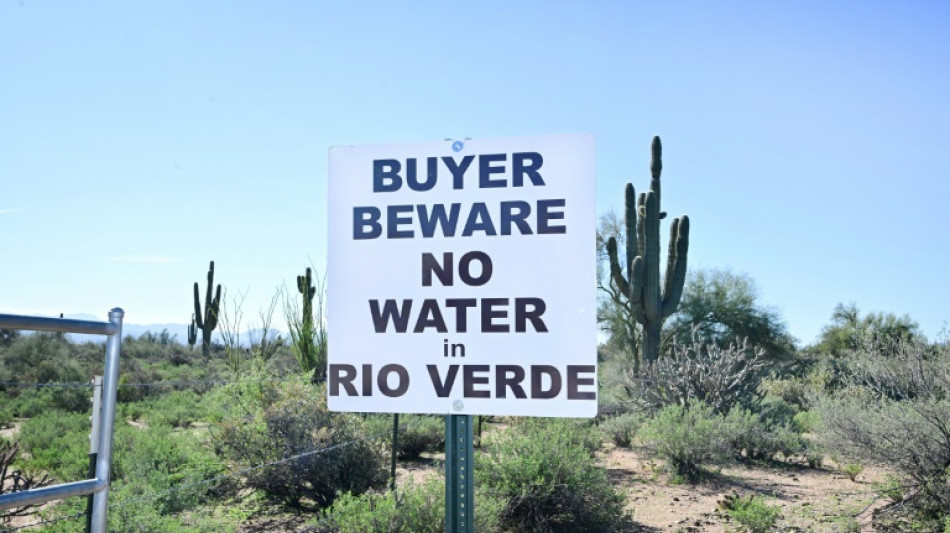
"Buyer beware! No water in Rio Verde," reads a sign he put up in front of his house warning people who come to tour the half-built housing estates nearby.
"We're getting drunk on growth here," he says.
"But we can't have out-of-control growth with a real water issue."
E.Borba--PC