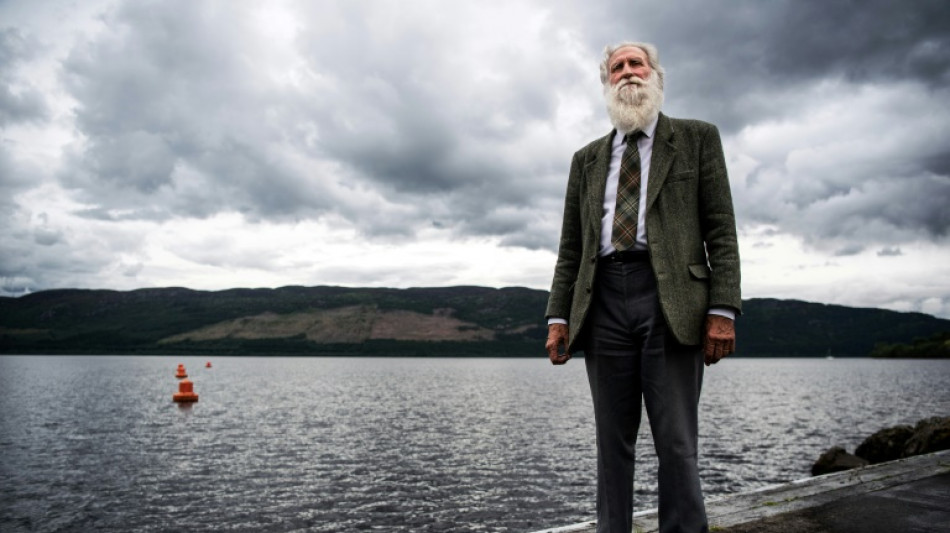
Loch Ness struggles with Scotland's shifting climate / Photo: Andy Buchanan - AFP

 Drone owners rush to offload devices ahead of Beijing ban

 Trump's beef policies irk Texas ranchers, testing their loyalty

 Nvidia, OpenAI CEOs to attend Xi dinner at White House

 Anthropic picks Accenture for in-house AI safety evaluation

 Balogun returns as Monaco beat Lens to continue strong Ligue 1 start

 'Pause' on overt repression in Venezuela, but reforms still needed: HRW

 Global stocks mixed as yen falls despite Bank of Japan rate hike

 Cuba hit with seventh major blackout of the year

 Murray out with concussion so Wentz will start for Vikings

 UN chief 'deeply regrets' US visa refusal to Abbas for annual meeting

 England quick Carse to face no charges over alleged nightclub assault

 Mancini brings nine newcomers into the first squad of his Italy comeback

 Czechs level Davis Cup tie against USA as South Korea eye Finals

 New France boss Zidane confirms Mbappe as captain after naming first squad

 California governor signs order to explore AI 'kill switch'

 Head leads run spree as Australia win Zimbabwe ODI series

 In-form Raphinha wants to finish career at Barcelona

 Warren Buffett steps down as Berkshire Hathaway chairman

 Carrick confident Man Utd can 'work through' tough time

 Mbappe ends Nike partnership to join Swiss brand On

 Liverpool boss Iraola puts Bournemouth love affair on hold

 'A disaster' if Man City do not win says Maresca after flawless start

 Kerry James Marshall: American 'blackness' painter celebrated in Europe

 Spain coach De la Fuente offers 'full support' to people of Ceuta

 Russia seizes assets of Nestle, French firms over West's Ukraine support

Around Scotland's Loch Ness, famous for hosting a mythical monster in its murky depths, another prolonged dry spell earlier this year has heightened fears of a different kind.
The drier than usual start to 2023, alongside other gradual climate shifts, is having implications for everything from native wildlife and species -- including Scotland's famous salmon population -- to farming and power production.
"Water is becoming a commodity that's becoming scarce in this part of the world," salmon fisherman Brian Shaw told AFP during a visit early last month, as Scotland reeled from its hottest June on record.
"Everybody's looking to use the water for their own needs."
Figures released in May by the Scottish Environment Protection Agency (Sepa) confirmed what seasoned observers could already see: Loch Ness's fresh waters -- Scotland's largest by volume -- had dropped to their lowest level in decades.
It had not been this shallow -- with a depth of around 109 cms (3.5 ft) at a hydroelectric dam halfway along its eastern shore -- since the early 1990s.
"It's held at this level for several months now," Gordon Mangus, 84, who grew up near the legendary lake and now serves as its harbour master, noted.
"We are used to rain, but we are not used to having quite such dry spells."
The situation is mirrored in other Highlands areas, including Loch Maree to the northeast and Black Isle to the west.
- More dry weather -
"Everybody thinks of Scotland as a wet country, but the droughts are becoming more frequent now, as a result of climate change," explained Nathan Critchlow, the head of water and planning at Sepa.
"We used to see drought very rarely, about once every 18 years. By 2050, we predict you will have very low water levels about every other year.
"So Scotland's climate is changing and we are starting to see the impacts of that change."
On the banks of the River Ness, which flows from the loch into the sea at Inverness, the UK's northernmost city, Shaw pointed to the waterway's visible stone bed as evidence of its diminishing levels.
The director of the Ness District Salmon Fishery Board said the river's depth had been falling steadily for years, but the trend had become more noticeable.
"A dry winter, a really dry spring, a very hot June and the river just got smaller and smaller," he told AFP.
The warmer, drier weather had hit its wild salmon population, Shaw said.
One of the small streams that feeds the river has already dried up, leaving dead fish behind, he added.
"You're starting to see this sort of event happening all the time and I think there's real concern about the future of salmon and a more challenging environment as we go ahead."
While much-needed rain in recent weeks has brought some respite to parts of Scotland, water levels remain depleted to "an alert point" in some areas, according to Sepa.
And Britain's Meteorological Office is forecasting another dry period later in the summer.
- Demand for water -
Demand for water in summer is also intensifying, with more competition for it among farmers, fishermen, domestic users including tourists and hydroelectric firms, according to locals.
SSE Renewables, which runs a hydroelectric scheme at Loch Ness, has faced claims from fishermen and others that it was causing the loch's levels to drop by storing water to generate electricity.
The operator has denied that, saying the months of dry weather had depleted it.
Environmental experts are warning residents and businesses must adapt to the changing weather patterns and to prepare for periods of water scarcity and floods as the average temperature rises.
According to the Climate Change Committee (CCC), an advisory body appointed by the UK Government, Scotland's 10 warmest years on record have all occurred since 1997.
The average temperature between 2010 and 2019 was around 0.7 degrees Celsius warmer than the average between 1961 and 1990.
Wetter weather in some places has arrived in tandem with the temperature rises, mainly in winter, with the annual average rainfall between 2010 and 2019 up nine percent on 1961-1990.
At Loch Ness, before retreating back to his cabin to monitor the boats, Mangus recalled childhood memories, from entering its waters to exploring its shoreline with his father and brother.
Although the octogenarian blames the hydroelectric dam as much as the changing climate for Loch Ness's shifting water levels, he conceded that what is happening there now is "rare".
V.F.Barreira--PC