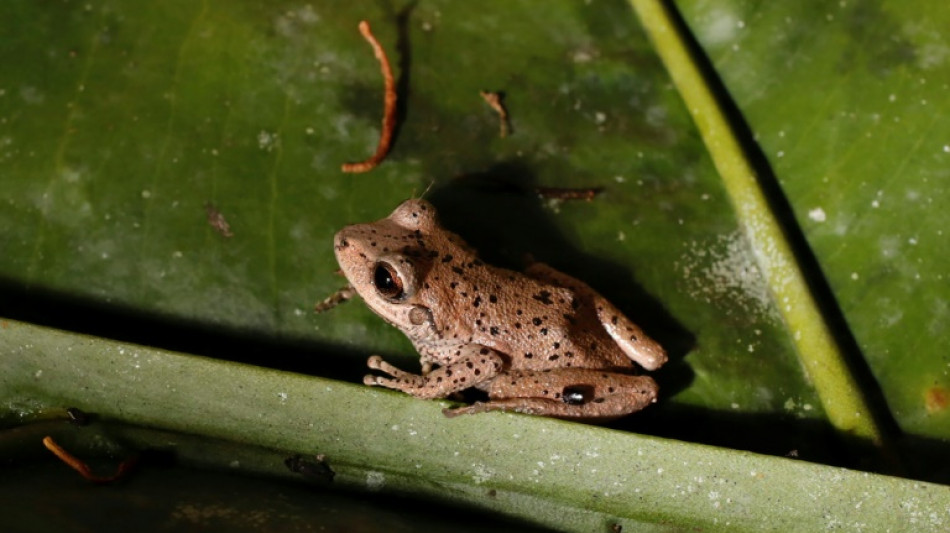
Climate change primary driver of amphibian decline: study / Photo: Galo PAGUAY - AFP

 Drone owners rush to offload devices ahead of Beijing ban

 Trump's beef policies irk Texas ranchers, testing their loyalty

 Nvidia, OpenAI CEOs to attend Xi dinner at White House

 Anthropic picks Accenture for in-house AI safety evaluation

 Balogun returns as Monaco beat Lens to continue strong Ligue 1 start

 'Pause' on overt repression in Venezuela, but reforms still needed: HRW

 Global stocks mixed as yen falls despite Bank of Japan rate hike

 Cuba hit with seventh major blackout of the year

 Murray out with concussion so Wentz will start for Vikings

 UN chief 'deeply regrets' US visa refusal to Abbas for annual meeting

 England quick Carse to face no charges over alleged nightclub assault

 Mancini brings nine newcomers into the first squad of his Italy comeback

 Czechs level Davis Cup tie against USA as South Korea eye Finals

 New France boss Zidane confirms Mbappe as captain after naming first squad

 California governor signs order to explore AI 'kill switch'

 Head leads run spree as Australia win Zimbabwe ODI series

 In-form Raphinha wants to finish career at Barcelona

 Warren Buffett steps down as Berkshire Hathaway chairman

 Carrick confident Man Utd can 'work through' tough time

 Mbappe ends Nike partnership to join Swiss brand On

 Liverpool boss Iraola puts Bournemouth love affair on hold

 'A disaster' if Man City do not win says Maresca after flawless start

 Kerry James Marshall: American 'blackness' painter celebrated in Europe

 Spain coach De la Fuente offers 'full support' to people of Ceuta

 Russia seizes assets of Nestle, French firms over West's Ukraine support

Climate change has become the main factor driving amphibians towards extinction as they remained the most threatened vertebrates over the past two decades, according to research published on Wednesday.
Frogs, toads, newts, salamanders and other cold-blooded creatures living in moist settings are acutely vulnerable to changes in their environment.
As they breathe through their skin and have no feathers, hair or scales for protection, extreme heat linked to climate change means they dehydrate quickly and lose breeding sites that need moisture.
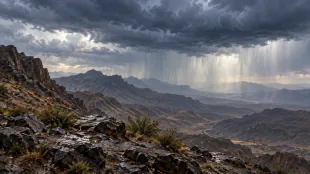
More frequent, intense and longer storms, floods and higher sea levels can destroy their forest habitats and breeding grounds.
"In many cases these changes are happening too quickly for them to adapt," said Kelsey Neam, of the Amphibian Specialist Group at the International Union for Conservation of Nature's (IUCN) Species Survival Commission.
"Climate change is an underestimated threat to amphibians" and will become "more evident" as more data emerges going forward, she added, predicting "an exponential effect".
"We expect climate change to push species closer to extinction," Neam told AFP.
A landmark 2004 study, the Global Amphibian Assessment, showed amphibians were the world's most threatened vertebrates.
In a paper published in the journal Nature on Wednesday, researchers built on a second such study published last year that evaluated 8,011 species for the IUCN Red List.
They found almost 41 percent of amphibians were globally threatened, defined as appearing under the list's "critically endangered", "endangered" and "vulnerable" categories.
That represented a deterioration from 37.9 percent in 1980 and 39.4 percent in 2004.
Climate change was the main driver of 39 percent of status declines from 2004 to 2022, affecting 119 species, with habitat loss and degradation at 37 percent.
Climate change can also exacerbate other threats such as fires, disease and land use change, the authors noted.
Habitat loss and damage linked to agriculture, infrastructure development and other industries remained the most common threat but did not primarily drive as many status deteriorations.
In contrast, habitat loss and disease -- especially the chytrid fungus, which devastated amphibians worldwide starting in the late 1990s -- were responsible for 91 percent of status deteriorations between 1980 and 2004, with just one percent primarily due to climate change.
- 'Investment in our planet' -
Threatened species were concentrated most in Caribbean islands, Mesoamerica, the tropical Andes, Cameroon, Nigeria, Madagascar, India's Western Ghats mountain range and Sri Lanka.
Salamanders and newts were the most affected species.
For example, five US salamander species have experienced status declines due to fires and less humid soils caused by droughts and wildfires that scientists say climate change has exacerbated.
In parts of Australia and Brazil, reduced rainfall linked to climate change is predicted to threaten the reproduction of frogs that depend on high levels of moisture in the soil and fallen leaves to prevent their eggs drying up.
The authors called for greater investment and policy responses to support amphibians, which play a key role in ecosystems and can help fight climate change.
They are prey for mammals, birds and reptiles, contribute to recycling nutrients and help sustain the food web, which would collapse without them, said Neam, who highlighted the urgency of protecting habitats and slashing carbon emissions.
"By protecting amphibians, we are protecting the forests and ecosystems that are key, nature-based solutions to battling climate change," she told AFP.
"An investment in amphibians is an investment in the future of our planet."
Amphibians' small distribution often makes them more vulnerable to extinction than other vertebrates, but that can also facilitate conservation efforts, said study co-author Jennifer Luedtke, of the IUCN's Amphibian Specialist Group.
Improved habitat protection and management played major roles in species who improved their category between 2004 and 2022, Neam added.
T.Resende--PC