In Peru, a small carbon footprint is not a choice / Photo: Ernesto BENAVIDES - AFP

 Ed Sheeran returns to stage after Palestinian controversy

 Asian Games to open in Japan after troubled build-up

 Drone owners rush to offload devices ahead of Beijing ban

 Trump's beef policies irk Texas ranchers, testing their loyalty

 Nvidia, OpenAI CEOs to attend Xi dinner at White House

 Anthropic picks Accenture for in-house AI safety evaluation

 Balogun returns as Monaco beat Lens to continue strong Ligue 1 start

 'Pause' on overt repression in Venezuela, but reforms still needed: HRW

 Global stocks mixed as yen falls despite Bank of Japan rate hike

 Cuba hit with seventh major blackout of the year

 Murray out with concussion so Wentz will start for Vikings

 UN chief 'deeply regrets' US visa refusal to Abbas for annual meeting

 England quick Carse to face no charges over alleged nightclub assault

 Mancini brings nine newcomers into the first squad of his Italy comeback

 Czechs level Davis Cup tie against USA as South Korea eye Finals

 New France boss Zidane confirms Mbappe as captain after naming first squad

 California governor signs order to explore AI 'kill switch'

 Head leads run spree as Australia win Zimbabwe ODI series

 In-form Raphinha wants to finish career at Barcelona

 Warren Buffett steps down as Berkshire Hathaway chairman

 Carrick confident Man Utd can 'work through' tough time

 Mbappe ends Nike partnership to join Swiss brand On

 Liverpool boss Iraola puts Bournemouth love affair on hold

 'A disaster' if Man City do not win says Maresca after flawless start

 Kerry James Marshall: American 'blackness' painter celebrated in Europe

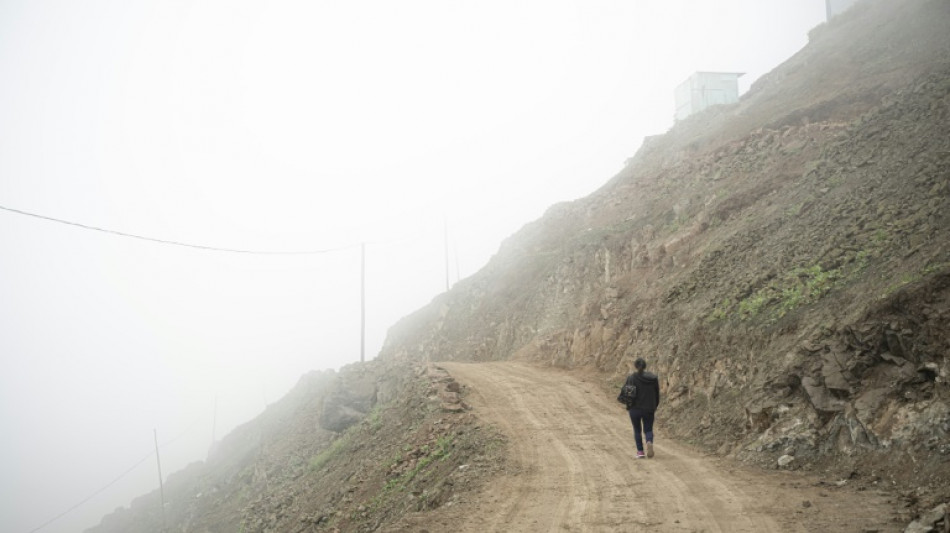
Sofia Llocclla Pellaca always descends on foot from the unlit hill where she lives with hardly any electricity on the outskirts of Lima. She rarely eats meat and cooks on a gas or wood stove.
She has never even heard of a carbon footprint.
While some climate-conscious people in rich countries try to restrict their carbon emissions, Pellaca's minimal impact on the environment is an unhappy side-effect of poverty.
Giving the poor a better life and spurring economic growth while also curbing planet-harming emissions is one of the major challenges facing world leaders meeting for COP28 climate talks next month in the United Arab Emirates.
"I walk down, I walk where I need to be, I walk back" up the hill, said Pellaca, 31, a single mother of two who barely uses public transport, owns no car or motorbike, and has never traveled by plane.
Pellaca is a domestic worker who earns less than half Peru's minimum wage of $265 per month.
She lives in a shantytown in the fog-covered desert highlands of the Peruvian capital that are home to many of Lima's 2.7 million poor people.
Peru's economy mainly leans on fishing and mining, with 73 percent of the working population in the informal sector.
It has one of the lowest carbon footprints in South America, emitting an average of 1.7 tons of carbon per person, compared to 4.2 tons in Argentina.
In the United States, the average annual footprint per person is 15 tons, more than three times the global average.
Experts say that to stay below the critical benchmark two-degree Celsius (3.6-degree Fahrenheit) rise in global temperature, individuals need to reduce their carbon footprint to less than two tons in the coming decades.
Eating less meat, taking fewer flights, driving less and using electricity more frugally are all billed as ways to reduce the emission of planet-warming greenhouse gases.
- 'Confusing and misleading' -
In Pellaca's prefabricated home, there is no bathroom or heating. She has a television and a half-empty fridge. She and her mother, who lives a few houses away, get infrequent electricity from a pirate connection.
There is no public lighting or sewage system, and drinking water arrives every 15 days in tanker trucks.
Some 27.5 percent of Peru's population of 30 million lives in poverty.
Eradicating poverty and boosting access to services without increasing CO2 emissions from burning fossil fuels is a major challenge facing developing countries.
In Peru, almost two-thirds of carbon emissions are a result of deforestation in the Amazon jungle and urbanization, said Manuel Pulgar-Vidal, former environment minister and president of the COP 20 in Lima in 2014.
He told AFP most of Peru's energy comes from hydro-electric sources.
It is "confusing and misleading" to assume that because it is a developing country, Peru can shirk its responsibilities in the face of the climate crisis, said the former minister.
Much of Latin America, he said, has failed to come up with "clear and well-planned strategies" to migrate towards renewable energy because it is "caught in the trap of oil, coal and gas."
Rich or poor, "the world will gradually leave fossil fuels behind. That is inevitable," said Pulgar-Vidal.
On the outskirts of Lima, residents need improved landfills, basic services and construction that is in harmony with "the surrounding ecosystem," he said, and transport shortages must be addressed with electric vehicles.
Pellaca, meanwhile, dreams of buying a motorbike on which to take her 14-year-old daughter to school.
"It would be good" to buy a solar panel for more regular electricity, but a small one costs $115.
"In the future I will buy one, little by little," she said.
Ferreira--PC