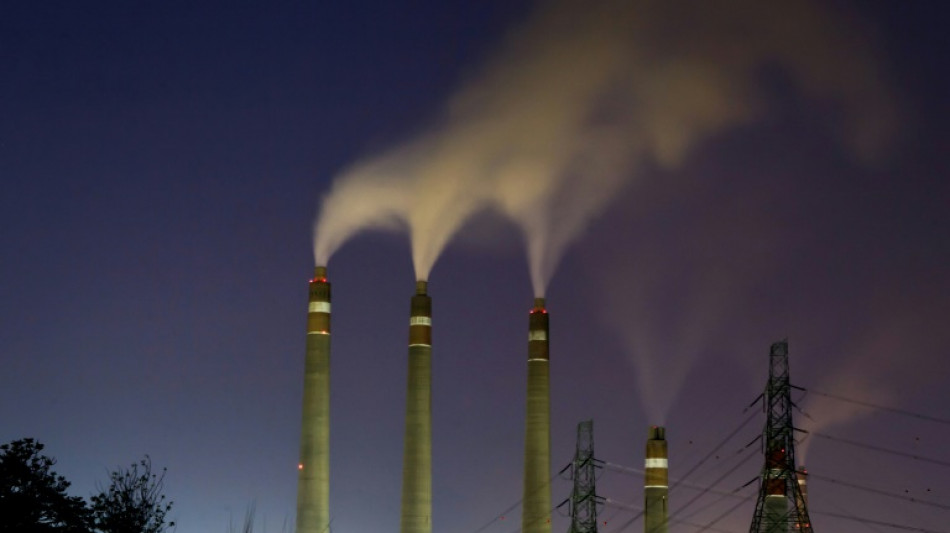
World's available CO2 'budget' for 1.5C smaller than thought: study / Photo: ADITYA AJI - AFP/File

 Ed Sheeran returns to stage after Palestinian controversy

 Asian Games to open in Japan after troubled build-up

 Drone owners rush to offload devices ahead of Beijing ban

 Trump's beef policies irk Texas ranchers, testing their loyalty

 Nvidia, OpenAI CEOs to attend Xi dinner at White House

 Anthropic picks Accenture for in-house AI safety evaluation

 Balogun returns as Monaco beat Lens to continue strong Ligue 1 start

 'Pause' on overt repression in Venezuela, but reforms still needed: HRW

 Global stocks mixed as yen falls despite Bank of Japan rate hike

 Cuba hit with seventh major blackout of the year

 Murray out with concussion so Wentz will start for Vikings

 UN chief 'deeply regrets' US visa refusal to Abbas for annual meeting

 England quick Carse to face no charges over alleged nightclub assault

 Mancini brings nine newcomers into the first squad of his Italy comeback

 Czechs level Davis Cup tie against USA as South Korea eye Finals

 New France boss Zidane confirms Mbappe as captain after naming first squad

 California governor signs order to explore AI 'kill switch'

 Head leads run spree as Australia win Zimbabwe ODI series

 In-form Raphinha wants to finish career at Barcelona

 Warren Buffett steps down as Berkshire Hathaway chairman

 Carrick confident Man Utd can 'work through' tough time

 Mbappe ends Nike partnership to join Swiss brand On

 Liverpool boss Iraola puts Bournemouth love affair on hold

 'A disaster' if Man City do not win says Maresca after flawless start

 Kerry James Marshall: American 'blackness' painter celebrated in Europe

The amount of CO2 the world can emit and still limit warming to 1.5C is much smaller than previously thought and could be used up in six years at current pollution levels, according to research published on Monday.
Scientists said the revised "carbon budget" meant that humanity was now more likely than not to blow past the Paris Agreement's safer temperature threshold of 1.5 degrees Celsius since the preindustrial era.
"The window to avoid 1.5 degrees of warming is shrinking, both because we continue to emit and because of our improved understanding of atmospheric physics," said lead author Robin Lamboll, of Imperial College London.
But with climate impacts magnifying as warming increases, the researchers stressed that the findings make every fraction of a degree worth fighting for.
"It's not that the fight against climate change will be lost after six years," Lamboll said, adding however that if there was not a "strong downward trajectory" by then, it would be too late for that 1.5 degree limit.
The most recent reports from the UN's IPCC climate expert panel said to keep 1.5C in play the world had a carbon budget of some 500 gigatons, from 2020, warning that emissions would need to be slashed in half by 2030.
This new assessment, which focuses on the main greenhouse gas CO2, calculated that the budget has now dwindled to 250 gigatons, measured from the beginning of 2023.
The study, published in the journal Nature Climate Change, was presented as an update to the IPCC figures, incorporating new expectations for the role of other pollutants, particularly the cooling impacts of aerosols -- emitted with planet-heating fossil fuels.
Meanwhile emissions remain stubbornly high, despite a slight dip at the beginning of the Covid-19 pandemic, and are around 40 gigatons a year.
The findings come a month ahead of crucial UN climate negotiations in the United Arab Emirates, tasked with salvaging the Paris deal goals after the latest round of reports from the IPCC made clear that the world was far off track.
Co-author Joeri Rogelj, also of Imperial College London, said that high-likelihood options for limiting warming to 1.5C -- 50 percent or better -- "are gone".
"That doesn't mean that we're spinning out of control to three or four degrees, but it does mean that the best estimates suggest that we will be above 1.5 of global warming," he said.
- Net-zero 2034? -
Earth's average temperature has already risen nearly 1.2C, causing a cascade of deadly and costly weather extremes.
While temperatures this year, boosted by the El Nino weather phenomenon, could average out at 1.5C, the Paris target is measured over a period of decades.
The IPCC has said 1.5C could be passed by the mid-2030s, with scientists warning this could trigger dangerous tipping points in Earth's fragile life support systems.
The Paris deal's main target was to limit warming to "well below" 2C, but with greenhouse gas emissions still at record highs the world is currently on a path to warm 2.4C or more by the end of the century.
Lamboll said the researchers also calculated for 2C as a "last resort" and found the budget for a 50 percent chance of limiting warming to this threshold was 1,220 gigatons.
To improve the odds to 90 percent, the budget falls to 500 gigatons, or around 12 years at current emissions.
The study should make "uncomfortable reading" for policymakers, said a commentary published in Nature Climate Change by Benjamin Sanderson at Norway's Centre for International Climate and Environmental Research, who was not involved in the research.
He said the new carbon budget would mean the world would need to reach "net zero" emissions by 2034, not in the middle of the century as is envisaged in climate policies across the world.
Rogelj said the IPCC had already acknowledged uncertainties in calculating the remaining carbon budget and had given a one in three chance it could be as low as the latest study suggests.
"A one in three chance is far from unexpected, it's like playing Russian roulette with two bullets. Few people will be surprised if someone gets shot with such odds," he said.
A.Motta--PC