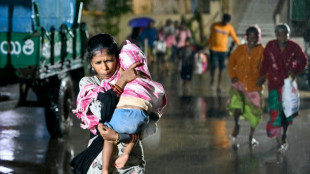
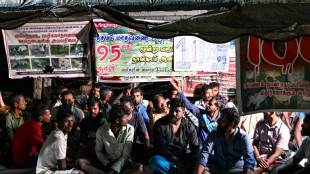
Japan orders evacuations as heavy rains trigger floods in quake-hit area / Photo: Handout - JIJI Press/AFP

 Manchester United rallies past Roma as PSG dominates in Champions League

 Qatar sees tentative opening for renewed regional diplomacy

 Qatar Tourism joins Pacific Asia Travel Association at London travel market

 Abdul El-Sayed Wins Michigan Senate Seat in Historic Election

 Qatar media bodies discuss support for humanitarian initiatives

 No. 22 UCLA defeats No. 5 Arizona 84-75 despite Kharchenkov's 38 points

 Vessel operator seeks witnesses after Vancouver grounding

 US Air Force deploys F-16 fighters to remote Aleutian base for readiness drill

 Bezos grant helps Seattle nonprofit move thousands of families toward housing

 Shrini Srivastava joins crew of Varanasi-Delhi Vande Bharat Sleeper service

 Nearly Half of Australian Workers Overqualified, Survey Finds

Japanese authorities told tens of thousands of people to evacuate the quake-hit region of Ishikawa on Saturday as "unprecedented" rains triggered floods and landslides.
A dozen rivers in the region, on the west coast of central Japan, had burst their banks by 11:00 am (0200 GMT), land ministry official Masaru Kojima said.
Three people were missing in Ishikawa, public broadcaster NHK reported, two of them carried away by strong river currents.
At least one person was missing further north in Wajima, and rescue workers were trying to confirm a report of another person missing, a local official told AFP.
Many buildings were inundated, with landslides blocking some roadways, the Ishikawa government said in a statement.
The cities of Wajima and Suzu, as well as Noto town, ordered about 44,700 residents to evacuate, officials said.
The Japan Meteorological Agency (JMA) said it issued its highest-level warning for Ishikawa, cautioning of a "life-threatening situation".
The areas under the warning were seeing "heavy rain of unprecedented levels", JMA forecaster Satoshi Sugimoto told reporters, adding "it is a situation in which you have to secure your safety immediately".
More than 120 millimetres (4.7 inches) of rainfall per hour was recorded in Wajima in the morning, the heaviest rain since comparative data became available in 1929.
Footage on NHK showed an entire street submerged in Wajima.
Prime Minister Fumio Kishida instructed the government "to do its best in disaster management with saving people's lives as the first priority", top government spokesman Yoshimasa Hayashi told reporters.
Self-Defense Forces personnel have been sent to the Ishikawa region to join rescue workers, he said.
At least one house was hit by a landslide, the Fire and Disaster Management Agency said, without giving further details.
Another 16,700 residents in Niigata and Yamagata prefectures north of Ishikawa were also told to evacuate, the agency said.
Some 6,600 households in the region were without electricity by Saturday afternoon and communication services were cut for some people, operators said.
Wajima and Suzu, in central Japan's Noto peninsula, were among the areas hardest hit by a huge New Year's Day earthquake that killed at least 236 people.
The region is still reeling from the magnitude-7.5 quake that toppled buildings, ripped up roads and sparked a major fire.
Parts of Japan have seen unprecedented rainfall in recent years, with floods and landslides sometimes causing casualties.
Scientists say human-driven climate change is intensifying the risk of heavy rain in the country and elsewhere because a warmer atmosphere holds more water.
M.Carneiro--PC