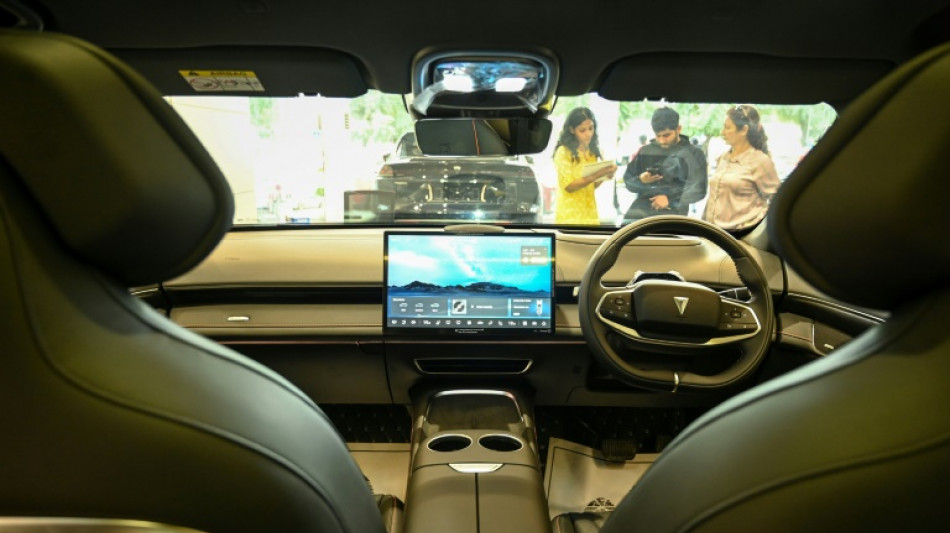
Nepal dam-building spree powers electric vehicle boom / Photo: Prakash MATHEMA - AFP

 Indians living in Japan on stand-by to house Asian Games athletes
 Trump signs bill authorizing sweeping Russia sanctions

 Protesters form human chain at Kennedy Center after Trump threat

 Death toll from attack at police HQ in Pakistan rises to 31

 Trump says Denmark to give US 'permanent control' over Greenland security

 Kennedy Center: future unclear for iconic Washington arts hub

 Trump claims 'infinite' Greenland security deal with Denmark

 Helicopters battle wildfire threatening Ecuador's capital

 Brentford batter Chelsea to undo Alonso's promising start

 Kane hits Bundesliga century as Bayern rout Union

 Trump says CNN, MS NOW, Politico banned from White House

 Hushing and hedging: US companies retreat on climate

 Springboks to face Fiji before 2027 Rugby World Cup

 Nigeria miners struggled to breathe in cell before 37 died: survivors

 McIlroy on the charge at PGA Championship as Reed withdraws

 McIlroy on the charge at PGA Championship

 Crisis-wracked Volkswagen warns of 10-bn-euro hit to profits

 Costa Rica's Grynspan tops third informal poll for UN chief: diplomat

 Stock markets retreat after central bank rate hikes

 Russia labels director of Cannes Grand Prix winner a 'foreign agent'

 Macron warns of Russian 'hybrid' threat after meeting presidential hopefuls

 UN holds third informal poll for new chief

 Kulusevski return can spark Spurs: De Zerbi

 Shakira to cap off world tour with Madrid 12-gig run

 Isolated Syrian-Druze city blames Damascus for shortages

Taxi driver Surendra Parajuli's decision to buy an electric cab would have been unthinkable a decade ago, when chronic power cuts left Nepalis unable to light their homes at night.
But a dam-building spree has led to dirt-cheap energy prices in a landlocked Himalayan republic otherwise entirely dependent on fossil fuel imports, meaning the switch has put more money in his pocket.
"It has meant huge savings for me," Parajuli, the proud new owner of a battery-powered and Chinese-made BYD Atto 3, told AFP in the capital Kathmandu.
"It gives 300 kilometres (186 miles) in a single charge and costs me a tenth of what petrol does. And it's environmentally friendly."
Kathmandu is ground zero of an incipient transport revolution set to see the clapped out cars that clog its traffic-snarled streets make way for emissions-free alternatives.
More than 40,000 electric vehicles are on the roads around the mountainous country, according to official estimates -- a small fraction of the 6.2 million motor vehicles currently in service.
But demand is insatiable: more than a quarter of those vehicles were imported in the 12 months to July, a near-threefold increase from the previous year.
Neighbouring China, now the dominant player in electric vehicles globally, is supplying nearly 70 percent of the market.
"EVs are genuinely suitable for Nepalis," Yajya Raj Bhatt, a prospective buyer at an electric vehicle motor show, told AFP.
"Before, we had to rely on petrol cars, but now we can drive independently."
- 'Great potential' -
More than four in five Nepalis did not have access to electricity at the turn of the century, according to the International Energy Agency.
But rapid investment in dams, which generate 99 percent of Nepal's baseload power, has transformed the energy grid since.
Hydropower output has increased fourfold in the past eight years, according to government figures, while 95 percent of the population now has access to electricity.
The country has already signed deals to export surplus power to coal-dependent India and has its sights set on future revenues by raising its current 3,200 megawatts of installed power generation capacity to 30,000 megawatts over the next decade.
Making electricity universal, and universally cheap, has the potential to jumpstart an economy that has historically depended on remittances from Nepalis working abroad.
Kulman Ghising of the Nepal Electricity Authority told AFP that the benefits have already been felt by setting the favourable conditions for widespread electric vehicle adoption.
Nepal is entirely dependent on imports from India to meet its fossil fuel needs, imposing additional costs on motorists, but Ghising said curbs on demand had saved the country around $224 million.
"The EVs have great potential for us," he added. "EVs in India and Bangladesh need to depend on coal, but in Nepal, it's fully green energy," he said.
Road transport accounts for just over five percent of greenhouse gas emissions and has fuelled a worsening air pollution crisis.
Kathmandu was this year listed as one of the world's most polluted cities for several days in April.
Experts say that getting more petrol-powered vehicles off the road will be a major step towards alleviating that problem.
Electric vehicles are subject to much lower import duties, and the government expects them to help Nepal reach its ambitious aim of becoming a net-zero greenhouse gas emitter by 2045.
Its plan aims to have electric vehicles account for 90 percent of all private vehicle purchases by the end of the decade.
- 'Immediate problems' -
But not everyone is convinced that the advent of Nepal's electric vehicle boom portends an environmentally friendly future.
Nepal's ambitious hydropower plans are contentious, with campaigners warning that the construction of new dams risk damaging sensitive ecological areas.
The government this year approved a new policy allowing the construction of dams that could impact previously protected areas, including forests, nature reserves and tiger habitats
Hydropower projects also face the risk of damage from floods and landslides common in the country, both of which are increasing in frequency and severity because of climate change.
Campaigners also say the government, in its rush to embrace electric vehicles, has neglected to make proper plans for managing the sizeable electronic waste burden.
EV lithium-ion batteries contain materials that are hazardous to humans and the environment, and their disposal is costly.
"The government does not seem far-sighted on this issue, it is just concerned with solving only immediate problems," Nabin Bikash Maharjan of recycling enterprise Blue Waste to Value told AFP.
"It is high time for the government to prioritise it. Otherwise it will create additional pollution."
Nogueira--PC