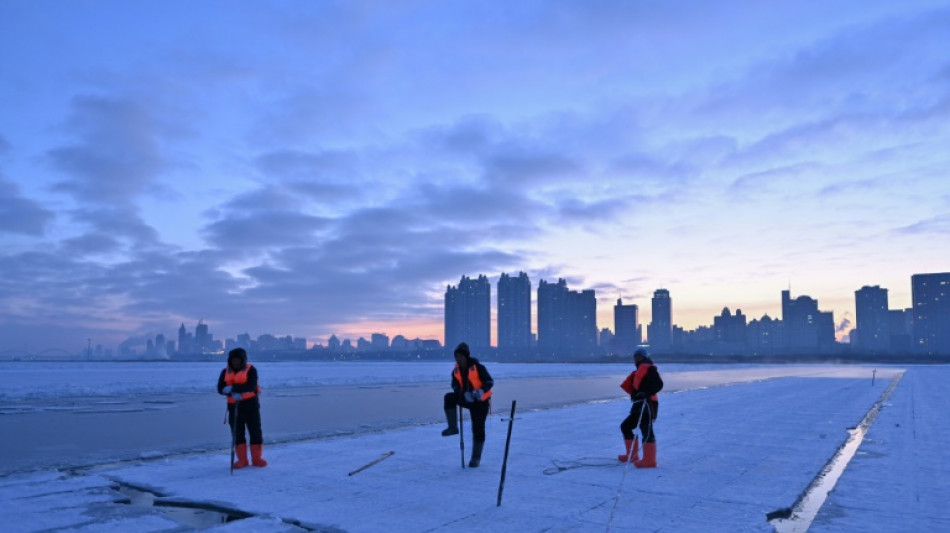
Warmer winter melts incomes of China's ice cutters / Photo: ADEK BERRY - AFP

 Ed Sheeran returns to stage after Palestinian controversy

 Asian Games to open in Japan after troubled build-up

 Drone owners rush to offload devices ahead of Beijing ban

 Trump's beef policies irk Texas ranchers, testing their loyalty

 Nvidia, OpenAI CEOs to attend Xi dinner at White House

 Anthropic picks Accenture for in-house AI safety evaluation

 Balogun returns as Monaco beat Lens to continue strong Ligue 1 start

 'Pause' on overt repression in Venezuela, but reforms still needed: HRW

 Global stocks mixed as yen falls despite Bank of Japan rate hike

 Cuba hit with seventh major blackout of the year

 Murray out with concussion so Wentz will start for Vikings

 UN chief 'deeply regrets' US visa refusal to Abbas for annual meeting

 England quick Carse to face no charges over alleged nightclub assault

 Mancini brings nine newcomers into the first squad of his Italy comeback

 Czechs level Davis Cup tie against USA as South Korea eye Finals

 New France boss Zidane confirms Mbappe as captain after naming first squad

 California governor signs order to explore AI 'kill switch'

 Head leads run spree as Australia win Zimbabwe ODI series

 In-form Raphinha wants to finish career at Barcelona

 Warren Buffett steps down as Berkshire Hathaway chairman

 Carrick confident Man Utd can 'work through' tough time

 Mbappe ends Nike partnership to join Swiss brand On

 Liverpool boss Iraola puts Bournemouth love affair on hold

 'A disaster' if Man City do not win says Maresca after flawless start

 Kerry James Marshall: American 'blackness' painter celebrated in Europe

Gruff men shout over an angry motor as they float huge blocks of ice towards a rusty conveyor belt on the bank of a frozen river in northeastern China.
Every winter, dozens of workers brave subzero temperatures to hack ice from the mighty Songhua River and deliver it around Harbin, the capital of Heilongjiang province.
It forms the building blocks for the massive sculptures that are the centrepiece of the city's Ice and Snow World, an annual festival that draws tens of thousands of visitors.
But this year, a warmer autumn has delayed the freeze and left the river ice thinner than normal.
"By now, the ice is (usually) 57 or 58 centimetres (23 inches) thick," said Huang Wu, 52, who has been harvesting it for two decades.
"This year, the ice has only reached about 44 or 45 centimetres," he told AFP earlier this month as he rested close to the shoreline in the pink light of dawn.
Like the rest of his eight-man crew, Huang is a fisherman who trades his net for a handheld ice pick once the river freezes over.
Clad in orange life vests and knee-high work boots, his team stood in a neat line on the snow-dusted surface, with one man chanting the count as they chiselled out slabs exactly 1.6 metres (five feet three inches) long.
The crew earns about two yuan ($0.27) per brick and can produce up to 2,700 in each gruelling 16-hour shift, Huang said, adding that they split their earnings equally.
Despite its high quality, Huang said the relative lack of ice has hit his income so far this winter.
"When the ice is thick, you make more money. When the ice is thin, you make less," he told AFP.
- Warmer than normal -
Once cut, the white, glossy blocks are hauled onto a motorised ramp that transports them to a line of forklifts.
From there, they are loaded onto trucks and lugged to the festival about a five-minute drive away.
Sculptures in recent years have included a towering palace, a tri-coloured snowflake and replicas of China's iconic Terracotta Army -- all illuminated in bright colours at night.
The attractions delight visiting tourists, but Huang said he has "seen enough" ice to last him a lifetime.
And while the frozen air chills outsiders to the bone, to hardy locals it still feels unseasonably warm.
Daytime temperatures in Harbin would usually hover around minus 20 degrees Celsius (minus four degrees Fahrenheit) by this point in the year, but lately it has got that cold only at night, Huang told AFP.
Climate change has brought extreme heat to large parts of the world this year, and Europe's climate monitor has said 2024 is "effectively certain" to be the hottest ever recorded.
China is the biggest emitter of the greenhouse gases that drive global warming, but has been building renewable energy infrastructure at a rapid pace and aims to become carbon neutral by 2060.
- 'When it's cold, we suffer' -
For others, however, warmer temperatures bring welcome relief from northeastern China's notoriously bitter winters.
"When the wind blows, no one can stand it," said first-time ice cutter Zhu Weizhong. "When it's cold, we suffer."
Zhu, a father of three who farms and works in city maintenance for most of the year, said the backbreaking labour beat sitting around at home.
There was "little work for the winter" in Harbin, he said, adding that he earned around 260 yuan for each eight-hour shift.
Compared to other jobs, chipping away at the frozen river was "tiring", Zhu, who is in his 50s, said.
But, he added, "you finish, and you look and think, 'Ah, I've done so much today'".
E.Borba--PC