As world heats up, UN cools itself the cool way: with water / Photo: ANGELA WEISS - AFP

 Ed Sheeran returns to stage after Palestinian controversy

 Asian Games to open in Japan after troubled build-up

 Drone owners rush to offload devices ahead of Beijing ban

 Trump's beef policies irk Texas ranchers, testing their loyalty

 Nvidia, OpenAI CEOs to attend Xi dinner at White House

 Anthropic picks Accenture for in-house AI safety evaluation

 Balogun returns as Monaco beat Lens to continue strong Ligue 1 start

 'Pause' on overt repression in Venezuela, but reforms still needed: HRW

 Global stocks mixed as yen falls despite Bank of Japan rate hike

 Cuba hit with seventh major blackout of the year

 Murray out with concussion so Wentz will start for Vikings

 UN chief 'deeply regrets' US visa refusal to Abbas for annual meeting

 England quick Carse to face no charges over alleged nightclub assault

 Mancini brings nine newcomers into the first squad of his Italy comeback

 Czechs level Davis Cup tie against USA as South Korea eye Finals

 New France boss Zidane confirms Mbappe as captain after naming first squad

 California governor signs order to explore AI 'kill switch'

 Head leads run spree as Australia win Zimbabwe ODI series

 In-form Raphinha wants to finish career at Barcelona

 Warren Buffett steps down as Berkshire Hathaway chairman

 Carrick confident Man Utd can 'work through' tough time

 Mbappe ends Nike partnership to join Swiss brand On

 Liverpool boss Iraola puts Bournemouth love affair on hold

 'A disaster' if Man City do not win says Maresca after flawless start

 Kerry James Marshall: American 'blackness' painter celebrated in Europe

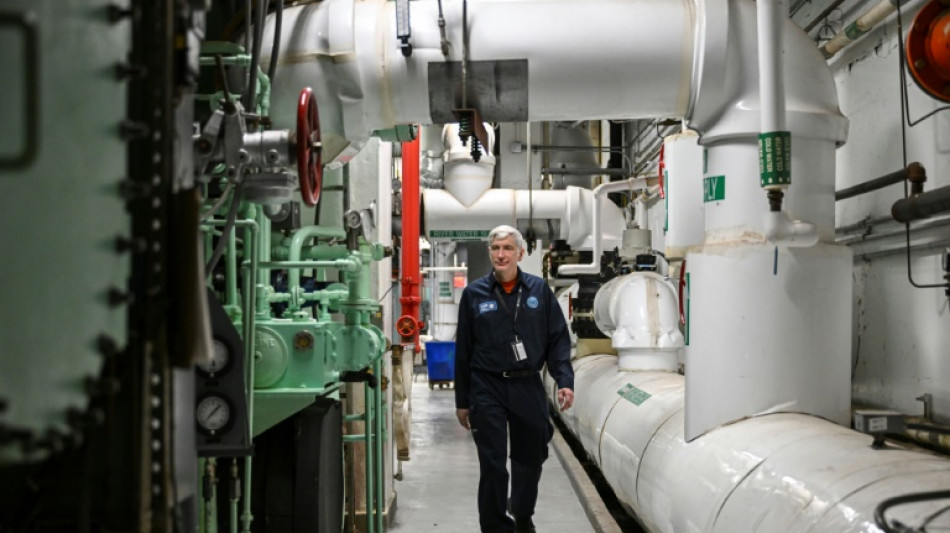
Deep in the bowels of the UN headquarters, a pump sucks in huge amounts of water from the East River to help cool the complex with an old but energy-efficient mechanism.
As more and more people want to stay cool in a planet that is steadily heating up, energy experts point to this kind of water-based system as a good alternative to air conditioning. But in many cases they are hard to set up.
The system has been part of the New York complex since it opened in the 1950s, chief building engineer Michael Martini told AFP during a tour of the cooling equipment.
The system, overhauled with the rest of the complex from 2008 to 2014, cools the UN center using less energy than a conventional air conditioning system. UN policy is to bring the air temperature down to about 24 degrees Celsius, or 75 degrees Fahrenheit.
In summer in New York, the river running beside the UN headquarters -- it is actually a salt water estuary -- stays much cooler than the surrounding air, which can reach 100 degrees. So cooling the building eats up less energy.
As many as 26,000 liters per minute (7,000 gallons) of water flow through fiber glass pipes to the complex's cooling plant, which uses it and a refrigerant gas to produce cold.
The system has two independent loops to prevent contamination of the water that flows back into the river at a higher temperature, said the head of the cooling system, David Lindsay.
Looking at the gleaming glass tower of the UN headquarters and the dome of the General Assembly, you would never know that the East River serves this purpose for the UN and is more than just part of the scenery.
The UN's New York headquarters is not its only building that depends on water.
In Geneva, its Palais de Nations features a cooling system that uses water from Lake Geneva. And the UN City complex in Copenhagen, which houses 10 UN agencies, depends on cold seawater that almost eliminates the need for electricity to cool the place.
This a huge benefit compared to the estimated two billion air conditioning units installed around a world.
- Why so rare? -
With the number of air conditioners due to increase so as to help people who are more and more exposed to dangerous temperatures, energy consumption for the purpose of cooling has already tripled since 1990, says the International Energy Agency, which wants more efficient systems.
Examples of these are centralized air conditioning networks using electricity, geothermal systems or ones that use water, like the UN complex in New York.
This latter system "has not been deployed as much as it should be for the issues we face today," said Lily Riahi, coordinator of Cool Coalition, a grouping of states, cities and companies under the aegis of the United Nations.
Some big organizations have been able to run such systems on their own, like the United Nations or Cornell University in New York State, which relies on water from Lake Cayuga.
But for the most part these systems require a lot of coordination among multiple stakeholders, said Riahi.
"We know it's technically possible, and we know actually there are many cases that prove the economics as well," said Rob Thornton, president of the International District Energy Association, which helps develop district cooling and heating networks.
"But it requires someone, some agent, whether it's a champion, a city, or a utility or someone, to actually undertake the aggregation of the market," he said.
"The challenge is just gathering and aggregating the customers to the point where there's enough, where the risk can be managed," Thornton said.
He cited Paris as an example, which uses the Seine River to run Europe's largest water-based cooling grid.
These networks allow for the reduced use toxic substances as coolants, and lower the risk of leaks.
And they avoid emissions of hot air -- like air conditioning units spew -- into cities already enduring heat waves.
But hot water from cooling units, when dumped back into rivers and other bodies of water, is dangerous for aquatic ecosystems, environmentalists say.
"This challenge is quite small, compared to the discharge from nuclear plants," said Riahi, adding the problem can be addressed by setting a temperate limit on this water.
F.Carias--PC