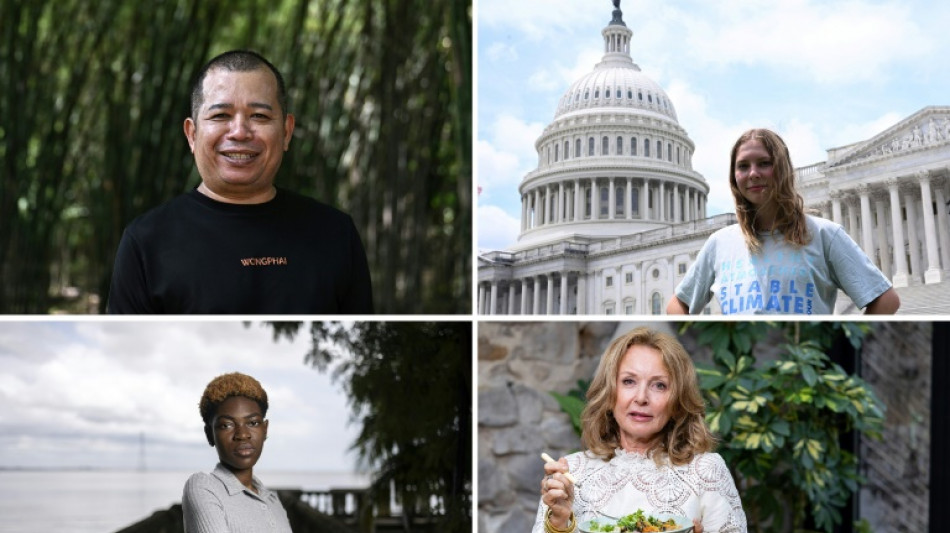
Personal tipping points: Four people share their climate journeys / Photo: Geoffroy VAN DER HASSELT, Olympia DE MAISMONT, Lillian SUWANRUMPHA, Alex WROBLEWSKI - AFP

 Drone owners rush to offload devices ahead of Beijing ban

 Trump's beef policies irk Texas ranchers, testing their loyalty

 Nvidia, OpenAI CEOs to attend Xi dinner at White House

 Anthropic picks Accenture for in-house AI safety evaluation

 Balogun returns as Monaco beat Lens to continue strong Ligue 1 start

 'Pause' on overt repression in Venezuela, but reforms still needed: HRW

 Global stocks mixed as yen falls despite Bank of Japan rate hike

 Cuba hit with seventh major blackout of the year

 Murray out with concussion so Wentz will start for Vikings

 UN chief 'deeply regrets' US visa refusal to Abbas for annual meeting

 England quick Carse to face no charges over alleged nightclub assault

 Mancini brings nine newcomers into the first squad of his Italy comeback

 Czechs level Davis Cup tie against USA as South Korea eye Finals

 New France boss Zidane confirms Mbappe as captain after naming first squad

 California governor signs order to explore AI 'kill switch'

 Head leads run spree as Australia win Zimbabwe ODI series

 In-form Raphinha wants to finish career at Barcelona

 Warren Buffett steps down as Berkshire Hathaway chairman

 Carrick confident Man Utd can 'work through' tough time

 Mbappe ends Nike partnership to join Swiss brand On

 Liverpool boss Iraola puts Bournemouth love affair on hold

 'A disaster' if Man City do not win says Maresca after flawless start

 Kerry James Marshall: American 'blackness' painter celebrated in Europe

 Spain coach De la Fuente offers 'full support' to people of Ceuta

 Russia seizes assets of Nestle, French firms over West's Ukraine support

From US President Donald Trump's all-out push for fossil fuels to political squabbles in Europe, governments are retreating on their climate promises. But most people around the world still see global warming as a serious threat.
Even as political momentum fades, many ordinary people are demanding tougher action -- and instead of waiting around, they're starting to do things themselves.
AFP spoke with four people from different continents to find out what pushed them to act.
Their personal reasons weren't always about climate change -- one cared about air pollution, another about animal cruelty -- but their efforts are helping to bring down planet-warming emissions all the same, showing how environmental causes overlap.
This story is part of The 89 Percent Project, an initiative of the global journalism collaboration Covering Climate Now. The name comes from recent research showing 80 to 89 percent of people support stronger climate action, challenging the notion that climate denialism is widespread.
- Breathing problems -
Saviour Iwezue traces her environmental awakening to when she was nine years old.
The acrid smoke wafting from burning waste in her neighbourhood in Nigeria's biggest city, Lagos, made it hard to breathe.
Not all air pollutants are greenhouse gases, but cutting air pollution helps fight climate change, too.
Now 21 and studying political science, Iwezue leads Team Illuminate, a collective she founded in 2021 to raise environmental awareness among young Nigerians.
With more than 200 volunteers, the group runs conferences and workshops for students and staff in dozens of schools across Lagos state, where it partners with the local government, as well as in Abuja and Benue states.
"For example, we talk about recycling, but also floods in Nigeria, their dangers, and the actions to be taken, sometimes with the support of NGOs," she said.
The daughter of two pastors, Iwezue says she grew up in a close-knit community where people looked out for each other.
At 15, she organised her first neighbourhood cleanup, and she hasn't stopped since. Her goal now is to expand Team Illuminate's network regionally, and eventually internationally, by partnering with other climate-focused organisations.
- A shocking documentary -
Anne Chassaignon says it was a series of images that opened her eyes.
In rapid succession, she watched a documentary exposing the link between intensive pig farming and green algae blooms in France's Brittany region, plus shocking footage released by the animal-rights group L214 showing the inside of slaughterhouses.
It was "an electric shock, a wake-up call about what changing our diets can mean for intensive animal farming and for deforestation", said the 63-year-old retiree, who lives in Ermenonville, an hour from Paris.
Again, there's no direct connection between animal welfare and climate change, but the two causes overlap. Chassaignon, who had already begun cutting back on meat, went vegan overnight. "It happened all at once -- and I never went back," she said.
Giving up meat, especially beef, is one of the most effective ways to shrink one's carbon footprint: livestock production accounts for about 12 percent of global emissions, according to the UN Food and Agriculture Organization.
"At that time, in 2016, there were already some vegans, but far fewer than today. It was also much harder to find certain products," Chassaignon recalled.
"The health and well-being aspect is important," she added, but it's also her way of doing her part to fight climate change.
"It helps with eco-anxiety" and "lets you respond to environmental problems that you can't otherwise control", she said.
She no longer cooks her mother's old recipes -- rabbit in mustard sauce, pork chops -- for her grandchildren. But now, she said, "I'm at peace with what I want to pass on."
- A 'thousand-year' flood -
Two floods left an indelible mark on 19-year-old Eva Lighthiser, and convinced the young American to make fighting climate change her life's work.
In 2018, floodwaters destroyed the bridge connecting her family's home to the nearby town of Livingston, Montana, a loss that ultimately forced them to move.
Then in 2022, the Yellowstone River burst its banks catastrophically in what was dubbed a "thousand-year event". She remembers spending hours that day filling sandbags for neighbours to take home and protect their properties.
Raised against the backdrop of Montana's snow-capped mountain ranges, river valleys and vast forests, Lighthiser has felt nature's pull for as long as she can remember, but knew from an early age that something wasn't right, she said.
"I began to see more and more wildfires, smoke permeating the air every summer becoming a season of its own, an increase in flooding events and extreme weather and mild winters where snow was becoming sporadic."
Lighthiser joined a youth-led lawsuit organized by the nonprofit Our Children's Trust, which in 2023 sued Montana and won a landmark climate ruling.
She was also the lead plaintiff in a federal case alleging that President Donald Trump's climate actions violated their rights. The case was dismissed, but her lawyers are appealing.
Now in college and planning to major in environmental studies, she said the climate crisis "depresses me, it makes me really anxious, and above all, it makes me incredibly uncertain".
But rather than ruminating on the global picture, "It makes me hopeful when I see individual action happening on smaller local levels, people using their voices and speaking up or taking action."
- Embracing country living -
Khomchalat Thongting says his tipping point came during the Covid pandemic.
After decades in tech, he decided to spend time on his family land in Thailand's countryside.
It wasn't until he started chatting with local farmers that he began thinking about climate change for the first time.
"I had no idea about climate things," the 50-year-old told AFP. "I watched the news, but I felt that the problem was far away from me."
He heard bamboo farmers say they could no longer rely on seasonal rhythms that once guided their crops, and started to read up.
During his research, he came across biochar, a way to turn organic waste into a soil-enriching product similar to charcoal that locks away carbon, and saw an opportunity to address "root causes".
Khomchalat founded biochar company Wongphai and now works across Thailand, helping farmers convert crop residues into "something that restores the soil, helps plants to grow more, reduces water usage and keeps the carbon".
It also prevents seasonal burning that causes annual air pollution.
"This work helps me address climate anxiety," he said.
"For me, quality of life is not just money in our pocket, it's about the food we eat, the water we drink and the air we breathe.
"We are building a system that regenerates the environment. That gives me hope."
jum-ks-jul-ia-sah/ico-ia/jhb
H.Silva--PC