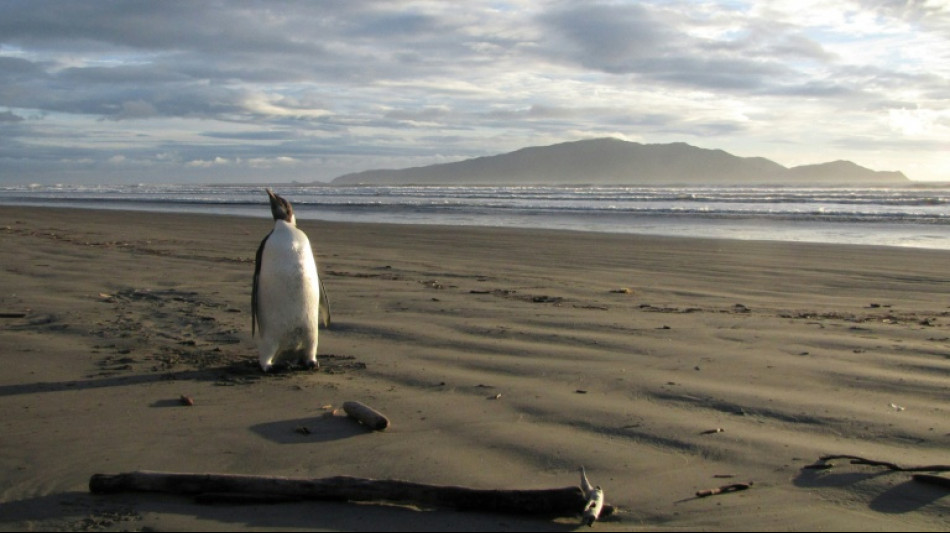
Ice melt threatens emperor penguins during annual moult: researchers / Photo: Richard Gill - DEPARTMENT OF CONSERVATION/AFP

 Trump's beef policies irk Texas ranchers, testing their loyalty

 Nvidia, OpenAI CEOs to attend Xi dinner at White House

 Anthropic picks Accenture for in-house AI safety evaluation

 Balogun returns as Monaco beat Lens to continue strong Ligue 1 start

 'Pause' on overt repression in Venezuela, but reforms still needed: HRW

 Global stocks mixed as yen falls despite Bank of Japan rate hike

 Cuba hit with seventh major blackout of the year

 Murray out with concussion so Wentz will start for Vikings

 UN chief 'deeply regrets' US visa refusal to Abbas for annual meeting

 England quick Carse to face no charges over alleged nightclub assault

 Mancini brings nine newcomers into the first squad of his Italy comeback

 Czechs level Davis Cup tie against USA as South Korea eye Finals

 New France boss Zidane confirms Mbappe as captain after naming first squad

 California governor signs order to explore AI 'kill switch'

 Head leads run spree as Australia win Zimbabwe ODI series

 In-form Raphinha wants to finish career at Barcelona

 Warren Buffett steps down as Berkshire Hathaway chairman

 Carrick confident Man Utd can 'work through' tough time

 Mbappe ends Nike partnership to join Swiss brand On

 Liverpool boss Iraola puts Bournemouth love affair on hold

 'A disaster' if Man City do not win says Maresca after flawless start

 Kerry James Marshall: American 'blackness' painter celebrated in Europe

 Spain coach De la Fuente offers 'full support' to people of Ceuta

 Russia seizes assets of Nestle, French firms over West's Ukraine support

 England can build on World Cup 'spirit', says Tuchel

Emperor penguins shed all their feathers once a year, a precarious ritual that may have become deadly as climate change pushes them into shrinking patches of Antarctic sea ice, researchers said Wednesday.
The flightless birds moult during summer, relying on stored fat to survive for several weeks until their waterproof coat grows back so they can swim and hunt in icy waters again.
Researchers from the British Antarctic Survey, analysing seven years of satellite images, accidentally discovered several moulting colonies along the extremely remote coastline of an area known as Marie Byrd Land.
As sea ice melted, the penguins were forced onto smaller spaces in increasingly large and tightly packed groups, the UK polar research organisation said in a statement.
In 2025, only 25 small groups of penguins were visible in the satellite images, it said. Prior to 2022, more than 100 groups had been spotted in the same region.
"While we don't know for sure what happened to those penguins, we know they can find new suitable breeding sites after ice loss, so it's possible they have established new moulting sites elsewhere," said Peter Fretwell, lead author and mapping expert at the British Antarctic Survey.
"But also it's possible that huge numbers of penguins perished after entering the Southern Ocean before they had replaced their waterproof feathers," Fretwell said.
"If this has happened, the situation for emperors as a species is even worse than we thought."
The researchers said that if emperor penguins are forced into the ocean before their feathers are replaced, they face exhaustion from increased energy use, hypothermia and increased risk from predators.
- Ice at record low -
Emperor penguin populations have shrunk by almost a quarter as global warming transforms their icy habitat, the British Antarctic Survey said in research published last year.
During the January-March Antarctic summer, emperor penguins from the Ross Sea in West Antarctica migrate as much as 1,000 kilometres (620 miles) to Marie Byrd Land to moult on stable sea ice, the researchers said Wednesday.
It is one of the few areas that historically retains its fast ice -- sea ice attached to the coast -- throughout the year.
The moulting process takes about four to five weeks and the penguins cannot go in the freezing water during that time.
The extent of Antarctic Sea ice fell to record lows between 2022 and 2024, accompanied by a drastic decrease in fast ice, the British Antarctic Survey said.
In the region they observed, sea ice coverage fell from a 50-year average of 500,000 square kilometres -- roughly the size of Spain -- to 100,000 square kilometres in 2023. Only 2,000 square kilometres of fast ice were left near the coast.
During those years, the sea ice broke before the penguins had finished moulting, raising fears that many may not have survived, the scientists said.
The survey's previous study found that some emperor penguin colonies lost all their chicks in recent years as the ice broke, plunging hatchlings into the sea before they were old enough to cope with the freezing ocean.
At current rates of warming, there is a 45 percent chance the species will become extinct by the turn of the century, the survey said.
L.Carrico--PC