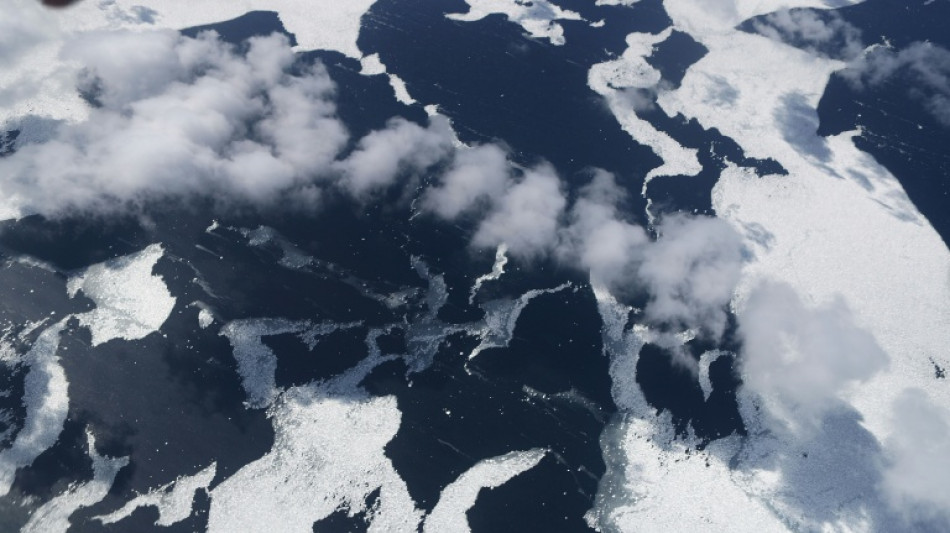
Storms, warm seas drove sudden drop in Antarctic ice: study / Photo: MARIO TAMA - GETTY IMAGES NORTH AMERICA/AFP

 Trump's beef policies irk Texas ranchers, testing their loyalty

 Nvidia, OpenAI CEOs to attend Xi dinner at White House

 Anthropic picks Accenture for in-house AI safety evaluation

 Balogun returns as Monaco beat Lens to continue strong Ligue 1 start

 'Pause' on overt repression in Venezuela, but reforms still needed: HRW

 Global stocks mixed as yen falls despite Bank of Japan rate hike

 Cuba hit with seventh major blackout of the year

 Murray out with concussion so Wentz will start for Vikings

 UN chief 'deeply regrets' US visa refusal to Abbas for annual meeting

 England quick Carse to face no charges over alleged nightclub assault

 Mancini brings nine newcomers into the first squad of his Italy comeback

 Czechs level Davis Cup tie against USA as South Korea eye Finals

 New France boss Zidane confirms Mbappe as captain after naming first squad

 California governor signs order to explore AI 'kill switch'

 Head leads run spree as Australia win Zimbabwe ODI series

 In-form Raphinha wants to finish career at Barcelona

 Warren Buffett steps down as Berkshire Hathaway chairman

 Carrick confident Man Utd can 'work through' tough time

 Mbappe ends Nike partnership to join Swiss brand On

 Liverpool boss Iraola puts Bournemouth love affair on hold

 'A disaster' if Man City do not win says Maresca after flawless start

 Kerry James Marshall: American 'blackness' painter celebrated in Europe

 Spain coach De la Fuente offers 'full support' to people of Ceuta

 Russia seizes assets of Nestle, French firms over West's Ukraine support

 England can build on World Cup 'spirit', says Tuchel

Unusually strong winds and warm ocean water likely drove a rapid plunge in Antarctic sea ice in recent years, scientists said on Wednesday, shedding new light on a puzzling event.
While the Arctic sea ice area has been steadily declining, the story has been very different in Antarctica, where coverage hit a record high in 2015 before flipping to a record low only two years later.
Climate models struggled to explain this "unexpected and abrupt decline" of the magnitude witnessed in recent decades, wrote a global team of scientists in new research exploring this anomaly.
Understanding why matters because Antarctic sea ice is critical not just to ocean currents and local ecosystems but the climate, as its reflective surface bounces solar energy back into the atmosphere.
In the journal Nature Climate Change, scientists led by Theo Spira from the University of Gothenburg in Sweden said the rapid loss of sea ice was caused by forces working together rather than any single factor.
In particular, they pointed to a gradual weakening of a layer of cold water beneath the surface that normally protects the sea ice from the warmer depths below.
"During the winter of 2015, storms in the Southern Ocean were unusually strong, reducing the cold-water protective layer effect and resulting in the sustained sea ice loss around Antarctica," Spira said in a statement.
Normally, water of vastly different temperatures and salinity -- such as deep ocean water and sea ice melt -- do not mix well and settle in layers in a process known as stratification.
This natural protection helped sea ice grow to record highs until 2015, when strong winds and powerful storms churned the Southern Ocean.
"The storms in 2015 stirred up the sea and warmer water mixed with the cold-water layer, the protection disappeared and the ice melted at record speed," said Spira, the first author of the study.
He said it was crucial scientists understand these complex factors to better predict how Antarctic sea ice may influence the climate and global weather patterns in future.
J.Oliveira--PC