Nigeria sweats in heatwave as Iran war drives up costs to stay cool / Photo: Benson Ibeabuchi - AFP/File

 Trump's beef policies irk Texas ranchers, testing their loyalty

 Nvidia, OpenAI CEOs to attend Xi dinner at White House

 Anthropic picks Accenture for in-house AI safety evaluation

 Balogun returns as Monaco beat Lens to continue strong Ligue 1 start

 'Pause' on overt repression in Venezuela, but reforms still needed: HRW

 Global stocks mixed as yen falls despite Bank of Japan rate hike

 Cuba hit with seventh major blackout of the year

 Murray out with concussion so Wentz will start for Vikings

 UN chief 'deeply regrets' US visa refusal to Abbas for annual meeting

 England quick Carse to face no charges over alleged nightclub assault

 Mancini brings nine newcomers into the first squad of his Italy comeback

 Czechs level Davis Cup tie against USA as South Korea eye Finals

 New France boss Zidane confirms Mbappe as captain after naming first squad

 California governor signs order to explore AI 'kill switch'

 Head leads run spree as Australia win Zimbabwe ODI series

 In-form Raphinha wants to finish career at Barcelona

 Warren Buffett steps down as Berkshire Hathaway chairman

 Carrick confident Man Utd can 'work through' tough time

 Mbappe ends Nike partnership to join Swiss brand On

 Liverpool boss Iraola puts Bournemouth love affair on hold

 'A disaster' if Man City do not win says Maresca after flawless start

 Kerry James Marshall: American 'blackness' painter celebrated in Europe

 Spain coach De la Fuente offers 'full support' to people of Ceuta

 Russia seizes assets of Nestle, French firms over West's Ukraine support

 England can build on World Cup 'spirit', says Tuchel

Azeez Akanni hopped on a yellow bus heading for the central business district on Lagos Island, beads of sweat rolling down his neck and arms.
The 32-year-old clothier regularly navigates chaotic traffic to deliver luxury clothes and footwear to customers across the megacity of Lagos, Nigeria's commercial capital.
But his and millions of others' commutes have been snarled by brutal temperatures as Africa's most populous country fights a heatwave.
Adding to the pain, a spike in fuel prices from the Iran war has sent costs for air conditioning and back-up generators shooting up alongside the mercury.
"The sun is too hot," Akanni told AFP, wedged between two equally sweaty passengers.
High temperatures are nothing new in the west African nation, perched just above the equator.
But according to the Nigerian Meteorological Agency (NiMet), things are getting worse: it warned in a 2025 report that in the decade from 2016-2025, nine out of the 10 years were "among the 12 warmest on record".
Last week, UK-based Korean DJ JinseoulMusic, who is currently touring Nigeria, shared her struggles in a post on Instagram to her more than 430,000 followers.
"Surviving Nigerian heat with no light," she wrote, using the colloquial term for electricity. "Heat woke me up in the middle of the night."
Analysts blame the rising temperatures in Lagos on climate change, its coastal location, dense population, limited greenery and heavy traffic.
The constant use of generators compounds the issue, as the petrol-guzzling machines release heat and greenhouse gases.
Public transport meanwhile is shambolic, with most commercial vehicles dilapidated and lacking working air conditioning.
Temperatures peaked in Lagos at 35C at the end of March, according to NiMet.
They reached 38C in the capital Abuja, while Sokoto in the northwest hit 44C, with NiMet describing the conditions as "unhealthy".
- Rising fuel prices -
Nigeria's unique economic situation as Africa's fourth-largest economy, but with a dilapidated power grid much less stable than some of its poorer neighbours, has led to the widespread use of private generators, at least among those who can afford them.
That number may be dwindling as fuel prices soar due to the Iran war.
"I no longer use it because of the hike in price," Emmanuel Chinonso, 40, a ride-share driver in Abuja, told AFP.
When the grid goes out on a sweltering night, so does his fan, he said.
Like elsewhere in the country, gasoline prices have nearly doubled in the capital, from around 850 naira per litre to more than 1,300 -- a record high in a country where petrol sold for around 195 naira at the start of 2023.
Many drivers, like Chinonso, keep their car air conditioning off to conserve fuel -- and "plead" for a tip from customers in return for switching it on.
"If you explain to them, some of them are very understanding and kind," he said.
- Health warnings -
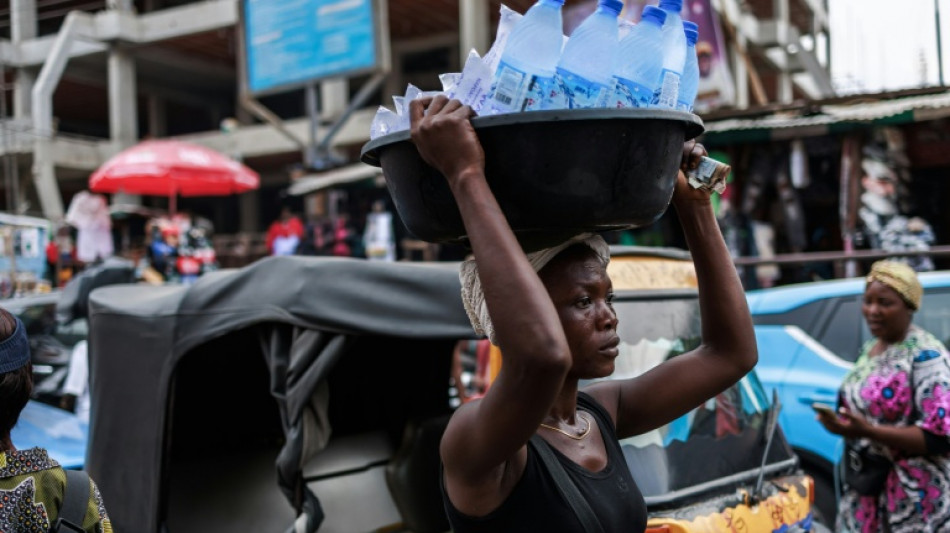
Despite humid air thick with dust and vehicle fumes, and engines idling as vehicles waited for passengers on a recent Wednesday, thousands of Lagos traders continued to display their goods under direct sunlight, despite warnings against prolonged exposure.
Hawkers balancing basins of iced fizzy drinks moved through traffic, offering quick relief to commuters.
With the cost of living on the rise following years of high inflation, many traders exposed to the sun and polluted air are more concerned about putting food on the table than air quality.
"The weather is not good," Aminat Jimoh told AFP as he fried tofu by a cluttered roadside. "But we have to endure because we cannot eat if we don't come here."
The heatwave could also worsen Nigeria's malaria burden. According to the World Health Organization, climate change -- through increased rainfall, temperatures and humidity -- can in some cases accelerate malaria transmission by enabling mosquitoes to breed faster.
Nigeria recorded about a quarter of the world's malaria cases and 30 percent of global deaths in 2024, according to the WHO.
The approaching rainy season offers some relief as storms tamp down temperatures.
But it will also bring its own challenges, such as flooding.
"I know that rain has its own problem but I can't wait for this heat to go," Akanni said.
M.A.Vaz--PC