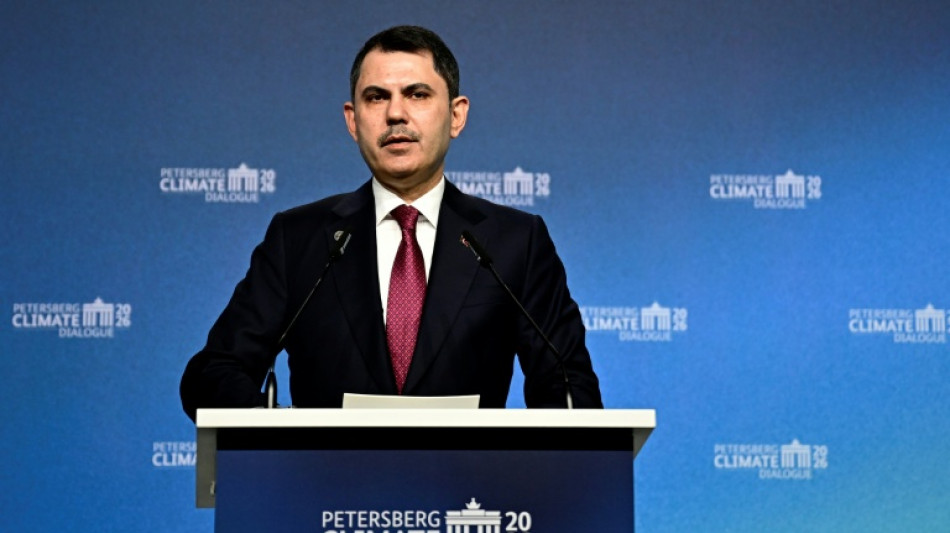
Renewables key to buffer fossil fuel energy shock: COP31 co-hosts / Photo: Tobias SCHWARZ - AFP

 Trump's beef policies irk Texas ranchers, testing their loyalty

 Nvidia, OpenAI CEOs to attend Xi dinner at White House

 Anthropic picks Accenture for in-house AI safety evaluation

 Balogun returns as Monaco beat Lens to continue strong Ligue 1 start

 'Pause' on overt repression in Venezuela, but reforms still needed: HRW

 Global stocks mixed as yen falls despite Bank of Japan rate hike

 Cuba hit with seventh major blackout of the year

 Murray out with concussion so Wentz will start for Vikings

 UN chief 'deeply regrets' US visa refusal to Abbas for annual meeting

 England quick Carse to face no charges over alleged nightclub assault

 Mancini brings nine newcomers into the first squad of his Italy comeback

 Czechs level Davis Cup tie against USA as South Korea eye Finals

 New France boss Zidane confirms Mbappe as captain after naming first squad

 California governor signs order to explore AI 'kill switch'

 Head leads run spree as Australia win Zimbabwe ODI series

 In-form Raphinha wants to finish career at Barcelona

 Warren Buffett steps down as Berkshire Hathaway chairman

 Carrick confident Man Utd can 'work through' tough time

 Mbappe ends Nike partnership to join Swiss brand On

 Liverpool boss Iraola puts Bournemouth love affair on hold

 'A disaster' if Man City do not win says Maresca after flawless start

 Kerry James Marshall: American 'blackness' painter celebrated in Europe

 Spain coach De la Fuente offers 'full support' to people of Ceuta

 Russia seizes assets of Nestle, French firms over West's Ukraine support

 England can build on World Cup 'spirit', says Tuchel

COP31 co-hosts Australia and Turkey said Tuesday that a major energy crisis ignited by the Middle East war underscored the urgency of reducing fossil fuel dependency and investing in renewable alternatives.
The energy shock rippling through the global economy loomed over the Petersberg Climate Dialogue in Berlin, where dozens of ministers are meeting to discuss the agenda for COP31 in November.
Global energy prices have soared since Iran effectively closed the Strait of Hormuz, a vital transit point for Gulf oil and gas shipments, in retaliation for US-Israeli attacks that began on February 28.
In the scramble for energy security, some governments have looked to fossil fuels in the short term to plug supply gaps or delayed coal phaseout plans, raising concerns about climate commitments.
Incoming COP31 president and Turkish Climate Minister Murat Kurum said the crisis "has shown us, once again, that fossil fuels do not guarantee energy supply security".
"Investment in alternative energy sources, in particular to support energy diversity, means stability, resilience and clean development. This is what we must all pursue," Kurum said through a translator.
Speaking later at a press conference, Kurum said: "We know that relying solely on fossil fuels means walking towards volatility, insecurity and climate collapse".
- Hostage economies -
Australia's Climate Minister Chris Bowen, who is steering the COP31 negotiations, said: "This is a fossil fuel crisis that the world is facing, and doubling down on more reliance on fossil fuels is not the answer to that crisis."
"Renewable energy cannot be interrupted by a war. Wind cannot be subject to a sanction," Bowen told reporters via video link after cancelling his trip to Berlin over the fuel crisis in Australia.
UN Secretary General Antonio Guterres told ministers at Petersberg that the energy crisis "makes one fact crystal clear: fossil fuels are not just wrecking our planet, they are holding economies hostage."
Roughly twice as much investment goes into clean energy as fossil fuels, which are the primary driver of human-caused climate change.
But heat-trapping emissions from burning coal, oil and gas rose again in 2025 to a record high.
Nearly 200 countries agreed at COP28 in 2023 to transition away from fossil fuels, but efforts to turn that pledge into action have faced strong resistance since.
Tensions boiled over at COP30 in Brazil in November when nations could not even agree to include an explicit reference to fossil fuels in the final deal, angering many countries.
- Fossil phaseout -
It remains to be seen if the contentious issue will be concretely addressed at COP31. Australia is a major producer of fossil fuels and Turkey is heavily reliant on coal for energy.
Kurum said the world was phasing out fossil fuels, but each country was making the transition to clean energy according to their respective economic needs and capabilities.
The Petersberg talks come just days before dozens of countries attend the first-ever international conference dedicated to phasing out fossil fuels in the Colombian city of Santa Marta.
The European Union, Canada, the UK and Norway are among those attending along with major emerging economies like Brazil and Angola, and smaller developing states.
Australia and Turkey are also expected at the much-anticipated event, which was born out of frustration with the COP negotiations, which take decisions by consensus and are criticised for moving too slowly.
Some observers have expressed reservations about how the co-hosting arrangement between Turkey and Australia may work.
Both countries wanted to hold COP31 but a compromise was reached where the summit would be held in the Mediterranean city of Antalya with Bowen presiding over the all-important negotiations.
F.Ferraz--PC