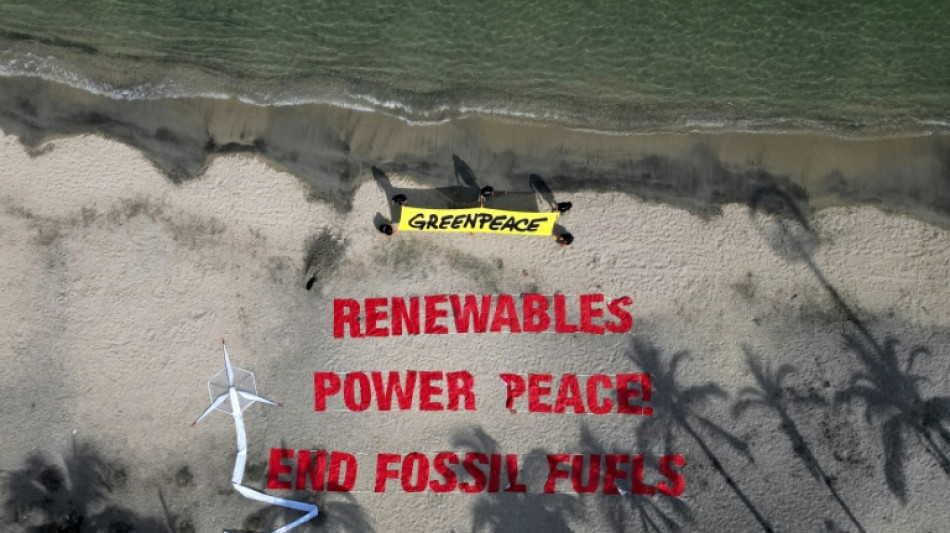
Nations kick off world-first fossil fuel exit talks in Colombia / Photo: Raul ARBOLEDA - AFP

 Trump's beef policies irk Texas ranchers, testing their loyalty

 Nvidia, OpenAI CEOs to attend Xi dinner at White House

 Anthropic picks Accenture for in-house AI safety evaluation

 Balogun returns as Monaco beat Lens to continue strong Ligue 1 start

 'Pause' on overt repression in Venezuela, but reforms still needed: HRW

 Global stocks mixed as yen falls despite Bank of Japan rate hike

 Cuba hit with seventh major blackout of the year

 Murray out with concussion so Wentz will start for Vikings

 UN chief 'deeply regrets' US visa refusal to Abbas for annual meeting

 England quick Carse to face no charges over alleged nightclub assault

 Mancini brings nine newcomers into the first squad of his Italy comeback

 Czechs level Davis Cup tie against USA as South Korea eye Finals

 New France boss Zidane confirms Mbappe as captain after naming first squad

 California governor signs order to explore AI 'kill switch'

 Head leads run spree as Australia win Zimbabwe ODI series

 In-form Raphinha wants to finish career at Barcelona

 Warren Buffett steps down as Berkshire Hathaway chairman

 Carrick confident Man Utd can 'work through' tough time

 Mbappe ends Nike partnership to join Swiss brand On

 Liverpool boss Iraola puts Bournemouth love affair on hold

 'A disaster' if Man City do not win says Maresca after flawless start

 Kerry James Marshall: American 'blackness' painter celebrated in Europe

 Spain coach De la Fuente offers 'full support' to people of Ceuta

 Russia seizes assets of Nestle, French firms over West's Ukraine support

 England can build on World Cup 'spirit', says Tuchel

More than 50 nations gathered in Colombia launched the first global conference on phasing out fossil fuels Tuesday, warning that the worldwide energy shock ignited by the Iran war drove home risks of relying on oil, gas and coal.
Ministers and climate envoys aim to revive the transition from fossil fuels at the inaugural conference in Santa Marta against a backdrop of crippling global energy shortages and soaring fuel prices.
"Let's make this a turning point in history," Colombia's Environment Minister Irene Velez Torres said as she opened the two-day talks.
The conference bypasses the United Nations climate talks and reflects a growing impatience with its failure to tackle fossil fuels, the main driver of global warming.
But ministers said the volatility driven by the Middle East conflict also underscored the energy security imperative of shifting to renewables.
"We in Europe... are losing half a billion euros each day this war continues," the bloc's climate envoy Wopke Hoekstra told delegates in the coastal city.
"We already had a very good reason to move on (from fossil fuels) for climate action... We now also have it for commercial reasons, and reasons of independence."
The conference was announced late last year but organizers say the Middle East war -- which has seen Gulf exports plummet -- had bolstered the case for a fossil fuel phaseout.
Some governments are however weighing short-term increases to fossil fuel production to plug supply gaps, illustrating the tensions between climate ambition and energy security.
On the list of attendees are major fossil fuel producers Canada, Norway and Australia, and developing oil giants Nigeria, Angola and Brazil.
They join coal-reliant emerging markets Turkey and Vietnam, and small island nations extremely vulnerable to climate shocks, among others.
But the world's biggest emitters of greenhouse gases -- including the United States, China and India -- are not attending, nor are oil-rich Gulf states.
- 'Good faith' -
The conference is not expected to produce binding commitments but a scientific panel has asked governments taking part to consider a halt on new fossil fuel expansion, among other proposals.
Many nations "are here in good faith to really work through what is a very complex challenge made more urgent by the crisis," the UK's special climate envoy Rachel Kyte told AFP in Santa Marta on Monday.
"People seem refreshed to be able to talk about these issues without having to sort of argue the existential question of -- do we need to do this at all?" she said.
As government delegates arrived Monday, activists protested against fossil fuels on the streets and beaches of the Caribbean city, one of the country's busiest coal hubs.
Colombia, which is co-hosting the conference with the Netherlands, is highly reliant on revenue from coal and oil exports, as are other developing fossil fuel producers attending the conference.
Among other agenda items, nations will consider how to equitably reduce fossil fuel production and consumption, and reforming subsidies that throw up barriers to renewable energy investment.
Analysis by the International Institute for Sustainable Development on Monday showed that governments still spent five times more public money on fossil fuels than renewable alternatives.
- 'Fossil fuel ban' -
On Sunday, a scientific panel released a 12-point "menu" of policy options that included "halting all new and expanding fossil fuel extraction and infrastructure projects."
"Without a doubt, there is no justification whatsoever for any new exploration of fossil fuels," the Brazilian scientist Carlos Nobre, a former member of the UN's climate advisory panel, told AFP.
Even as record investments flow into renewable energy, scientists warn the pace is still too slow to keep global temperature rises to safer levels.
"Even if we carried out no new exploration, the amount of fossil fuels -- oil, coal, and natural gas -- that already exists will push temperatures up to two and a half degrees by 2050," Nobre said.
The world has already warmed about 1.4C above pre-industrial times and is tracking to blow past 1.5C in a matter of years.
Above that threshold, scientists warn that coral reefs and Greenland ice sheets could disappear, among other catastrophic and irreversible impacts.
F.Moura--PC