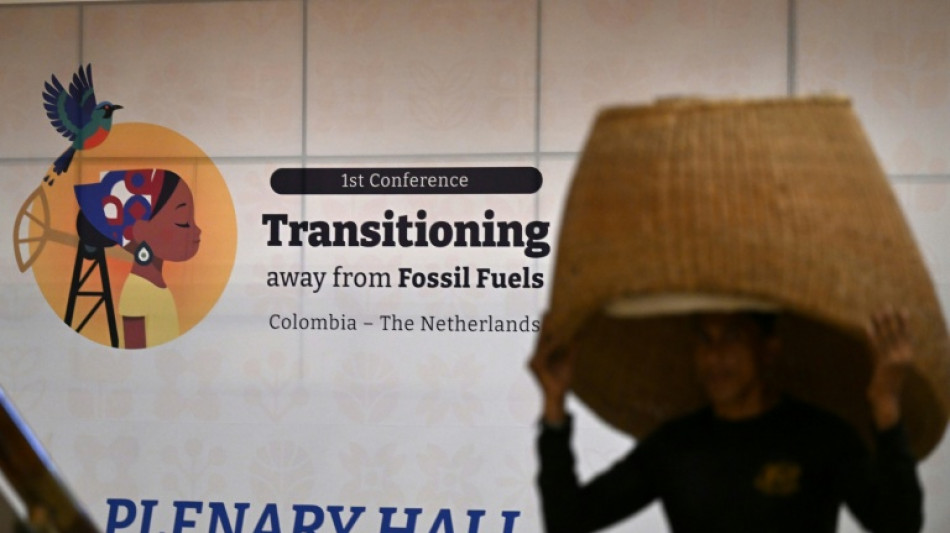
Key points from the first global talks on phasing out fossil fuels / Photo: Raul ARBOLEDA - AFP

 Trump's beef policies irk Texas ranchers, testing their loyalty

 Nvidia, OpenAI CEOs to attend Xi dinner at White House

 Anthropic picks Accenture for in-house AI safety evaluation

 Balogun returns as Monaco beat Lens to continue strong Ligue 1 start

 'Pause' on overt repression in Venezuela, but reforms still needed: HRW

 Global stocks mixed as yen falls despite Bank of Japan rate hike

 Cuba hit with seventh major blackout of the year

 Murray out with concussion so Wentz will start for Vikings

 UN chief 'deeply regrets' US visa refusal to Abbas for annual meeting

 England quick Carse to face no charges over alleged nightclub assault

 Mancini brings nine newcomers into the first squad of his Italy comeback

 Czechs level Davis Cup tie against USA as South Korea eye Finals

 New France boss Zidane confirms Mbappe as captain after naming first squad

 California governor signs order to explore AI 'kill switch'

 Head leads run spree as Australia win Zimbabwe ODI series

 In-form Raphinha wants to finish career at Barcelona

 Warren Buffett steps down as Berkshire Hathaway chairman

 Carrick confident Man Utd can 'work through' tough time

 Mbappe ends Nike partnership to join Swiss brand On

 Liverpool boss Iraola puts Bournemouth love affair on hold

 'A disaster' if Man City do not win says Maresca after flawless start

 Kerry James Marshall: American 'blackness' painter celebrated in Europe

 Spain coach De la Fuente offers 'full support' to people of Ceuta

 Russia seizes assets of Nestle, French firms over West's Ukraine support

 England can build on World Cup 'spirit', says Tuchel

The first global conference on transitioning away from fossil fuels wrapped up on Wednesday -- but what progress was made in Santa Marta, a coal port on the Caribbean coast?
Here are a few takeaways:
- Roadmaps -
France made headlines on the opening day of the conference when it published a "roadmap" detailing its path to eliminating the use of all fossil fuels for energy by 2050.
Analysts said no other country had published such a clear and comprehensive phaseout plan and it sent an important signal from a major economy about its direction on fossil fuels.
The splash caused some grumbling in Santa Marta as some pointed out that France was not announcing new policy but existing pledges under a different title.
Other nations contested that there was no widely accepted definition of a roadmap, and that they too had timelines to phase out coal and other planet-heating fuels, as well as renewable energy targets and plans for decarbonizing heavy industry.
Leo Roberts from the E3G climate change think tank said a roadmap should be guided by science and make a fossil fuel phaseout a "central planning principle" around which other policies gravitate.
- 'Spaghetti' science -
One of the key outcomes was the creation of an expert scientific panel to advise governments, cities or regions in planning their own pathways away from fossil fuels.
Carlos Nobre, a Brazilian climate scientist and one of the driving forces behind the panel, told AFP: "It will provide all the solutions -- to implement them, and to finance them."
The Scientific Panel for the Global Energy Transition was amusingly dubbed the "Spaghetti" group because of its acronym -- SPGET.
- Fossil Free Zones -
Popular among grassroots movements, the concept of "Fossil Free Zones" is slowly gaining traction in international meetings and found fertile ground in Santa Marta.
These zones aim to encompass territories that -- due to their ecological importance, from the Amazon to the Congo Basin and Indonesian rainforest -- are protected by governments that prohibit all hydrocarbon exploration and extraction within them.
The Earth Insight expert group estimates that there are 58 such protected areas worldwide.
Colombia, for example, banned the extraction of fossil fuels and minerals in the Colombian Amazon last year to "stop the expansion of the extractive frontier," said Colombia's Environment Minister Irene Velez Torres, host of the Santa Marta conference.
- New hosts -
Colombia passed the baton to Tuvalu, a tiny island nation in the Pacific Ocean that will host the next fossil fuel phaseout conference in 2027.
The low-lying island is seriously threatened by rising sea levels, and has been a strong voice on the international stage for impoverished countries imperiled by climate change.
"This journey that began here in a coal port of the Caribbean Sea, now voyages to the Pacific Ocean," said Tuvalu's Climate Minister Maina Talia.
Activists urged countries to turn up in numbers, despite the distance.
"I think the fact that the Pacific is far away cannot be an excuse," Nikki Reisch, from the Center for International Environmental Law, told AFP in Santa Marta.
"The Pacific Island countries are constantly bearing the burden of coming to other fora and trying to get their voice heard."
T.Batista--PC