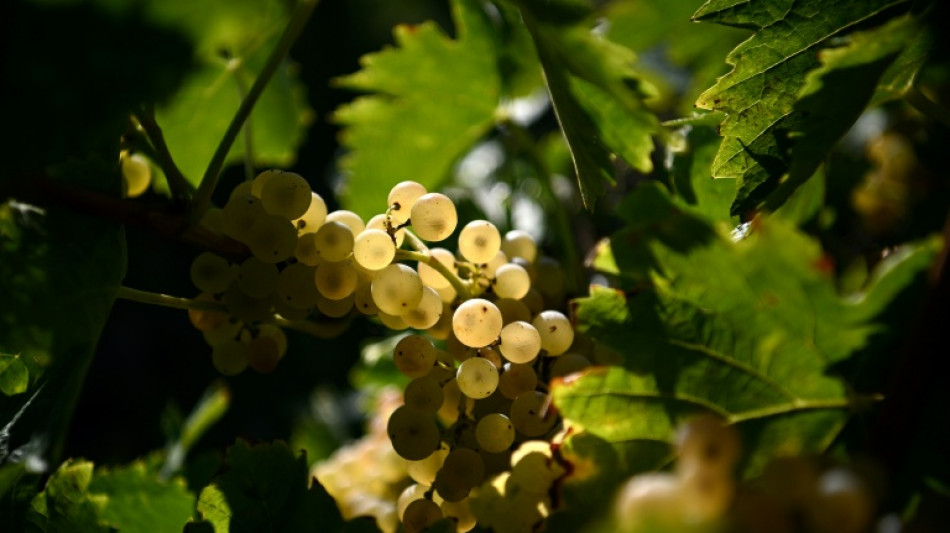
French wine growers plant trees to protect vines from climate / Photo: Christophe ARCHAMBAULT - AFP

 Trump's beef policies irk Texas ranchers, testing their loyalty

 Nvidia, OpenAI CEOs to attend Xi dinner at White House

 Anthropic picks Accenture for in-house AI safety evaluation

 Balogun returns as Monaco beat Lens to continue strong Ligue 1 start

 'Pause' on overt repression in Venezuela, but reforms still needed: HRW

 Global stocks mixed as yen falls despite Bank of Japan rate hike

 Cuba hit with seventh major blackout of the year

 Murray out with concussion so Wentz will start for Vikings

 UN chief 'deeply regrets' US visa refusal to Abbas for annual meeting

 England quick Carse to face no charges over alleged nightclub assault

 Mancini brings nine newcomers into the first squad of his Italy comeback

 Czechs level Davis Cup tie against USA as South Korea eye Finals

 New France boss Zidane confirms Mbappe as captain after naming first squad

 California governor signs order to explore AI 'kill switch'

 Head leads run spree as Australia win Zimbabwe ODI series

 In-form Raphinha wants to finish career at Barcelona

 Warren Buffett steps down as Berkshire Hathaway chairman

 Carrick confident Man Utd can 'work through' tough time

 Mbappe ends Nike partnership to join Swiss brand On

 Liverpool boss Iraola puts Bournemouth love affair on hold

 'A disaster' if Man City do not win says Maresca after flawless start

 Kerry James Marshall: American 'blackness' painter celebrated in Europe

 Spain coach De la Fuente offers 'full support' to people of Ceuta

 Russia seizes assets of Nestle, French firms over West's Ukraine support
 England can build on World Cup 'spirit', says Tuchel

In the wine-making heart of the northern Rhone hills in southeastern France, one of Pierre-Jean Villa's plots is a curiosity.
Unlike others stretching far around, the vines in this particular spot are interspersed with maples and fruit trees designed to stimulate the grapes -- and protect them from the ravages of climate change.
Slowly, French winegrowers are experimenting with "vitiforestry".
It is a new word for an ancient practice: growing vines alongside trees, something Italy and Greece have never stopped doing.
"Here, at the start of the 20th century, there was an orchard and a vegetable garden as well as vines," said Villa, standing on the plot that slopes down towards the Rhone, with the Alps on the horizon.
"The idea is to recreate a bit of what used to be done before. We've even brought back sheep and bees."
- 'Decent' grape yield -
As "a man of the land", Pierre-Jean says he is now struck by seeing "earlier harvests, heatwaves, drought or rain arriving with a suddenness and violence we didn't see before".
Like his neighbours, he had previously grown vines the traditional way. It was his son Hugo, a graduate of agricultural school in Montpellier, who had the idea of using trees to counter the harmful effects of climate warming.
Lying close to the officially designated wine regions of Condrieu and Cote-Rotie, the land that now holds the trees lay fallow just a decade ago.
On it, the father and son embarked on their "technical and family" project.
Helped by experts from the neighbouring regional park, they selected local species of tree and determined their layout with the right balance of shade and humidity.
As a result, for every 15 rows of prized Syrah grapevines, there are 400 apple, pear, peach, hazelnut and quince trees growing in dense rows.
While it is too early to draw firm conclusions, Pierre-Jean Villa believes the plot "came through rather better" than others during a 20-day heatwave in August 2025, with a "decent" yield.
- 40C heat -
Christian Dupraz, research director at the National Research Institute for Agriculture, Food and Environment (Inrae), agreed.
"When we had 40 degrees Celsius last year, our agroforestry vines coped perfectly."
In 1997, Dupraz launched his own "iconoclastic" test plot in the Herault region to bring trees back among crops.
His findings: trees limit damage to vines from spring frosts -- the bane of winegrowers -- and provide shade as well as helping the plants release water.
Vines were originally creepers growing on trees, Dupraz pointed out. Now with trees present, "temperatures on leaves and berries are reduced. That can save a harvest," he said.
"If we now regularly have more than 40C in summer, it will no longer be possible to grow vines in full sun."
- Long-term gains -
Trees are being planted to help vines in regions ranging from Bordeaux to Languedoc and even Champagne.
Regional authorities are offering subsidies, and customs authorities defined a legal framework for the activity in 2024.
Today, two to five percent of vineyard areas are involved, to varying degrees, the French Agroforestry Association estimated, calling it a "growing trend in the face of climatic hazards".
Bernard Farges, president of the National Committee of Wine Joint-Professions (CNIV), was more cautious, however.
"The expected gain is long-term. Given the difficulties (in the sector), some people have other priorities."
Yet with a tendency for growers in difficulty to abandon their vineyards, "there is room for trees," said Dupraz, the Inrae expert.
At Pierre-Jean Villa's estate, other growers have come to look at his young vitiforestry plot -- including ones from the key southern winemaking region of Bordeaux, faced with a warming climate.
"It's my finest achievement. My whole region is here -- the environment, the granite sands, the vine stakes," he said. "The fruits of my childhood."
E.Paulino--PC