Climate change-fuelled storm decimated world's rarest great ape: study / Photo: Handout - Orangutan Information Centre/AFP

 Trump's beef policies irk Texas ranchers, testing their loyalty

 Nvidia, OpenAI CEOs to attend Xi dinner at White House

 Anthropic picks Accenture for in-house AI safety evaluation

 Balogun returns as Monaco beat Lens to continue strong Ligue 1 start

 'Pause' on overt repression in Venezuela, but reforms still needed: HRW

 Global stocks mixed as yen falls despite Bank of Japan rate hike

 Cuba hit with seventh major blackout of the year

 Murray out with concussion so Wentz will start for Vikings

 UN chief 'deeply regrets' US visa refusal to Abbas for annual meeting

 England quick Carse to face no charges over alleged nightclub assault

 Mancini brings nine newcomers into the first squad of his Italy comeback

 Czechs level Davis Cup tie against USA as South Korea eye Finals

 New France boss Zidane confirms Mbappe as captain after naming first squad

 California governor signs order to explore AI 'kill switch'

 Head leads run spree as Australia win Zimbabwe ODI series

 In-form Raphinha wants to finish career at Barcelona

 Warren Buffett steps down as Berkshire Hathaway chairman

 Carrick confident Man Utd can 'work through' tough time

 Mbappe ends Nike partnership to join Swiss brand On

 Liverpool boss Iraola puts Bournemouth love affair on hold

 'A disaster' if Man City do not win says Maresca after flawless start

 Kerry James Marshall: American 'blackness' painter celebrated in Europe

 Spain coach De la Fuente offers 'full support' to people of Ceuta

 Russia seizes assets of Nestle, French firms over West's Ukraine support

 England can build on World Cup 'spirit', says Tuchel

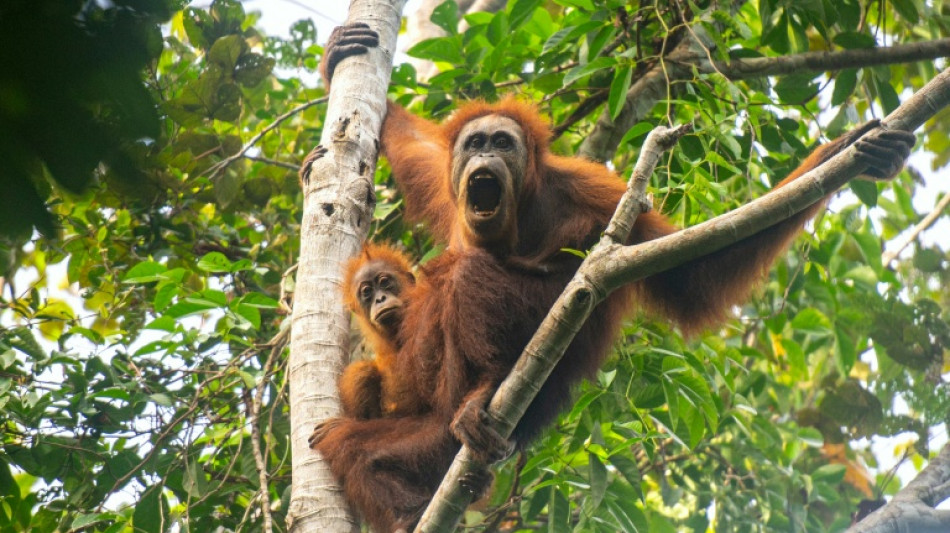
Climate change-fuelled landslides wiped out nearly one in ten of the world's rarest great ape species on Indonesia's Sumatra island, scientists said Wednesday.
A single weather event last November pushed the Tapanuli orangutan -- of which there are fewer than 800 left in the wild -- even closer to extinction, according to a study published in the science journal Current Biology.
An estimated 58 Tapanuli orangutans died as a result of mudslides triggered by heavy rains during Cyclone Senyar -- about 11 percent of the total living in the region, or seven percent of the estimated overall wild population.
The flooding killed more than 1,000 people.
Only scientifically classified as a species in 2017, Tpanulis are incredibly rare, confined to a small range in Sumatra.
"This level of loss is substantial for a species with such a small total population," said Erik Meijaard, chief scientist at Borneo Futures, a conservation initiative.
The floods also wiped out sources of Tapanuli food and shelter.
Scientists analyzed satellite evidence of landslide scars in the Batang Toru Ecosystem -- home to the largest remaining population of the apes.
They found that about 8,300 hectares of forest -- more than 11 percent of the area -- were affected.
The lost forest area was overlaid with orangutan density maps to come up with an estimate of population loss.
"The loss of an estimated 58 Tapanuli orangutans to a single climate-induced landslide event is a devastating demographic shock to the world's rarest great ape," said researcher Jatna Supriatna of Indonesia University.
Environmentalists have long campaigned against industrial activity in Batang Toru, particularly a hydroelectric dam and gold mine.
The highland homes inhabited by Tapanulis are not their preferred habitat, but it is where remaining orangutans have been pushed by human development elsewhere.
"To prevent the first modern extinction of a great ape species, Indonesia must permanently protect the Batang Toru ecosystem," Jatna said.
"But our international partners must also meet their global commitments by providing immediate biodiversity-recovery financing."
Sumatra lost 4.4 million hectares of forest -- an area larger than Switzerland -- between 2001 and 2024, making hilly landscapes more vulnerable to landslides, the conservation group Mighty Earth said in February.
N.Esteves--PC