
Climate change to blame for intensity of Europe heatwave: scientists / Photo: Dimitar DILKOFF - AFP

 2.4 million girls banned from Afghan schools since Taliban return: UNESCO

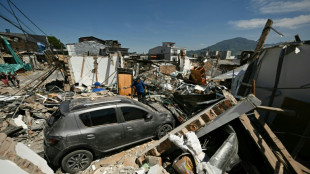 Colombians dig through rubble as quake death toll surpasses 240

 New Zealand's ruling party meets to decide PM Luxon's fate

 Total solar eclipse to spellbind Europe

 Jodar, Nakashima to make Masters semis debuts in Montreal

 Chilean veteran Sanchez signs with MLS club Montreal

 Cristiano Ronaldo marries long-term partner Georgina Rodriguez

 Oil prices higher, stocks mixed ahead of inflation report

 Jacobs into 100m final with eye on third title

 Eight-try New Zealand cruise to tour victory over Sharks

 Trump's secret plane swap triggers questions and confusion

 California calls Paramount's threat to leave state 'blackmail'

 PSG 'want to win everything', says Luis Enrique

 Barred from elections, Russia's anti-war party vows to fight on

 Jaissle states Newcastle ambition but urges patience

 NBA star Cooper Flagg trading card a slam dunk for lucky buyer
 ForumPay Expands Payment Infrastructure with New Card and Bank Transfer Acceptance Solution

 Oil prices higher, stocks flat ahead of inflation report

 Orban-critic ex-judge becomes Hungary president after predecessor ouster

 US rights groups sue Trump over ICC sanctions

 Sphere 3D Corp. (Nasdaq: ANY) Attracts 6.5% Stake from Turnaround Bitcoin-Mining Investor

 Oil prices lower, stocks higher as Hormuz doubts drag on

 Colombia scrambles to find survivors as quake kills 181

 Colombia scrambles to find survivors as quake kills 169

 MEXC Report: 74.2% of Traditional Finance Users Have Shifted Their Trading Activity to Crypto Exchanges

Human-caused climate change is "unequivocally" responsible for the intensity of a record-breaking heatwave scorching Europe, scientists said Friday.
It would have been "virtually impossible" for such exceptional temperatures to occur in June fifty years ago, the World Weather Attribution group of scientists said.
A similar heatwave would have been 3.5C cooler during the day in June 1976, concluded the study by scientists from Europe, the United States and the United Kingdom.
But the world is hotter today and "the chance of a heatwave like this has changed immensely", said the study's lead author Theodore Keeping from Imperial College London.
"This event would not have been possible in June without climate change," Keeping told reporters.
The planet has warmed about 1.4C above pre-industrial times, driven by the burning of coal, oil and gas.
Scientists agree this is making extreme weather events like heatwaves more frequent and intense, and that limiting warming is vital to avoiding the worst impacts of climate change.
Europe is the world's fastest-warming continent and tens of millions of people have sweltered this week in temperatures that broke records in some countries.
"The weather pattern itself is not particularly unusual, but the temperatures are -- or at least they used to be, without human-induced climate change," Friederike Otto, the co-founder of World Weather Attribution from Imperial College London, told reporters.
- 'Unpleasant and dangerous' -
As the heatwave is still unfolding, scientists used observed and forecast temperatures to compare this heatwave against how it might have behaved in the cooler climates of 2003 and 1976.
Even compared to 2003 -- when tens of thousands of people died in a major European heatwave -- the current episode was notably extreme, the authors said.
A similar heatwave in June 2003 would have been about 2C cooler, the study said.
"In 2003... daytime heat like this would still have been very rare", while overnight temperatures would have been more than a hundred times less likely.
"Our analysis here shows that intense heat is increasing rapidly even in living memory, with such events tens to hundreds of times more likely since only 2003 and virtually impossible just 50 years ago," said the study.
"Climate change is unequivocally to blame."
The El Nino weather pattern -- a natural warming climate phase -- had "no role in driving the heat", the authors said.
Otto also singled out the threat of "heat stress" posed by the combination of high temperatures and humidity.
Heat stress occurs when the body's natural cooling systems are overwhelmed, causing symptoms ranging from dizziness and headaches to organ failure and death.
Of the nearly 850 cities in Europe analysed in the study, some 45 percent had broken -- or were expected to break -- their all-time heat stress records in June, the study said.
This made the heatwave "particularly unpleasant and dangerous", Otto said.
This episode is the second of the year for Europe after an early-season heatwave in May brought temperatures more typical of high summer to central and western parts of the continent.
World Weather Attribution said the rapid phase out of fossil fuels was "critical if we are to avoid even higher temperatures and their consequences in the future".
V.Fontes--PC