European heatwave's unlikely accomplice: an ocean 'cold blob' / Photo: Olivier MORIN - AFP/File

 What to know about the total solar eclipse

 Tentoglou claims fourth Euro long jump title, injured Jacobs falters

 All Blacks knew Nonu would perform solo Haka - coach Rennie

 Britain's Glave upstages Jacobs to win European 100m gold

 Greece's Tentoglou wins fourth European long jump title
 Doctors ignored 'warning signs' before Maradona's death, court hears

 Pereira, the 'zombie city' devastated by Colombia's earthquake

 UN says 2 staff arrested by Afghan intelligence agency

 Colombia scrambles to find survivors as quake kills 240

 Ramsay-Peaty out of medals as Italy's Martinenghi wins European gold

 AI firm Manus to resume 'independent' operations after China blocks Meta deal

 Caught between great powers: the cautionary tale of Manus

 Heatwave hits evicted families sleeping rough in Rome

 US company stokes Greenland tensions by unloading drilling gear

 Cambridge academic in plagiarism row publishes memoir
 LeBron's Sixers hope to spoil Knicks party on NBA opening night

 UK 'on course' to record warmest summer for second year in a row

 Spotify to launch badge identifying AI music

 New plastic treaty document criticised for weaker ambition
 Hungary parliament approves Orban-critic judge as president

 Ebola outbreak in DR Congo kills more than 2,000

 ChargeAfter Powers BYLD Finance Expansion into Consumer Financing for Equipment Retailers

 MEXC Upgrades RealStocks With Three New Features to Enhance U.S. Stock Trading Experience

 Israel demolishes home of slain Palestinian involved in deadly West Bank clash
 Liverpool fans seek clarity on Bezos bid to buy stake

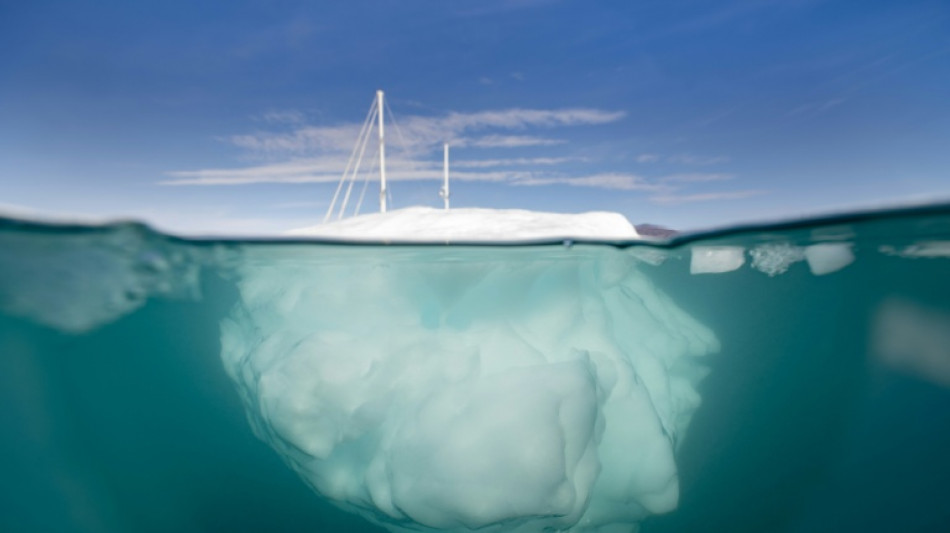
The heatwave battering Europe may have an unlikely partner-in-crime: a patch of cold ocean water south of Iceland and Greenland that can influence weather patterns over the continent.
Often called the "cold blob", this swath of water in the North Atlantic has bucked the global warming trend, cooling even as the planet's temperatures rise due to human-induced climate change.
A recent study reinforced concerns that it could signal a weakening of a key Atlantic Ocean current system that helps regulate the planet's climate.
A shutdown of this conveyor belt of ocean currents, known as Atlantic Meridional Overturning Circulation (AMOC), could potentially lead to harsher winters in northern Europe in the future, scientists say.
But researchers have also explored the cold blob's connection to heatwaves in Europe, finding that extreme hot spells have coincided with periods when these waters west of Britain were unusually cold.
"A cold Atlantic doesn't necessarily mean a colder Europe," Gerard McCarthy, oceanographer at Ireland's Maynooth University, told AFP.
"That cold isn't a kind of a get-out-of-jail-free card in terms of global warming. Some of the hot extremes can actually be exacerbated by this cold blob in the Atlantic," McCarthy said.
- Heat dome -
Greenhouse gas emissions are the main driver of climate change, which has made heatwaves more frequent and intense.
But several factors have made Europe the planet's fastest-warming continent, including changes in atmospheric circulation and melting ice.
Studies suggest the cold blob influences atmospheric circulation by altering the path and speed of the jet stream that flows west to east across the continent.
When cooler and warmer waters meet, the sharp contrast changes the air above, making the jet stream wavier and slower, according to researchers.
These changes can create conditions for high-pressure systems that park over Europe, such as the "heat dome" searing the continent this week.
Marilena Oltmanns, an ocean and climate physicist, pointed to recent data showing a strong cold anomaly currently present in the subpolar North Atlantic, creating a front that "acts like a guide" for the winds and the jet stream.
"The jet stream ... bends northward and flows northward around Europe instead of crossing it. As a result, a heat dome emerges over Europe," Oltmanns told AFP.
Oltmanns, a professor at the University of Bremen in Germany, led a 2024 study showing that the melting of Greenland ice pours freshwater into the ocean, creating colder surface waters in the North Atlantic.
"The chain of events, starting from the meltwater and the North Atlantic cold blob, then leading to changes in the ocean and atmospheric circulations, makes Europe heat up more quickly than other parts of the world in summer," she told AFP.
A 2016 study suggested that cold Atlantic anomalies were a "common precursor" to major heatwaves that had hit Europe since the 1980s.
Another paper published in 2023 ran computer simulations -- with and without the cold blob -- to see if the anomaly had an influence on European heatwaves.
"With this cold anomaly, we have longer and more intense heatwaves in Europe," that study's lead author Sabine Bischof, researcher at Germany's GEOMAR Helmholtz Centre for Ocean Research Kiel, told AFP.
- 'Very worried' -
While worldwide sea surface temperatures have increased by 1C on average since 1900, the cold blob region has cooled by up to 0.9C, according to a 2019 study.
Research published last month sought to settle a scientific debate over whether the loss of heat from the sea surface or a weakening AMOC were behind the cold blob.
"We find that this famous 'cold blob' in the northern Atlantic is caused by ocean currents bringing less heat into this region, and not by more heat lost through the sea surface there," the study's lead author, Stefan Rahmstorf, told AFP.
The AMOC carries warm tropical waters to the Northern Hemisphere, where they cool, become denser and sink before returning southward at depth.
Scientists broadly agree the AMOC is weakening with warming, but debate persists over how fast it could slow and whether a collapse is possible this century.
Rahmstorf, head of Earth system analysis at the Potsdam Institute for Climate Impact Research, used to be sceptical about the risk of an AMOC shutdown.
But he now gives it an over 50 percent chance of happening.
A shutdown would have dire consequences: tougher European winters, droughts in South Asia and parts of Africa, and higher sea levels around the North Atlantic.
"I am very worried," Rahmstorf said. "The consequences of an AMOC shutdown would be massive in many parts of the world."
A.Motta--PC