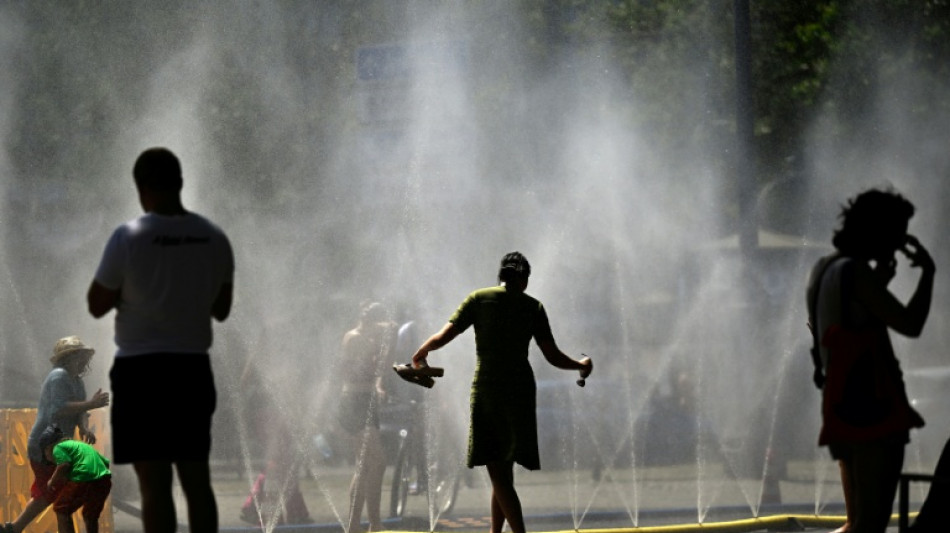
Take brutally hot weather seriously, heatstroke survivor warns / Photo: Ina FASSBENDER - AFP/File

 Hong Kong court set to sentence activist Joshua Wong in security case

 Australia raises benchmark rate to highest level in 18 years

 'The Remarried Empress' Cast Discusses Bringing Fantasy Royal Drama to Life

 Asian stocks retreat as AI worries outweigh steep oil-price drop

 Hamad International Airport stages emergency drills during WATAN 2026

 Global failure to punish attacks leaves journalists at continuing risk
 Researchers Warn 'Bookkeeping Trick' Masks Beef Industry's Methane Emissions

 Climate Change Intensified Atlantic Hurricanes, Study Finds

 Qatar solar expansion opens scope for technical performance gains

 IXOPAY Announces IXO One, a Modular Payments Platform Built for an Era of Fluid Commerce
History professor Ethan Borden Krizman was in high school when he collapsed 20 years ago at a race, suffering from heat stroke, but he says he remembers it well.
And the current heat wave in Europe has brought it all swirling back.
"I started getting tunnel vision, and I could feel my body weakening, and I collapsed, like just I completely blacked out," he told AFP, recounting how he was evacuated just short of the finish line in 95F (35C) heat that day in California while vomiting nonstop.
Krizman says he can feel himself "getting on edge" when he sees news alerts about extreme heat across Europe, where scores of deaths attributed to the heat have been reported.
"I can feel my heart (rate) elevating," he said.
Krizman says that ever since his brush with heat stroke, his tolerance for extreme heat has significantly diminished.
While children under the age of five and the elderly are most at risk in heat waves, teens and healthy adults can also suffer serious symptoms that can ultimately be fatal when exposed to high temperatures, especially when engaging in physical activity.
At the time, Krizman was a competitive runner, logging about 70 miles (more than 110 kilometers) a week.
"I wasn't an Olympic-level athlete, but I was probably more physically fit than 90 plus percent of the population," he said. "I had been hydrating all day long."
- Human 'threshold' for heat -
The number of deaths linked to extreme temperatures increased in the United States from 1999 to 2023, with an acceleration seen in the last seven years of that period, according to a study published in the American Medical Association's JAMA in 2024.
And heat waves now cause more deaths in the country than hurricanes or floods.
In 2018, University of Maryland football player Jordan McNair died at the age of 19 from complications related to extreme exhaustion and heatstroke.
Medical resident Evan Dishion died while on a hike with friends in Arizona in 2022.
"Even a doctor who runs marathons and is 32 years old can die of a heatstroke," his widow Amy Dishion told AFP.
Since her husband died, when their daughter was just three months old, Amy has fought to raise awareness about the dangers of extreme heat.
"As human beings, our bodies have a threshold of what we can survive in," she said, lamenting that decision makers routinely ignore this fact.
Krizman shares that view, noting that many athletic competitions take place even when temperatures soar.
"Is it really worth risking a teenage kid's life to go out there and play a sport when it's 100 plus degrees out?" he said.
He urged everyone to "take it seriously. Don't assume that 'Oh, it's just hot and I'll be okay.'"
Krizman offered easy-to-follow advice: stay hydrated, make sure you have eaten and limit physical activity.
"Do your best to stay out of the heat during the peak hours of the day, and know where you can go to potentially cool off," he added.
A.Aguiar--PC