Artificial cloud brightening could tame El Nino, but with risks: study / Photo: - - NOAA/AFP/File

 Kennedy Center: future unclear for iconic Washington arts hub

 Trump claims 'infinite' Greenland security deal with Denmark

 Helicopters battle wildfire threatening Ecuador's capital

 Brentford batter Chelsea to undo Alonso's promising start

 Kane hits Bundesliga century as Bayern rout Union

 Trump says CNN, MS NOW, Politico banned from White House

 Hushing and hedging: US companies retreat on climate

 Springboks to face Fiji before 2027 Rugby World Cup

 Nigeria miners struggled to breathe in cell before 37 died: survivors

 McIlroy on the charge at PGA Championship as Reed withdraws

 McIlroy on the charge at PGA Championship

 Crisis-wracked Volkswagen warns of 10-bn-euro hit to profits

 Costa Rica's Grynspan tops third informal poll for UN chief: diplomat

 Stock markets retreat after central bank rate hikes

 Russia labels director of Cannes Grand Prix winner a 'foreign agent'

 Macron warns of Russian 'hybrid' threat after meeting presidential hopefuls

 UN holds third informal poll for new chief

 Kulusevski return can spark Spurs: De Zerbi

 Shakira to cap off world tour with Madrid 12-gig run

 Isolated Syrian-Druze city blames Damascus for shortages

 Isolated Syrian-Druze city shortages

 Dutch drop Depay for Germany match in Xavi's first pick

 Ronaldo named in Portugal squad for Nations League

 Stock markets diverge after central bank rate hikes

 Anti-Assad music star makes triumphant return to Syria

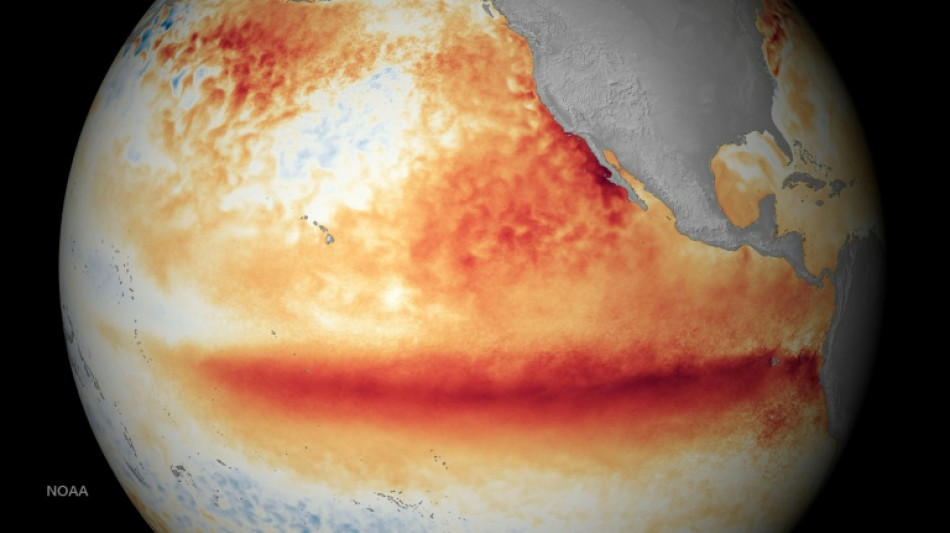
A brewing "Super" El Nino cycle is poised to unleash heat waves, floods and drought worldwide, with the effects amplified by long term human-caused climate change.
But what if it was possible to interrupt and effectively "switch off" the Pacific Ocean heating phenomenon as it starts to form?
That's the premise of a new Science Advances study published Wednesday, which uses computer models to show that artificially brightening clouds over the Pacific, when timed right, could neutralize the influential weather pattern and blunt its worst impacts.
While previous research on so-called geoengineering has focused on cooling the planet as a whole, the new paper instead proposes more targeted interventions.
"These shorter timescales of interventions could be a very powerful way that geoengineering enters this portfolio of responses to climate change," lead author Jessica Wan, a postdoctoral researcher at the University of Chicago, told AFP.
Prior research had shown that the "Black Summer" bushfires that scorched Australia in 2019-2020 played a key role in creating a multi-year La Nina, the cool phase of the El Nino-Southern Oscillation cycle.
As smoke particles entered the clouds, they set off chain reactions that actually made the clouds brighter, bouncing more of the Sun's energy back to space.
Motivated by this "natural experiment," Wan and her colleagues wondered whether solar geoengineering could achieve a similar effect.
They used a powerful forecasting model to gauge what impact artificial marine cloud brightening over a vast rectangular zone in the equatorial Pacific would have had on the 1997-1998 and 2015-16 El Nino events.
This could theoretically be achieved by using ships fitted with nozzles that spray sea salt into the lower atmosphere.
El Ninos are linked with warming sea surfaces in the eastern tropical Pacific, with knock on effects globally including drier conditions and drought in Australia, wetter winters in East Africa, and warmer overall global temperatures.
After running several simulations, they found the intervention worked best when started early -- in June -- and continued through the following February.
"But the reason people would ever care about this is not temperature in a box in the Pacific, but how the impacts translate over land," said Wan.
Extreme weather events linked to El Nino have caused loss of life and trillions of dollars of economic damage.
The modeled cloud brightening reversed most of the temperature and precipitation effects -- those areas that got warmer under an El Nino were cooler, regions that got wetter instead became drier, and vice versa.
So what's the catch?
- Unknown consequences -
For starters, the technology isn't yet ready.
Teams around the world are developing the nozzles to spray sea salt into the sky, but the devices can't yet shoot nearly enough volume. Even if a nozzle is perfected, it would take roughly 2,400 ships to make the required impact.
Beyond the engineering challenges, there are further risks.
Not all regions of the world would benefit from reversing El Nino conditions, and the models showed unintended consequences, including warming over Europe and Asia.
"The other catch I would say is that we didn't look at long-term impacts," said Wan, including what would happen if marine cloud brightening was used repeatedly to suppress El Ninos.
Geoengineering has many detractors, who argue it creates a moral hazard by giving polluters a free pass to keep emitting if the climate can be artificially cooled. Wan disagrees.
"We're beyond the point now where we could just turn off emissions today and be totally fine, we're locked into warming already, and so the way that I viewed geoengineering is 'how can we reduce the worst of those impacts while we work on a long-term solution?'" she said.
"I think it would be irresponsible to not do the research, given that's the context we're in."
B.Godinho--PC