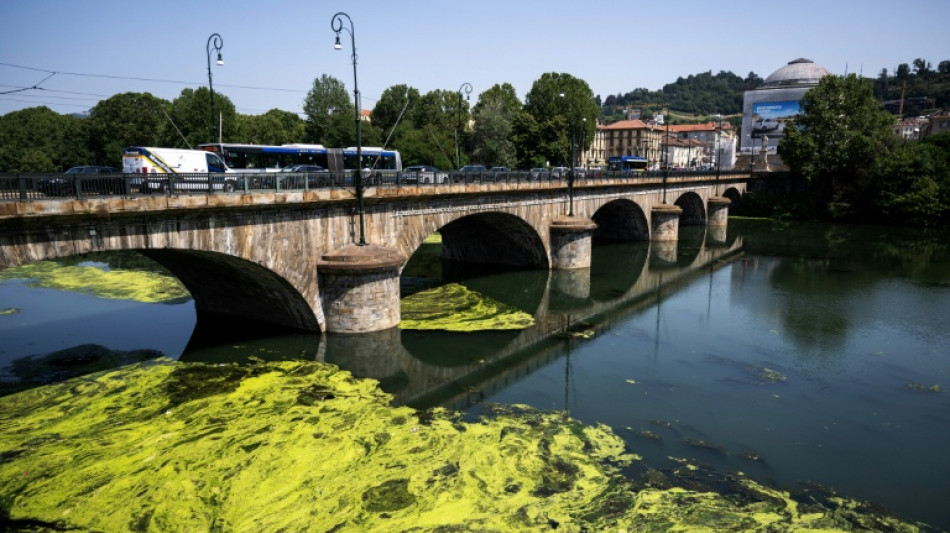
Algae fed by farm waste carpet Italy's warm River Po / Photo: Marco BERTORELLO - AFP

 Kennedy Center: future unclear for iconic Washington arts hub

 Trump claims 'infinite' Greenland security deal with Denmark

 Helicopters battle wildfire threatening Ecuador's capital

 Brentford batter Chelsea to undo Alonso's promising start

 Kane hits Bundesliga century as Bayern rout Union

 Trump says CNN, MS NOW, Politico banned from White House

 Hushing and hedging: US companies retreat on climate

 Springboks to face Fiji before 2027 Rugby World Cup

 Nigeria miners struggled to breathe in cell before 37 died: survivors

 McIlroy on the charge at PGA Championship as Reed withdraws

 McIlroy on the charge at PGA Championship

 Crisis-wracked Volkswagen warns of 10-bn-euro hit to profits

 Costa Rica's Grynspan tops third informal poll for UN chief: diplomat

 Stock markets retreat after central bank rate hikes

 Russia labels director of Cannes Grand Prix winner a 'foreign agent'

 Macron warns of Russian 'hybrid' threat after meeting presidential hopefuls

 UN holds third informal poll for new chief

 Kulusevski return can spark Spurs: De Zerbi

 Shakira to cap off world tour with Madrid 12-gig run

 Isolated Syrian-Druze city blames Damascus for shortages

 Isolated Syrian-Druze city shortages

 Dutch drop Depay for Germany match in Xavi's first pick

 Ronaldo named in Portugal squad for Nations League

 Stock markets diverge after central bank rate hikes

 Anti-Assad music star makes triumphant return to Syria

Rowers on the River Po in Turin are battling vast blooms of algae, as high temperatures in northwest Italy and runoff from farms create ideal conditions for rampant plant growth.
"Look at these (plants), if you put your oar in, they wouldn't let it go," rowing coach Roberto Romanini told AFP, as four rowers struggled in their boat through a patch of green slime.
Sitting between the Alpine chain on one side and hills on the other, heavily urbanised Turin has suffered soaring temperatures this summer, as heat waves rendered more intense by man-made climate change have gripped Italy.
And the Po, Italy's longest river, is struggling.
It has experienced a significant decline in flow, down 50 percent on its yearly average, due to low rainfall and persistently high temperatures in June and July.
Despite that, dozens of plant species have been blooming since May.
"It looks like a meadow," 60-year-old Romanini said, adding he had "never seen anything like it."
Tearing tangled plants off his motor boat's propeller, he noted, "The river is changing, the climate is changing".
- 'Exceptional' -
At the dyke that has controlled the river's level since the 19th century, a thick layer of algae trapped various bottles and a shoe.
Local species such Spirogyra, known as mermaid's tresses, and the blanket weed Cladophora, mingle with the invasive Blitum nuttallianum -- or Nuttall's povertyweed, which is native to North America.
Further upstream, herons have nested under the historic stone Isabella Bridge, and their chicks are taking advantage of the thick layer of vegetation to learn how to walk.
Algae have always been present in the Po, but climate change "makes these phenomena more extreme", said Turin Deputy Mayor Francesco Tresso, calling this year's proliferation "quite exceptional".
"It's no longer really a river, but rather a warm lake," reaching temperatures of 28 degrees Celsius even though it originates in the nearby Alps, he told AFP.
"Agricultural nutrients from livestock farms are also dumped throughout the basin, which means that plants find an ideal environment here to thrive," he said.
Alice de Marco, the local head of environmental organisation Legambiente, said the algae blooms were encouraged "above all by excess nutrients" from farms.
She said a large part of the solution would be "limiting, reducing, or even eliminating the use of pesticides in agriculture".
This mass of vegetation "has an impact on the food chain -- it reduces the oxygen level underwater, affecting other plants and animals," she said.
- 'More respect' -
Algae have also invaded Lake Iseo in neighbouring Lombardy this summer, as well as further afield, from canals in France to the Ebro River in Zaragoza, Spain.
Turin wants to make the Po one of its starring attractions: two river shuttles are scheduled to resume service in 2027 and the city council has renovated a large park next to the river.
But first it needs to get rid of the green weeds.
Near Turin's mock medieval village, an excavator perched on a barge pulls up clumps of dripping algae.
A truck comes every morning to collect the plants, which are then turned into compost. More than 150 tons have been removed in three weeks, at a cost of approximately 100,000 euros ($115,000).
Secondo Barbero, director of the Piedmont Environmental Protection Agency, noted that there is a correct way to remove it.
"The plant shouldn't be cut but uprooted; otherwise, the cut parts can generate new plants," while also contaminating downstream riverbanks, he said.
The growth should slow with the drop in temperatures in autumn, but the city should prepare for a fresh round in spring, Barbero said.
Rower Romanini said that, for now, locals will just have to learn to live with it -- "and show more respect for the river."
L.Henrique--PC