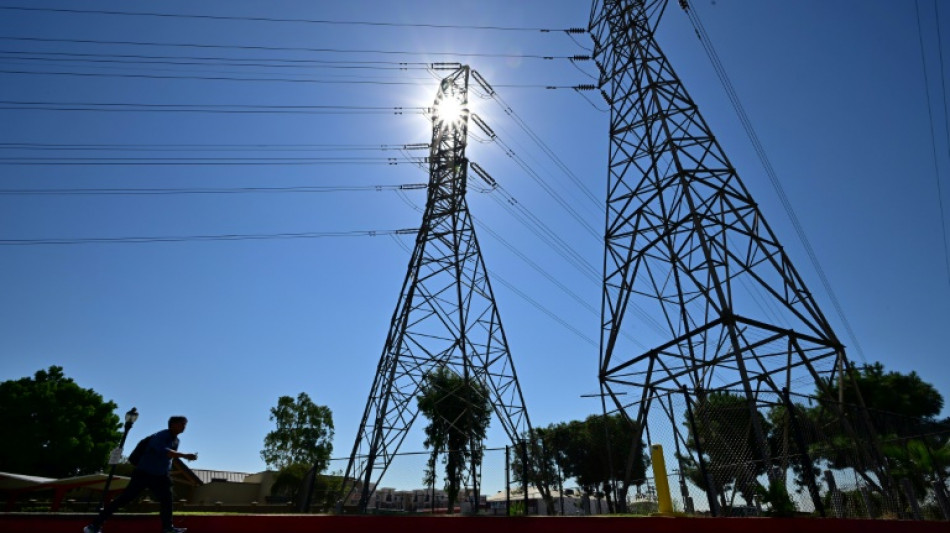
Californians told not to charge EVs as grid struggles in heat wave / Photo: Frederic J. BROWN - AFP

 Trump's beef policies irk Texas ranchers, testing their loyalty

 Nvidia, OpenAI CEOs to attend Xi dinner at White House

 Anthropic picks Accenture for in-house AI safety evaluation

 Balogun returns as Monaco beat Lens to continue strong Ligue 1 start

 'Pause' on overt repression in Venezuela, but reforms still needed: HRW

 Global stocks mixed as yen falls despite Bank of Japan rate hike

 Cuba hit with seventh major blackout of the year

 Murray out with concussion so Wentz will start for Vikings

 UN chief 'deeply regrets' US visa refusal to Abbas for annual meeting

 England quick Carse to face no charges over alleged nightclub assault

 Mancini brings nine newcomers into the first squad of his Italy comeback

 Czechs level Davis Cup tie against USA as South Korea eye Finals

 New France boss Zidane confirms Mbappe as captain after naming first squad

 California governor signs order to explore AI 'kill switch'

 Head leads run spree as Australia win Zimbabwe ODI series

 In-form Raphinha wants to finish career at Barcelona

 Warren Buffett steps down as Berkshire Hathaway chairman

 Carrick confident Man Utd can 'work through' tough time

 Mbappe ends Nike partnership to join Swiss brand On

 Liverpool boss Iraola puts Bournemouth love affair on hold

 'A disaster' if Man City do not win says Maresca after flawless start

 Kerry James Marshall: American 'blackness' painter celebrated in Europe

 Spain coach De la Fuente offers 'full support' to people of Ceuta

 Russia seizes assets of Nestle, French firms over West's Ukraine support
 England can build on World Cup 'spirit', says Tuchel

Californians were told Wednesday not to charge their electric vehicles, just days after the state said it would stop selling gas-powered cars, as the aging electricity grid struggles with a fearsome heatwave.
Temperatures as high as 112 degrees Fahrenheit (44 Celsius) were expected in some Los Angeles suburbs as a huge heat dome bakes a swathe of the western United States.
The sweltering weather is expected to put huge demands on the already-stretched power grid, especially when people crank up the air conditioners during the broiling hours after work and school.
"Consumers are urged to reduce energy use from 4 to 9pm when the system is most stressed because demand for electricity remains high and there is less solar energy available," said the American Public Power Association, a body that represents public utilities.
"The top three conservation actions are to set thermostats to 78 degrees or higher, avoid using large appliances and charging electric vehicles, and turn off unnecessary lights."
California's power companies routinely call for households to limit their usage during the so-called "shoulder hours," when rooftop solar panels stop producing electricity but demand remains high because of still-elevated temperatures.
The call to limit electric vehicle charging comes a week after state regulators banned the sale of new petrol- and diesel-powered vehicles from 2035.
All but a handful of SUVs, cars and light trucks will have to produce zero tailpipe emissions, with only highly efficient plug-in hybrids permitted to burn fossil fuels.
The move was hailed as a game-changer for the EV industry because of the size of California's auto market and the potential it has to set national, and even international, standards.
- 'Dangerously hot' -
Wednesday's call to conserve power was greeted with derision on Twitter, where some said it was proof the state had not thought through its green agenda.
"Perhaps we should figure out how to fix our electric grid before we outlaw gas cars...just a thought," tweeted @AerysGG
"So.........this is what they want. Walking? Hitchin' A Ride?? Moving to a more reasonable state??" tweeted @cinda_scheef
The National Weather Service has issued an "excessive heat warning" for most of California, as well as parts of Arizona and Nevada.
"Dangerously hot conditions expected... until Sunday evening," the NWS said.
"A prolonged period of excessive heat will significantly increase the potential for heat related illnesses, particularly for those working or participating in outdoor activities."
"Those without access to adequate or reliable cooling or hydration will be at most risk, but much of the population could be susceptible to impacts as well," the NWS warned.
Nighttime temperatures are not expected to offer much relief, with lows struggling to get below 80 degrees Fahrenheit in many places.
It is not unusual for southern California to experience heat waves in September, but temperatures above 100 degrees Fahrenheit are considered hot even for a place almost perpetually baked by sunshine.
The heat wave comes after swathes of the southwest were lashed with torrential rains over recent weeks.
Some areas, including the notoriously dusty Death Valley, suffered flooding, and one person died after being swept away in Zion National Park in Utah.
Scientists say global warming, which is being driven chiefly by humanity's use of fossil fuels, is making natural weather variations more extreme.
Heat waves are getting hotter and more intense, while storms are getting wetter and, in many cases, more dangerous.
A.S.Diogo--PC