Cost, taboo make menstruation a nightmare for Cameroonian refugees

 Britain's Hunt wins 200m for European sprint double

 Draper dumped as Norrie saves face for Britain in Cincinnati

 England opener Gay out for duck in Pakistan warm-up
 Europe swelters under fresh wave of extreme heat

 French Olympic gold medallist Florent Manaudou announces retirement
 Tourists rescued by boat as forest fire threatens Greek beaches
 Indicted Raul Castro reappears after months out of public view
 Italian teen Curtis breaks women's 50m backstroke world record for second time

 Taulagi steps out of 'comfort zone' with code switch to French Top 14 new boys

 Leicester's Thai owners put troubled club up for sale: reports

 Stocks steady as US inflation worries ease, oil slips
 Porsche to end production of flagship electric car: report

 Twitch sparks gamers' wrath with Amazon AI sharing deal

 Blaze forces families to abandon Turkish tour boat
 'If you can, move!' say Rome's viral dancing seniors
 Zambia voters weigh Hichilema's economic record

 SBCFX to Showcase Trading Innovation, Regional Growth Strategy, and Future Vision at iFX EXPO Asia 2026

 Hodgkinson sets up Werro showdown after Euro 800m drama
 'How many will die?': the mysterious ailment killing Kenyan elephants
 Arteta coy over Lewis-Skelly's Arsenal future after 'emotional' celebration

 Romania shuts down nuclear plant as Danube drops

 German steel giant Thyssenkrupp weighs options as Rhine drops

 US ambassador denounces settler siege as Israel dispatches troops
 Hasan takes 6-55 as Bangladesh claim opening day of Australia Test

 Taiwan says AI agents used in cyberattacks targeting island
On the day Geraldine Mbia Enu fled her home with her three children to escape the conflict in southwestern Cameroon, her period began.
Having hastily gathered her belongings when the sound of gunshots inched closer to her village, she'd forgotten to take menstrual pads.
So on their exhausting seven-day trek to neighbouring Nigeria in 2018, the 33-year-old had to make do -- like many women in similar situations.
"We just used pieces (of cloth) to pad ourselves," she said.
Even after reaching safety, the challenges are manifold for menstruating refugee women who have abandoned their homes and lost their livelihoods.
One million people have fled the violence in Cameroon between security forces and rebels fighting for an independent state.
More than 70,000 of them have arrived in Nigeria.
- 'Too expensive' -
Magdalene Ajili lives in one of three camps set up in Ogoja, eastern Nigeria, with her 86-year-old grandmother, her two daughters and their children.
She also sought refuge in 2018 after becoming separated from her husband when they fled their village and has since lost contact with him.
"I’m the head of the family," she said, "I take care of the family for food."
However, when it comes to sanitary pads "it's not possible (to buy them) as it’s too expensive," she added.
A pack of sanitary pads costs about 600 naira (1.2 euros) -- or a fifth of the cash they receive every month from the UN refugee agency (UNHCR).
"Most of the refugees cannot afford the cost of (the) monthly purchase of disposable pads," said UNHCR's gender-based violence protection officer in Ogoja, Mmone Moletsane.
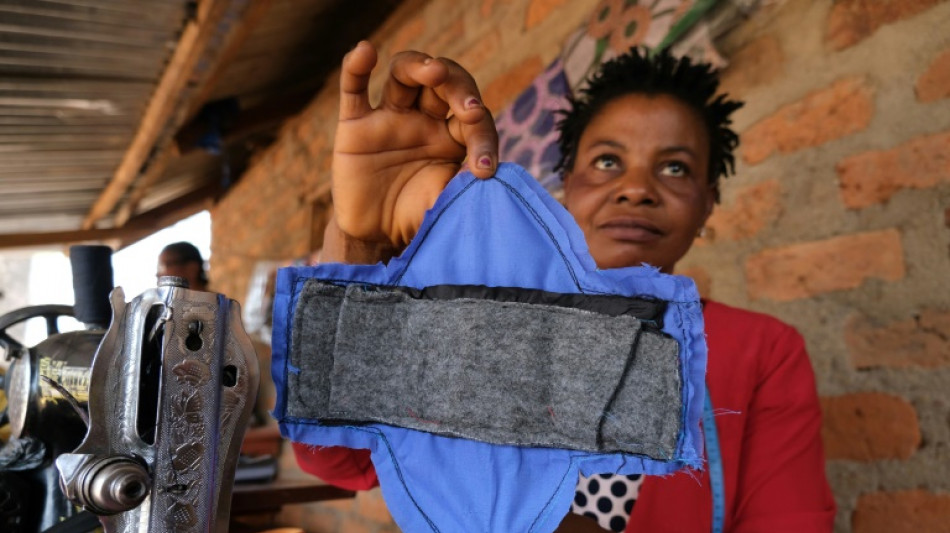
UNHCR and its NGO partner distribute washable and reusable pads.
- Missing school -
"I preferred the ones we were using in Cameroon, disposable ones, but the pads they gave us are ok," said 16-year-old Christabel, another refugee.
For three years, Ajili has been using the same reusable pads provided by the UN.
She says she is happy with them but would like to get new ones. "Sometimes... it gives me rashes," she said.
But the UNHCR says it doesn't have the funds to provide new pads, or to give packs to every single refugee.
Many other women uprooted by the conflict in Cameroon live outside the official camps and have not received any pads at all.
They use what they can find -- pieces of cloth -- despite the risk of infection.
Lack of proper protection means that sometimes girls "miss school when they are menstruating", said Moletsane.
Older women often miss work.
On top of the practical challenges, the subject of periods is taboo in Nigeria, as in many countries around the world, she added.
That makes it difficult, for instance, to dry washable pads outdoors which is important for avoiding bacteria, or when girls have to share the same toilet block as boys at school.
- New buyers -
Some refugees are taught how to make reusable pads to sell.
Mbia Enu has made about a hundred using materials provided by Save the Children.
The charity also bought the pads she made and distributed them to those in need.
But Mbia Enu is now struggling to find new customers among the refugee community.
The pads she makes -- sewed using three layers of different types of cloth including a waterproof one -- are sold for 800 naira for a pack of three.
Determined to find new buyers, Mbia Enu used her meagre savings to travel to a market in Ikom, about 90 kilometres (56 miles) away, where she convinced a shop owner to buy the pads.
"He thinks Nigerian women might be interested in buying them," Mbia Enu said, hopefully.
Period poverty doesn't just affect refugees but also millions of poor Nigerian women.
Inflation has hit Nigeria hard this year, and the price of sanitary products has gone up like everything else.
According to the government, 37 million women in the country cannot afford menstrual pads.
A.Santos--PC