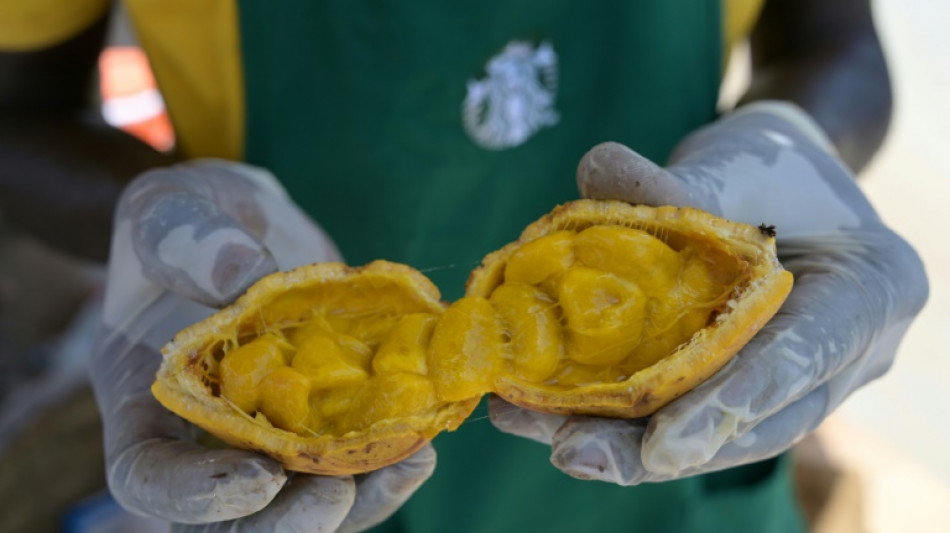
Senegalese go wild for prized 'maad' fruit / Photo: SEYLLOU - AFP

 US judge weighing Trump's White House ban on media outlets

 At UN, OpenAI's Altman calls 'for extreme care' in AI

 Hamilton gives thumbs up to Gulf GPs despite Iran conflict

 Leclerc admits going 'too far' in Hamilton shunt in Italy

 Row engulfs Dolly Parton's estate as manager accuses nephew of making threats

 Mandela Digital Extends Early Access Programme to 11 February 2027 Following Strong Response

 US seeks 11th Presidents Cup win in a row over global foes

 McDonald's to boost franchisees as inflation weighs on consumers

 Trump invites Putin to G20 summit in Miami

 Archaelogical 'breakthrough' could confirm origins of Paris

 ILO financial crisis takes centre stage in leadership race

 Stocks dip, oil soars despite Trump hailing "productive" Iran talks

 China's Xi to get rare airport welcome from Trump

 Turkey reassures investors over investment fund crisis

 Saka says England still have 'scar' from World Cup semi-final loss

 アレックス・ボディ氏とシュテファン・ハウプト教授、ルーマニアの伝説的な美術コレクションをめぐり提携に合意

 亞歷克斯·博迪與史蒂芬·豪普特教授就羅馬尼亞傳奇藝術收藏達成合作協議

 Алекс Боди и проф. д-р Стефан Хаупт договорились о сотрудничестве в рамках легендарной коллекции произведений искусства в Румынии

 French foreign minister says Palestinians 'must' hold polls

 Fresh Russian strikes on Ukraine's infrastructure kill seven

 Eriksen to return to Denmark after parting ways with Wolfsburg

 Brad Pitt says working with dog co-star was 'really moving'

 Golan will remain Syrian, vows President al-Sharaa at UN

 Blueberry Strengthens MENA Presence with CMA Category 5 License and Dubai Office Launch
 Russia probes bear attacks, as official says town under 'siege'

Outside a bustling fruit market in Senegal's Dakar region, three trucks are blocking the road while a dozen men sweat to unload the precious cargo.
Working in intense heat and racing against the clock, they are shifting 60 tonnes of maad -- a delicate tropical fruit which is massively popular in the West African state.
A yellow fruit with a pulp that has a distinctive sweet and sour savour and is rich in vitamins and fibre, maad comes from a vine called the Saba senegalensis, which grows wild and is common across the region.
The fruit's season is relatively short, running from May to August, which prompts a rush of sellers at street corners, hawking the delicacy with salt, sugar or chilli, blenderised into juice or turned into jam.
Maad has different names and spellings across West Africa, where it is eaten from Ivory Coast to Mali and Guinea -- but the lust for it is strongest in Senegal.
Countless jobs depend on the fruit, from harvesting and distribution to selling and processing.
At the Sandika market in Pikine, workers laboured to empty the trucks that had just arrived, sorting the maad according to ripeness.
- Rush to market -
"The unloading will be finished by the end of the day," said Dame Sarr, a 28-year-old wholesaler who with his uncle had invested six million CFA francs ($10,000) in the consignment.
They reckoned they could clear the equivalent of at least a thousand dollars in profit -- if the fruit was sold fast.
"If I don't shift the goods, I will have to cut the price tomorrow because with every passing day maad loses its quality," he explained, sitting under a parasol.
The good news was that several customers were already hovering around.
Sarr had separated out the finest fruit to sell for 4,200 francs for a bucket of 40 pieces. The others were on sale for half that price. A 20-kilogram (44-pound) box of maad cost between 20,000-25,000 francs.
"Maad is a very risky investment. It can't stand sunlight or rain, and transporting it is difficult," said market representative and salesman Djiby Sandika.
The fruit "best suits small-scale retailers, who make large profits," said Sarr.
- Southern delicacy -
In Senegal most maad grows in the southern Casamance region on vines that wrap themselves round trees in thickly-forested areas.
Picking the fruit is done by hand and involves using long sticks -- a labour that comes with added risk from snakes.
According to the Economy, Territory, Development and Service (ETDS) NGO, nearly 1,500 tonnes of maad are harvested annually in the Ziguinchor, Kedougou and Kolda areas.
Mariama Dieme, who heads a project to market maad production in Casamance, said that with better access, output could be trebled.
The fruit is already under threat from "over-exploitation," from fires used to burn stubble from fields and from damage caused by forest hunters, Dieme said.
The ETDS is fostering a programme for small-scale woman-led producers to make maad jam, juice or syrup and even export some of their production.
Maad jam sold in France via sellers on Instagram costs 25 euros ($27.38) for a 300 grams (10.5 ounces) jar, said Fatou Binetou Adour, a Senegalese who lives in Paris.
V.Fontes--PC